
Sindh govt to ban plastic bags from June 15, KU moot told
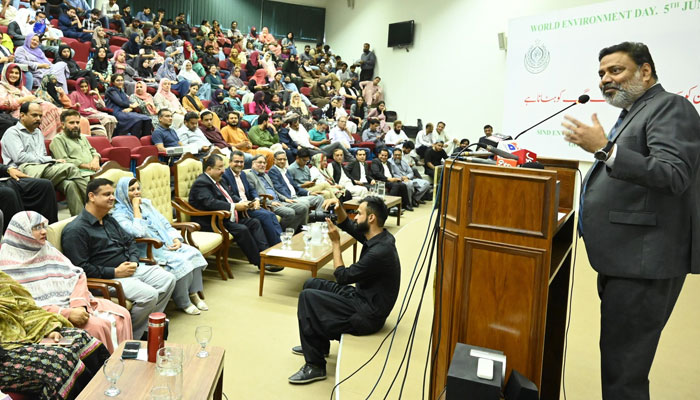
The Department of Mass Communication of the University of Karachi and the Sindh Environmental Protection Agency (Sepa) jointly organized an awareness seminar in connection with World Environment Day at the Jinnah Auditorium of the KU’s Dr A. Q. Khan Institute of Biotechnology and Genetic Engineering.
The provincial secretary for environment, climate change, and coastal development, Agha Shahnawaz Khan, informed the audience that the Sindh government is going to ban the use of plastic bags from June 15, 2025 and the provincial government is set to launch a crackdown on plastic bags in major cities. He shared that plastic poses severe threats to our ecosystems.
Speaking the seminar entitled ‘Reducing plastic pollution’, Khan reaffirmed the Sindh government’s commitment to banning plastic all over the province. He announced that from June 15, a crackdown on plastic bags would begin in major cities, including Karachi, Hyderabad, Mirpurkhas, and Larkana and others.
He emphasized that extensive consultation with stakeholders had been conducted to ensure effective implementation. He mentioned that plastic pollution is a global environmental challenge. He observed that each year, 11 million tonnes of plastic waste pollutes our land, water, and food supply. We must adopt a circular economy and encourage eco-friendly alternatives. He called for collective efforts to eliminate plastic bags and protect future generations from environmental hazards.
KU VC Professor Dr Khalid Mahmood Iraqi emphasized that climate change is a pressing global issue, particularly for Pakistan. Rising temperatures, melting glaciers, and unpredictable rainfall patterns have led to a severe decline in water availability.
He warned that the rapid increase in temperature is not just climate change—it is an alarming warning. “If we don’t take decisive action today, we will be left with nothing but regret tomorrow.”
He explained why single-use plastic bags should be avoided. Professor Iraqi noted that 98 percent of plastic bags are non-biodegradable and non-recyclable, posing serious environmental risks. He stressed the importance of eliminating access to plastic bags at stores and markets, promoting awareness about their harmful effects, and ensuring the availability of alternatives.
“Climate change is a global issue and particularly in the context of Pakistan. Climate change is an urgent issue to be addressed by the policy makers, academia, social workers, and students.”
Sepa Director General Waqar Hussain Phulpoto mentioned that a complete ban on plastic bags would take effect from June 15. The first phase provided industries time to develop alternatives, and now the policy is being implemented across the province.
He mentioned that public awareness campaigns, community engagement, and legal enforcement will ensure compliance. He highlighted that Sepa is actively promoting the “No Plastic Carrier Bags” policy and urged all sectors to collaborate in making Sindh cleaner, greener, and more sustainable. He mentioned that Sepa is committed to eliminating plastic waste from the province.
Dr Phulpoto also advocated for cloth bags as an alternative to plastic shopping bags, recognizing their environmental and health benefits. He stressed that industrial monitoring and enforcement of environmental regulations are Sepa’s top priorities, and the agency is consistently conducting awareness programs in educational institutions to promote eco-friendly practices.
KU Dean of the Faculty of Arts and Social Science Professor Dr Samina Saeed emphasized that environmental responsibility extends beyond science and technology—it is a social duty. She underscored the importance of educating communities, empowering local groups, and fostering a culture of care that persists across generations.
She observed that this issue is not limited to individuals or any one community; it is a global problem that affects every society. Intellectuals from every field—whether environmental science, social sciences, researchers, or scientists—should come together to address this challenge and find effective ways to tackle it here in Pakistan. We all must work together to find and apply better methods to protect our environment.
The former chairperson of KU’s Department of Geography, Professor Dr Jamil Hasan Kazmi, pointed out the challenges of implementing large-scale environmental policies, especially in Karachi. He noted that environmental concerns extend beyond plastic bags.







-
 Eric Dane's Girlfriend Janell Shirtcliff Pays Him Emotional Tribute After ALS Death
 -
 King Charles Faces ‘stuff Of The Nightmares’ Over Jarring Issue
 -
 Sarah Ferguson Has ‘no Remorse’ Over Jeffrey Epstein Friendship
 -
 A$AP Rocky Throws Rihanna Surprise Birthday Dinner On Turning 38
 -
 Andrew Jokes In Hold As BAFTA Welcomes Prince William
 -
 Sam Levinson Donates $27K To Eric Dane Family Fund After Actor’s Death
 -
 Savannah Guthrie Mother Case: Police Block Activist Mom Group Efforts To Search For Missing Nancy Over Permission Row
 -
 Dove Cameron Calls '56 Days' Casting 'Hollywood Fever Dream'
 -
 Prince William, Kate Middleton ‘carrying Weight’ Of Reputation In Epstein Scandal
 -
 Timothée Chalamet Compares 'Dune: Part Three' With Iconic Films 'Interstellar', 'The Dark Knight' & 'Apocalypse Now'
 -
 Little Mix Star Leigh-Anne Pinnock Talks About Protecting Her Children From Social Media
 -
 Ghislaine Maxwell Is ‘fall Guy’ For Jeffrey Epstein, Claims Brother
 -
 Timothee Chalamet Rejects Fame Linked To Kardashian Reality TV World While Dating Kylie Jenner
 -
 Sarah Chalke Recalls Backlash To 'Roseanne' Casting
 -
 Pamela Anderson, David Hasselhoff's Return To Reimagined Version Of 'Baywatch' Confirmed By Star
 -
 Willie Colón, Salsa Legend, Dies At 75