
Urgent fight for justice
Pakistan ranks as sixth most dangerous country for women, according to Thomas Reuters Foundation poll
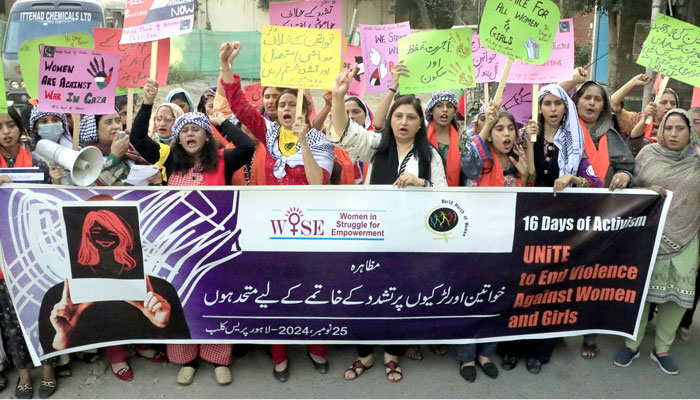
In Pakistan, the struggle for women’s rights is not just a policy issue but a daily battle against a broken system. While the constitution enshrines equality through Article 25 and guarantees women’s participation under Article 34, the reality is stark: Pakistan ranks as the sixth most dangerous country for women, according to a Thomas Reuters Foundation poll, and 153 out of 156 nations on the Global Gender Gap 2021 index.
On International Women’s Day, we must confront a legal system where laws remain ink on paper while lived experiences reveal a crisis in progress.
Legislation such as the Protection Against Harassment of Women at the Workplace Act (amended in 2022) and domestic violence laws at the provincial level have not translated into tangible protection. Over 58 per cent of women in Pakistan experience physical violence in their lifetime and 47 per cent of married women suffer sexual abuse, yet only 0.4 per cent seek legal recourse. In recent years, 16,153 cases of sexual violence and workplace harassment have been reported, while the Ministry of Human Rights recorded 63,000 cases of violence over three years.
Despite legal safeguards, the reality remains grim. Every day, 11 rape cases are reported -- only 41 per cent of the true incidents. Of these, just 18 per cent reach prosecution, and a mere 0.3 per cent of the accused are convicted. For survivors of gender-based violence, navigating the justice system is akin to traversing a labyrinth designed to exhaust rather than empower. Victim blaming, bureaucratic delays, and financial burdens deter countless women from pursuing justice. Lodging an FIR is a daunting task -- female victims, already stigmatised and lacking resources, must contend with police forces where only 1.5 per cent of officers are women. Delays in registering complaints, sometimes stretching up to a month, only compound victims’ trauma.
Once a case is registered, court proceedings remain slow and unsupportive. Trials drag on for years, pressuring victims and their families into compromise or informal resolutions that reinforce patriarchal norms. In Sindh, despite the Domestic Violence Act that was passed in 2013, the first conviction under this law took six years -- a clear testament to entrenched patriarchy and systemic indifference.
Judicial processes are painfully slow. On average, rape cases take 1.3 months to report, 1.6 months for investigations, 4.3 months for processing a challan, and 10 months in trial proceedings. These delays, compounded by under-resourced and insensitive investigation practices, ensure that justice remains elusive, paving the way for impunity.
The crisis extends beyond survivors to women incarcerated by the justice system itself. Although women prisoners comprise only 1.37 per cent of Pakistan’s prison population, 73 per cent remain under trial, often for minor, non-violent offences linked to coercion by male relatives. Many lack legal representation, healthcare, and basic hygiene, trapped in overcrowded facilities with their children. Over 100 children currently live in prisons alongside their incarcerated mothers, perpetuating cycles of poverty and despair.
Pakistan’s legal landscape is riddled with contradictions. The Domestic Violence (Prevention and Protection) Act of 2020 and the Anti-Rape Ordinance 2020, while promising expanded definitions and stronger penalties, remain weakly enforced. The 2016 law mandating life imprisonment for honour killings was undermined when, in a notorious case, Qandeel Baloch’s brother was released after only six years due to familial pardon. Similarly, in the Usman Mirza case, as in 86 per cent of cases of sexual violence, victims inevitably resile or compromise. These legislative shortcomings reveal that even when progressive laws are passed, without effective implementation, they offer little more than an illusion of justice.
This International Women’s Day, we must recognise that justice for women in Pakistan is not an abstract ideal but an urgent necessity.
The path forward requires a holistic approach that transforms legislative frameworks into practical, accessible, and compassionate systems. Women must be able to report abuse without fear, receive prompt legal and medical support, and see their cases expedited through gender-sensitive courts.
Reforms must strengthen implementation by enforcing existing laws and ensuring effective application of the Domestic Violence Act and the Anti-Rape Ordinance.
They should enhance support structures by expanding access to legal aid, healthcare (especially reproductive and mental health), witness protection and safe havens for survivors.
The judicial processes should be revamped and court proceedings made efficient and sensitive to women’s needs, reducing delays and eliminating victim-blaming practices. Societal norms need to be addressed via robust awareness campaigns challenging patriarchal norms and promoting women’s rights at every societal level.
The National Commission for Human Rights remains committed to working with policymakers, civil society and citizens to transform these statistics into a story of empowerment and justice.
The writer is the chairperson of the National Commission for Human Rights.


