
‘Disturbing strategic stability equation will not be allowed’
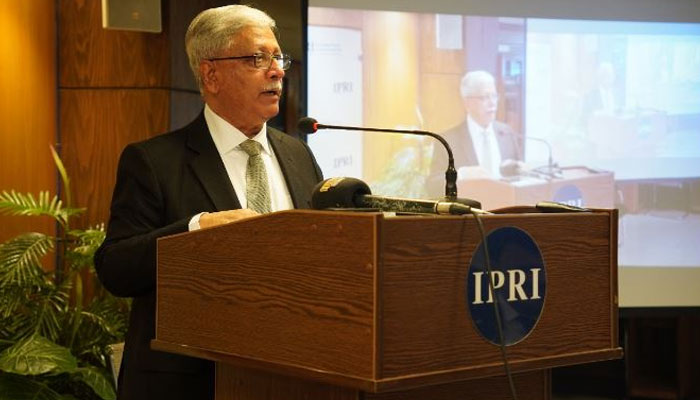
Islamabad:Lieutenant General (r) Khalid Ahmed Kidwai, advisor, to National Command Authority and former DG, Strategic Plan Division, has said that it has increasingly become Pakistan’s responsibility not to allow the strategic stability equation to be disturbed to its disadvantage.
General (r) Kidwai was commenting on the dynamic and elusive nature of changing geo-political realities in the region at a talk organised here by the Institute of Regional Studies (IRS).
General (r) Kidwai called Pakistan’s strategic weapons, especially the tactical nuclear weapons, as ‘weapons of peace’ as they had been effectively ensuring strategic equilibrium in the region. He also noted that Pakistan’s nuclear programme enjoys a wide national consensus as being central to Pakistan’s national security and was indeed an inherent strength. He said that Pakistan's entire spectrum of deterrence—from strategic to operational and tactical, combined with its ready nuclear capability—demonstrates Pakistan's resolve to protect its land from any kind of external aggression.
He emphasised that ‘Pakistan’s Full Spectrum Deterrence (FSD) doctrine is effectively countering India’s aggressive designs and keeping its ‘Cold Start Doctrine’ or ‘Proactive Operations’ under check. He criticised India’s mantra of ‘Ghar mein ghus ke marenge’ (will chase infiltrators inside Pakistan) as mere political rhetoric stemming from frustration over Pakistan's strong nuclear capabilities that deterred one of the world’s largest militaries.
General (r) Kidwai told the participants that Pakistan has always shown restraint and maturity as a responsible nuclear power in defusing Indian-generated tensions and preventing them from spiralling into potential catastrophe as was evident from the Balakot incident in 2019.
He underscored that Pakistan’s strong nuclear capability had constrained India’s conventional military options, leading India to engage in 5th generation warfare against Pakistan. He emphasised the need for increased vigilance and preparedness. He noted that the retaliatory options of “offensive-defence” were valid for countering that hybrid strategy since ‘defensive-defence’ alone could not do so.
Dr Zafar Nawaz Jaspal, Dean of Social Sciences, QAU, said that Pakistan must adopt a multi-pronged strategy to counter India’s propaganda machine. He also noted that the growing US defence collaboration with New Delhi to counter China was further complicating South Asia's already fragile security environment, highlighting the necessity for nuclear diplomacy.
Earlier, Jauhar Saleem, president, IRS, cautioned that India's increasing defence procurement and advanced weaponry posed new threats to South Asia’s stability beyond the threat of direct confrontation. He also highlighted the desirability of resumption of dialogue and revival of confidence-building measures amid region's increasingly fragile strategic environment.






-
 Queen Elizabeth II Knew Son Andrew Was The Most ‘vulnerable’ Of All Kids
 -
 Noah Wyle Achieves His '50-year' Dream In Hollywood: 'Truly Humbled'
 -
 Cardi B 'pauses' Divorce Drama After Offset Shooting Shock
 -
 Zendaya Reveals Which Disney Movie Inspired Her Past Fashion Style
 -
 Jennie Garth Reacts To Rumours About Her, Jason Priestly's Off Camera Love Affair
 -
 'Project Hail Mary' Beat Hit Space Movie At Box Office: Here's Which Film
 -
 Prince William Secretly Called Andrew Night He Lost All Titles: Expert
 -
 James Bourne's Bandmate Provides Health Update Post Life Threatening Scare
 -
 Chase Infiniti Shares What Surprised Her Most About Leonardo DiCaprio
 -
 Jackie Tohn's Hilarious Joke About Kristen Bell's Daughters Goes Viral
 -
 Queen Elizabeth II Apt Fashion Told ‘story Of A Lifetime’
 -
 Patrick Ball Recalls Challenging Times Before Landing 'The Pitt' Gig
 -
 Taylor Swift Steps Out Looking Like A Bride
 -
 Nicole Kidman 'embraces Independence' As She Navigates New Chapter Of Life Post Keith Urban Split
 -
 'Breaking Bad' Duo Aaron Paul, Bryan Cranston Drop Exciting News For Fans
 -
 BTS Kicks Off Massive World Tour