
Journey through Sindhi literature
This year’s conference theme was ‘Sindhi language, Indus script, and socio-cultural perspectives of mother languages’
In my previous column (‘Who will guard the universities’, June 1), I highlighted the concerns of academics and intellectuals about the declining academic freedom at the institutes of higher education, especially in Sindh. But that does not mean all is not well and everything is going down the hill; many positive developments are also taking place.
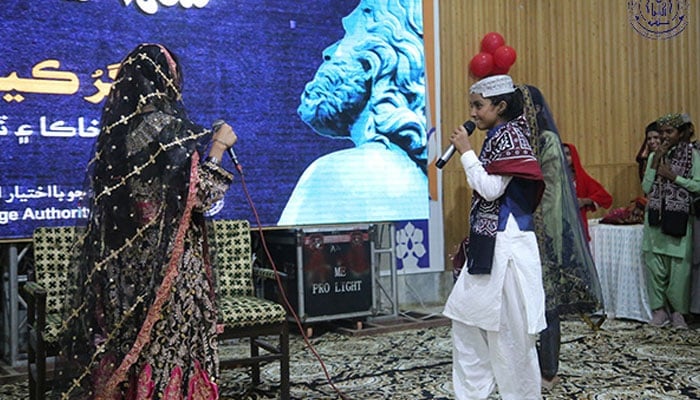
One of them was the Third International Sindhi Language conference held in the last week of May at the Arts Council Karachi under the auspices of the Sindhi Language Authority (SLA). Dr Ishaq Samejo has been leading the SLA since 2022. He is an eminent critic of Sindhi literature and a cultural activist who strives to promote the Sindhi language in all possible ways. As a poet and writer, Ishaq Samejo has dozens of articles, books, and essays to his credit discussing Sindhi language and literature, especially with a progressive tinge.
This year’s conference theme was ‘Sindhi language, Indus script, and the socio-cultural perspectives of mother languages’. It was a two-day conference that the Arts Council and the Sindh government amply supported. The Sindh government may be taking some missteps, but it also moves in the right direction, especially in the sphere of arts and culture, with an overall liberal and secular outlook. The conference offered dozens of sessions with renowned scholars presenting their research papers and studies that were mostly of good quality. Conference secretary Rafiq Wassan and Ishaq Samejo did a great job by organising the conference so well.
Here I share with my readers the gist of some of the sessions I could attend despite other pressing engagements. Dr Sajid Khan presented his paper on ‘The linguistic and cultural imperialism of the British and its implications on the Sindhi language’. He traced the history of cultural imperialism in Sindh, discussing the infamous ‘Minutes on Indian Education’ by Lord Macaulay, who stressed in 1835 on shaping education policy in British India according to the colonisers’ needs. Macaulay advocated for a shift in the focus of education from Persian to a more English-oriented curriculum.
This delinking of Persian from the curriculum in Sindh had both positive and negative impacts, as Dr Sajid Khan highlighted that introducing new knowledge was the harbinger of modernisation and westernisation to some extent. The British also promoted the vernacular, but ultimately it led to a class-based system in which the English medium schools served the purpose of the elite, and the education in the vernacular catered to the middle and lower-middle classes that faced intellectual barriers, creating new challenges from within.
The presentation by Prof Aziz Kingrani, ‘Deciphering the Fish Sign: A New Perspective’, discussed his research on the image of fish in the ancient language of Sindh. Aziz Kingrani is a renowned poet, researcher and short story writer with multiple collections of short stories to his credit and a raft of research papers that have broken new ground in Sindh.
Prof Kingrani explained that the Sindhi language could serve as a valuable resource in deciphering the Ancient Indus script as it has its linguistic connection to Dravidian languages. Though no expert has yet managed to decipher the Indus script fully, Kingrani’s research focused on interpreting the fish sign with an alternative perspective based on Sindhi language.
Sindhi is now classified as an Indo-Aryan language but it also retains its linguistic structures derived from the Proto-Dravidian and Dravidian languages, and a rich vocabulary including words with similar phonetic features. Kingrani quoted studies by some Finnish, Indian and Russian linguists such as Asko Parpola, Iravatham Mahadevan and Yuri Knorozov. To my surprise, Kingrani did not mention the Indian archaeologist S Ranganatha Rao, who in the early 1970s promoted in his book ‘Lothal and the Indus Civilization’ the hypothesis that the Indus script records an early Indo-Aryan language. Yuri Knorozov to me sounded remote as his primary research was on the Maya civilisation rather than the Indus script.
Kingrani argued that the fish symbol held significant political and religious importance within the Indus Valley civilisation. He treated the symbol as an ideogram, prioritising its conceptual meaning rather than its phonetic value. Though the fish sign may have multiple interpretations, one prominent theory suggests that the fish symbol represents a star, astral deities, and the Dravidian etyma min (fish) and min/vin (star, to glitter, shine, and flash). Etyma is the plural of etymon, meaning a word or phoneme from which a later word takes shape.
For the uninitiated, let me clarify that in many Dravidian languages, the word for fish is ‘meen’, and there is also another homophone ‘meen’ meaning star; and derived from the same root, the word also means to shine. Kingrani concludes that there is a possible connection between the concepts of fish and star in Dravidian thought, with the fish being associated with aquatic life and the star representing brilliance or light. Kingrani believes that this interpretation aligns with various elements of Indian astronomical and religious traditions including planetary worship, the Vedic star calendar, the vernal equinox and the significance of ‘due east’ which means directly towards the east.
Maria Memon’s paper ‘Sindhi literature and the discourse of women in Sindhi short story’ presented a brilliant textual analysis on how Sindhi writers from Khairunisa Jafri, Mehtab Mehboob and Naseem Thebo to Nurulhuda Shah, Shabnum Gul and Tanveer Junejo have highlighted the power dynamics in Sindh. Maria Memon particularly focused on two of the most absorbing stories by Nurulhuda Shah and Mehtab Mehboob: ‘Jilawatan’ and ‘Chandea joon taroon’ respectively. Maria Memon talked at length about Jilawatan’s protagonist Maryam Hussain, who has become one of the most interesting characters in modern Sindhi literature.
Ali Faisal, in his paper ‘Gendered experience of partition in Sindhi literature’, began his discussion by defining a state-centric narrative that focuses more on a nation-building project. Faisal gave numerous examples to show that most of the fiction writers in Sindhi have tried to challenge the statist explanation of a nation that perhaps never was a monolithic entity. Hindu Sindhis who migrated from their homeland – where their ancestors had lived for centuries – carried with them a certain nostalgia that reflected in most of the post-partition Sindhi writings, especially in India.
From Ulhasnagar to Bangalore (now Bengaluru), Sindhi language and literature thrived in India. Ulhasnagar is a city not far from Mumbai in Maharashtra, where hundreds of thousands of Hindu refugees coming from Sindh settled after Partition. They still observe Cheti Chand with fasting and prayers dedicated to Lord Jhulelal. Ali Faisal put his discussion in a proper theoretical framework, referring to the concepts of ‘lived experiences’ and ‘unclaimed experiences’ with a particular reference to the trauma theory. He referred to the works by writers such as Kamla Bhasin, Urvashi Butalia and Vazira Zamindar.
Dr Naila Pervaiz’s paper on ‘Mae ni mai kinnun akhan’: feminine voice of Shah Husayn of Lahore’ discussed how the Sufi poetry challenged the elite culture and promoted the culture that belonged to the masses. Naila also explained how the statist history ignores common people and popular culture, and even now in most of the official textbooks, social issues are conspicuous by their absence. Dr Shakeela Ibraheem’s paper on ‘Masculinity and femininity: the role of sociolinguistic perspective in constructing gender’ and Tehmina Mufti’s ‘Conservative society’s impact on gender and language’ were also informative and enlightening.
The session on ‘Language and literary resistance’ had five papers with researchers such as Zafar Mohiuddin, M Nasir, Dr Hakim Buriro, Dr Nawab Kaka and Dr Mahar Khadim. Dr Zafar Muhiuddin discussed ‘the role of sufis in dissenting the colonial and sustaining the folk through poetry’. Dr Hakim Buriro’s paper dealt with ‘Rebellious tendencies in Sindhi Sufi poetry’ but it also reminded me of two other papers by Dr Rafiq Wassan and Oscar Verkaaik that I read a while ago. Dr Wassan discussed progressive secular Sindhi Sufism, in which he presented a case study of GM Syed as a secular Sufi against the backdrop of increasing religious extremism.
Oscar Verkaaik’s research, ‘Sindhi separatist intellectuals in Pakistan’, dilates upon G M Syed and Ibrahim Joy. Dr Zohaib Kaka’s paper ‘The case for the protection and sustenance of Sindhi language in Sindhi short story’ explored how the Sindhi short story contributed to maintaining Sindhi cultural identity and literary richness of the language. He discussed numerous characters and themes that some renowned Sindhi short story writers employed in their fiction. Overall, the conference was an excellent event, gathering dozens of researchers and scholars to discuss language and literature.
The Sindhi Language Authority and its leading lights, Ishaq Samejo and Rafiq Wassan, have been working hard to make such conferences a success.
The writer holds a PhD from the University of Birmingham, UK. He tweets/posts @NaazirMahmood and can be reached at:
mnazir1964@yahoo.co.uk


