
Ex-AJK president terms Indian attacks UN charter violation
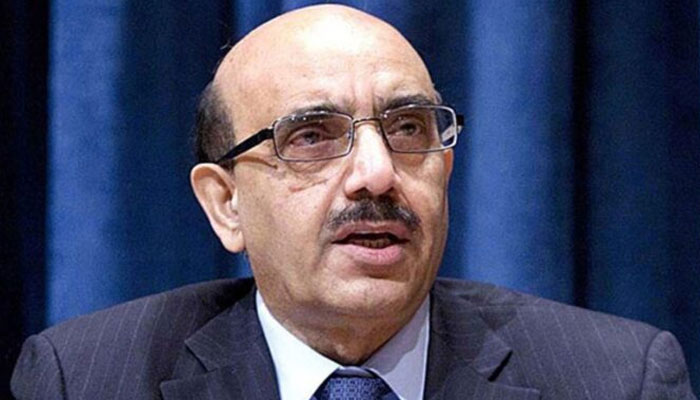
MUZAFFARABAD: Former president of Azad Jammu and Kashmir, Sardar Masood Khan, has strongly condemned what he described as unprovoked and unjustified Indian attacks on civilian populations in Azad Jammu and Kashmir (AJK), calling it a blatant violation of the United Nations charter and international law.
“This is a criminal, unprovoked act of war. Pakistan has retaliated justly and robustly,” stated Khan during his visit to the Bilal Mosque and nearby residential areas in Shawai Nullah near Muzaffarabad, which were struck by Indian forces on the night between Monday and Tuesday. The attack resulted in the tragic deaths of three civilians, including an 80-year-old muezzin, and critically injured an eight-year-old girl.
Describing the incident as “naked aggression,” Khan emphasised that Pakistan’s response falls under Article 51 of the UN Charter, which allows a nation to defend its sovereignty and territorial integrity. He rejected Indian claims that the strikes targeted militant camps, questioning, “What kind of terror camps kill an elderly prayer caller and injure a young child?”
Highlighting the resilience of AJK’s people, Khan stated, “The people of Azad Kashmir are a martial race who liberated this land through immense sacrifice. We are peace-loving but will defend our freedom and liberty at all costs. The international community must hold India accountable for endangering regional peace and stability.”
Khan also praised the resolve of the Pakistani and Kashmiri people and paid tribute to Pakistan’s Armed Forces for what he termed a “just and punitive” response to Indian aggression.
Earlier, Khan addressed students and faculty at Cadet College Muzaffarabad, warning of potential future strikes and stressing the need for vigilance. He called upon students to prepare themselves to serve their homeland and to support the ongoing struggle for the liberation of Indian Illegally Occupied Jammu and Kashmir (IIOJ&K).
“The people of Kashmir have historically been subjected to oppression-first by Dogra rulers, now by India—merely because of their faith,” Khan remarked. “Today, you enjoy freedom earned by your forefathers’ sacrifices. Never take it for granted.”
Commenting on India’s suspension of water flow from IIOJ&K into Pakistan, Khan denounced the move as a direct violation of the Indus Waters Treaty. “India has no legal right to unilaterally alter or suspend this agreement,” he stressed, adding that Pakistan may explore all legal and diplomatic avenues, including engagement with the World Bank, the UN Security Council, and the International Court of Justice.
Ambassador Khan also visited the Centre for International Strategic Studies to discuss India’s strategic implications with researchers. He also met with AJK Chief Justice Raja Saeed Akram Khan, the Chief Secretary, the Inspector General of Police, and Prof. Dr. Nadeem Haider Bukhari, Vice Chancellor of the University of Azad Jammu and Kashmir.
The Cadet College event was also addressed by leaders of the All Parties Hurriyat Conference, including Ghulam Mohammad Safi and Altaf Hussain Wani, along with Brigadier Asrat Mahmood (Principal), Dr. Raja Sajjad, Ms Samia Sajid (Chairperson, Kashmir Women Alert Forum), and other dignitaries.







-
 UFOs Damage Human Brains? Stanford Scientist Makes Chilling Claims
 -
 Paul Simon Says One Classic Hit Could Still Be Around In 100 Years
 -
 Italy Shuts Down Piracy Network Linked To $348m Losses For Netflix
 -
 Piers Morgan, Who Called Stephen Colbert A Hypocrite Over Kate Middleton, Reacts To His Last Show
 -
 Katie Price Faces Doubt As She Releases Emotional Song For 'missing' Husband Lee Andrews
 -
 Andrew Scott Describes His 'Pressure' Costar Brendan Fraser In Two Words
 -
 China To Launch Shenzhou 23 Crew To Tiangong Space Station
 -
 South Korea Warns AI Wealth Gap Could Fuel Labor Unrest
 -
 Strait Of Hormuz Toll Revenue Talks: Iran, Oman Discuss Proposal Despite US Warning
 -
 Coros CEO Explains Why AI Voice Is The Future Of Sports Watches
 -
 Drake's Secret Formula For Going Viral Revealed By Comedian?
 -
 Nvidia’s Jensen Huang Says $200 Billion CPU Market Forecast Includes China
 -
 King Charles Lands In Big Trouble Over Andrew: 'Extremely Delicate' Position
 -
 WiFi Tracking Tech Identifies People With Near-perfect Accuracy, Raising Surveillance Fears
 -
 Meta’s New ‘Forum’ App Triggers 6% Drop In Reddit Stock
 -
 'Meghan Markle Now Acknowledges Prince Harry Is A Problem'