
Sindh, IFC agree to enhance service delivery, urban infrastructure in Karachi and beyond
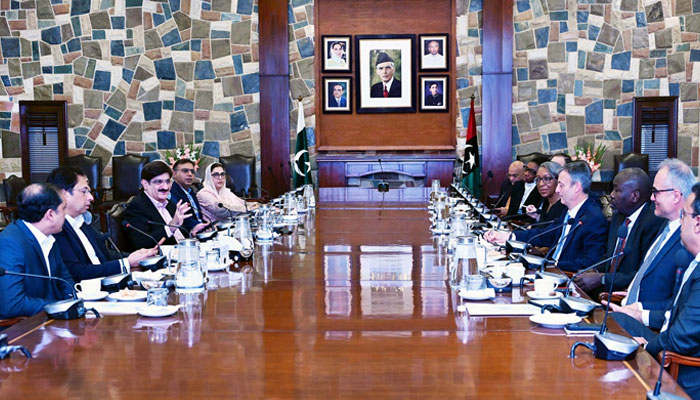
Sindh Chief Minister Syed Murad Ali Shah on Thursday met with an IFC delegation led by Ms Linda Rudo Munyengeterwa, director for public-private partnerships (PPPs), Privatizations & Corporate Finance Advisory, IFC’s Global, to discuss urban mobility, water, and sanitation projects, and both sides agreed to collaborate closely on future PPP initiatives to enhance service delivery and urban infrastructure in Karachi and beyond.
The high-level meeting was held at the CM House. The nine-member International Finance Corporation (IFC) delegation comprised Country Manager Zeeshan Sheikh, regional Manager Ian Twinn, Regional Manager Mr Tonci Bakovic, Regional Operational Manager Mr Michael Opagi, and others. From the Sindh government, Karachi Mayor Murtaza Wahab, Principal Secretary Agha Wasif, Chairman P&D Board Najam Shah, Finance Secretary Fayaz Jatoi, DG PPP Unit Asad Zamin, and other senior officials were present.
The meeting focused on strengthening public-private partnerships in important sectors, including urban mobility and water, sanitation, and hygiene (WASH). The CM briefed the delegation on Sindh’s robust PPP legal and institutional framework, highlighting progress in sectors such as road networks, energy, health, education, and transport.
Ms Linda Rudo Munyengeterwa said, “Sindh is a province that has been implementing PPPs since 2008, and it truly stands as an example of how public-private partnerships should be done. It’s essential to continue working with the private sector, especially as we see a growing need for investment.”
“We believe that the only way to meet the goal of delivering better services to the people is by expanding PPPs. We’re genuinely excited to explore more opportunities to partner with you on future projects,” Ms Linda said.
“We believe the local market is ready, and there is significant liquidity available for the private sector to collaborate with the government. We look forward to showcasing Sindh as a model for other provinces, and even other countries, on how to successfully execute PPPs. Hopefully, your success can serve as an international example of how to do PPPs the right way.”
Highlighting the importance of Karachi as Pakistan’s economic hub, the CM emphasised that the Sindh government is committed to addressing the city’s transport, water, and sanitation challenges. He noted that several Bus Rapid Transit (BRT) systems, including the Green and Orange lines, are already operational, while work continues on the Red and Yellow lines and other infrastructure projects.
Ms Linda highlighted the IFC’s experience in advising on over 500 projects globally and emphasised the advantages of electric buses (e-buses), including cost efficiency, lower maintenance, and environmental sustainability. She noted that by 2024, 80 per cent of urban transport buses in successful models would be e-buses.
The Sindh government has already introduced e-buses in Karachi and plans to expand its fleet to 800 vehicles, confirmed Shah. The IFC recommended implementing e-buses through PPP models, where operational costs, maintenance, and risks are shared with private partners.
Ms Linda outlined a mass transit strategy comprising four main components: BRT operations, urban rail systems, ferry services, and ride-hailing platforms. She suggested constructing a new 18.3km BRT system in Karachi, financed through the World Bank, along with an integrated feeder bus network. The IFC also stressed the need for modern e-buses to reduce noise and air pollution in the city.
Chief Minister Shah stated that Karachi requires 1,200 million gallons of water daily, while the current supply is insufficient, resulting in a significant shortfall. The under-construction K-IV project is expected to add to the water supply once completed. The government is also working on plans to install desalination plants to treat seawater.
The CM expressed interest in initiating water-related projects through the PPP model to address the water crisis. The IFC recommended establishing water treatment plants for industrial use and proposed that water supply and sanitation projects follow the PPP model. The IFC team presented various successful global PPP models and praised the Sindh government’s PPP Unit and its overall policy framework.




-
 Chinese New Year Explained: All You Need To Know About The Year Of The Horse
 -
 Canadian Passport Holders Can Now Travel To China Visa-free: Here's How
 -
 Glen Powell Reveals Wild Prank That Left Sister Hunting Jail Cells
 -
 Edmonton Weather Warning: Up To 30 Cm Of Snow Possible In Parts Of Alberta
 -
 'A Knight Of The Seven Kingdoms' Episode 5: What Time It Airs And Where To Stream
 -
 Amy Schumer Drops Cryptic Message On First Valentine Amid Divorce
 -
 Savannah Guthrie Sends Desperate Plea To Mom Nancy Kidnapper
 -
 NBA All-Star 2026 Shake-up: Inside The New USA Vs World Tournament Format
 -
 Warner Bros Consider Reopening Deal Talks With Paramount, Says Reports
 -
 Andrew Mountbatten Windsor Faces Future With UK MPs, Says Expert
 -
 Eva Mendes Shared Bedroom Photos For Ryan Gosling On Valentine’s
 -
 Shamed Andrew Told 'nobody Is Above The Law' Amid Harrowing Silence
 -
 Gisele Bundchen Melts Hearts With Sweet Bike Ride Glimpse Featuring Son
 -
 Prince William Found Meghan Markle ‘quite Refreshing’ At Start
 -
 Kate Middleton Knew Should Could Not Be ‘voice Of Reason’ With Prince Harry
 -
 Rihanna Has Wardrobe Malfunction At A$AP Rocky Fashion Show