
Trade tensions can lead to stock market crashes, IMF says
Trade tensions can trigger large corrections in stock prices resulting in market volatility, warns lender
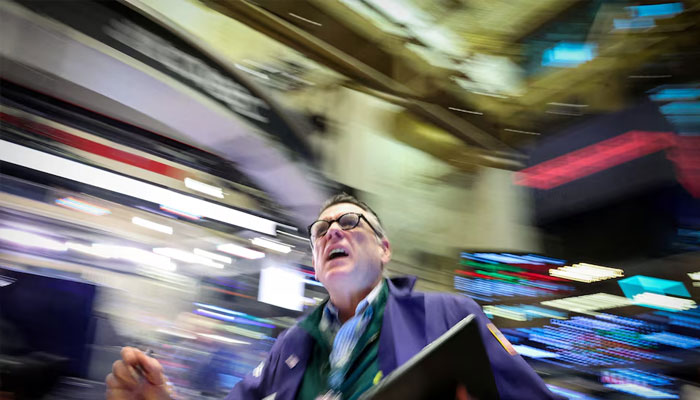
WASHINGTON: Major geopolitical risk events, including trade tensions, can trigger large corrections in stock prices, the International Monetary Fund said in a report on Monday.
That in turn can generate market volatility which can threaten financial stability, it said in a chapter from its forthcoming Global Financial Stability Report.
The IMF did not mention specific events, such as the sweeping tariffs US President Donald Trump has announced in recent weeks. But it noted that news-based measures of risk, including conflicts, wars, terrorist attacks, military spending and trade restrictions had increased sharply since 2022.
In an accompanying blog, the IMF urged financial institutions to hold enough capital and liquidity to help them deal with potential losses from geopolitical risks, and urged them to use stress tests and other analyses to identify and manage such risks.
In its report, the IMF said its research had shown that big risk events such as wars, diplomatic tensions or terrorism sent stock prices down an average 1 percentage point monthly across all countries, with the average drop for emerging markets 2.5 percentage points.
International military conflicts, such as Russia's invasion of Ukraine in 2022, were the most significant risk events, pushing stock returns down an average 5 percentage points monthly, twice the level of other geopolitical risk events.
The IMF is due to release the full report at its spring meetings with the World Bank the week of April 21. Trump’s tariff announcements will likely dominate the meetings. Last week saw the wildest swings on Wall Street since the Covid pandemic of 2020. The benchmark Standard & Poor’s 500 index is down more than 10 per cent since Trump took office on January 20, while gold has hit record highs.
One US survey of consumers showed inflation fears have hit their highest level since 1981, while financial institutions have been warning of the growing risk of recession. The IMF also said economic uncertainty increases so-called market tail risks -- the chance of extreme, unexpected losses in an investment portfolio -- which in turn boost the risk of stock market crashes.
It said heightened geopolitical risks also drive up sovereign risk premiums -- the prices for credit derivatives that protect against default -- and could spill over to other economies through trade and financial linkages. In the accompanying blog, the IMF looked at the impact of US-China tariff actions from 2018 to 2024, noting that some larger-scale announcements had driven shares in both countries lower.





-
 Trump Administration Loses Latest Battle Over Voter Registration Records
 -
 Shamed Andrew Preferred ‘sophisticated’ Countries For Royal Tours
 -
 GOP Senators Slam Trump’s 'anti-weaponization' Fund As 'galactic Blunder'
 -
 Sarah Ferguson Offers ‘price For Silence’ In ‘schizophrenic’ Relationship
 -
 Marco Rubio Says Cuba Is 'national Security Threat' As Havana Accuses US Of 'lies'
 -
 Mark Scheifele Stars As Canada Beats Norway In OT At World Hockey Championship
 -
 The Trumps Assure Support To Vanessa Trump During Cancer Battle
 -
 Oil Markets Near Danger 'red Zone' Amid Iran War, Warns IEA Chief
 -
 Nancy Guthrie Update: Ex-detective Who Solved Big Case Says Police Have Suspect's Name
 -
 NASCAR Driver Kyle Busch Breathes His Last At 41
 -
 Matt Damon Feels Jealous Of 'The Odyssey' Costar Charlize Theron's One Physical Trait
 -
 US Senators Oppose Plan To Feature Donald Trump On Commemorative Passports
 -
 Lizzo Shares Fun Story Behind Her Social Media Moniker
 -
 Prince William Expands His Plans For ‘shelter Built Homes’
 -
 Meghan Markle, Prince Harry Given ‘absolutely Nothing’ By Royals For Key Reason
 -
 Rami Malek Feels 'honored' After Receiving Standing Ovation At Cannes Film Festival For 'The Man I Love'