
Webb telescope reveals wild weather on cosmic brown dwarfs
Researchers have used James Webb Space Telescope observations to conduct detailed examinations of atmospheric conditions on brown dwarfs
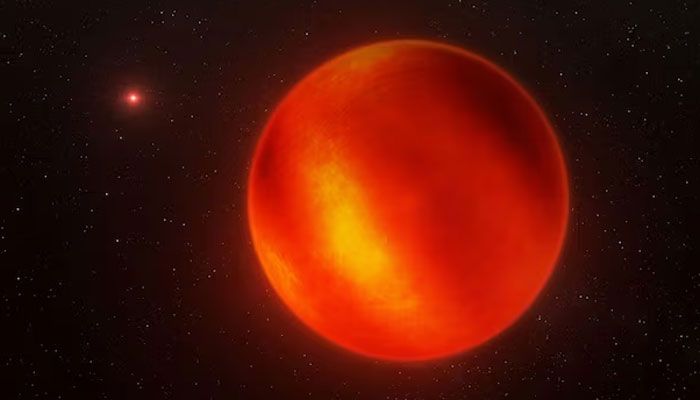
WASHINGTON: The weather report is in for the two brown dwarfs - celestial bodies bigger than a planet but smaller than a star - closest to us. It is inclement, to put it mildly: blazingly hot, with a toxic chemical cocktail swirling in the atmosphere and clouds of silicate particles blowing around like a Saharan dust storm.
Researchers have used James Webb Space Telescope observations to conduct detailed examinations of the atmospheric conditions on brown dwarfs, specifically a pair that orbit each other around six light years from Earth, quite close by cosmic standards. A light-year is the distance light travels in a year, 5.9 trillion miles.
The Webb data provided a three-dimensional look at how the weather changed over the course of a brown dwarf’s rotation - the larger of the two taking seven hours and the smaller five hours - with multiple layers of clouds found at different atmospheric depths.
Both have atmospheres dominated by hydrogen and helium, with trace amounts of water vapor, methane and carbon monoxide. The temperature at their cloud tops was about 1,700 degrees Fahrenheit, similar to a candle flame.
“In this study, we created the most detailed ‘weather maps’ for any brown dwarf to date,” said astronomer Beth Biller of the University of Edinburgh’s Institute for Astronomy, lead author of the study published on Monday in the scientific journal Monthly Notices of the Royal Astronomical Society.
Brown dwarfs are neither a star nor a planet, but something in between. They give off their own light thanks to their sheer heat - “just like you would see embers in a fire glowing red because of how hot they are,” Biller said. It was that light that the researchers observed with Webb. Unlike stars, brown dwarfs do not have nuclear fusion occurring at their core.
“Like planets, but unlike stars, brown dwarfs can also have clouds made out of precipitates in their atmospheres. However, while we have water clouds on Earth, the clouds on brown dwarfs are much hotter and likely made up of hot silicate particles -kind of like a very hot Saharan dust storm,” Biller said.
The current scientific thinking is that brown dwarfs form from large clouds of gas and dust like stars do, but fall short of mass sufficient to ignite nuclear fusion. Their composition is similar to gas giant planets like Jupiter, our solar system’s largest planet. Their mass is up to 80 times greater than Jupiter’s. By comparison, the sun’s mass is about 1,000 times greater than Jupiter’s.







-
 'A Very Special Visitor' Meets Queen Camilla At Clarence House
 -
 Jodie Turner Smith Shares One Strict Rule She Follows As A Mom
 -
 Hailey Bieber Reveals KEY To Balancing Motherhood With Career
 -
 Photo Of Jay-Z, Other Prominent Figures With Jeffrey Epstein Proven To Be Fake
 -
 Hillary Clinton's Munich Train Video Sparks Conspiracy Theories
 -
 Fans Slam Talk Show Host For 'cringe' Behavior In Chris Hemsworth Interview
 -
 Woman Jailed Over False 'crime In Space' Claim Against NASA Astronaut
 -
 James Van Der Beek’s Close Pal Reveals Family's Dire Need Of Donations
 -
 Prince William And Harry's Cousins Attend 'Wuthering Heights' Event
 -
 Hailey Bieber Turns Heads Just Hours After Major Business Win
 -
 King Charles' Andrew Decision Labelled 'long Overdue'
 -
 Timothee Chalamet 'forever Indebted' To Fan Over Kind Gesture
 -
 Columbia University Sacks Staff Over Epstein Partner's ‘backdoor’ Admission
 -
 Ozzy Osbourne's Family Struggles Behind Closed Doors
 -
 Dua Lipa Claims Long-distance Relationship 'never Stops Being Hard'
 -
 BTS Moments Of Taylor Swift's 'Opalite' Music Video Unvieled: See Photos