
Workers’ protests in Bangladesh
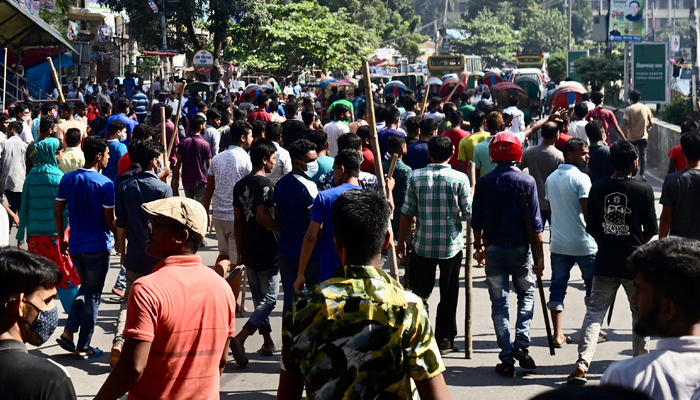
Strikes and protests by thousands of garment factory workers in Bangladesh have closed down more than 500 factories and crippled production.
The protests started from the Ghazipur industrial area but later spread to other areas. The protests in Ghazipur began shortly after factory owners submitted their wage-related proposals to the wage board. The workers and union leaders immediately rejected the offer. Labour leaders have made it clear that the longer it takes to announce a reasonable wage structure, the more the industry will suffer.
These protests are taking place almost two months before the general elections in Bangladesh which are likely to take place in January 2024. The Hasina Wajid government wants to end the protests and strikes immediately. The workers’ protests also coincided with an ongoing agitation by the Bangladesh Nationalist Party (BNP), which has demanded that a non-partisan government should be installed to conduct the elections early next year.
The police used tear gas, water cannons and rubber bullets to disperse the protesting workers. At least two protesting garment workers have been killed as strikes and street protests that started last week enter a second week despite the use of repressive measures by the authorities.
Garments are Bangladesh’s biggest export, accounting for more than 80 per cent of annual export earnings. The garment exporters are earning billions of dollars as profits every year but they are not sharing these profits with their workers who are considered as one of the poorest factory workers in the world. The majority of the country’s garment industry workers earn wages well below the poverty line.
The growth of the Bangladesh garment industry is presented as a success story. The garment industry in Bangladesh flourished on three factors. One, Bangladeshi garments have enjoyed duty-free and preferred access to markets in North America and European Union for nearly three decades and garment factories there manufacture clothes for many leading American and European global brands.
Two, the government in Bangladesh offered many concessions and incentives to the garments sector, also encouraging foreign direct investment in the sector. Three, the superexploitation of workers and wage suppression also played an important role in the growth of the garment sector. To keep the prices down, factory owners kept wages lower. And then to increase their profits, factory owners super-exploit garment workers women.
The garment sector is Bangladesh’s second biggest employer after agriculture, with about 4,500 factories employing about four million workers, with many living in poverty and working in dangerous conditions. Hundreds of workers have lost their lives in different incidents due to lack of occupational safety hazards.
Bangladesh exported $45 billion worth of clothing in 2022, accounting for a 7.9 per cent share of the global market. In the first six months of 2023, clothes worth $23.6 billion have been exported.
Garment workers are demanding higher wages, unions saying a big raise is required: from the current $73 to $184 taka per month. But factory owners have proposed $94 taka, an increase of $21.
Begum Monnujan Sufian, the state minister of labour and employment, has labeled the proposal from the factory owners as “unreasonable”. “In the last five years, workers’ salaries would have already increased to about 10,400 taka at a 5 per cent annual rate as stipulated in the rules. Is this a worthy proposition?” She has urged workers to return to their jobs, pledging that the government would soon announce “an acceptable” wage structure while also warning that the BNP was inciting workers’ unrest.
In 2018, when the current minimum wage of 8,000 taka was fixed, that salary equalled about $100 per month. Workers’ leaders cite these statistics to argue that the owners’ proposal is equivalent to a pay cut. The current minimum wage of 8,000 taka was already insufficient for a decent living when it came into force in 2019. Since then, workers have had to endure the additional pressure of the Covid-19 pandemic and the subsequent high inflation without seeing their wages increase at all.
A new monthly minimum wage demand of 23,000 taka has been calculated based on an extensive cost of living study done by the Bangladesh Institute for Labour Studies and has been unanimously supported by trade unions in the country.
Bangladesh’s labour law only requires the wage board to convene once every five years. This has led to very slow wage growth. Union membership is also low due to the active suppression of freedom of association by employers and by state actors. So when unions come to the table their power to achieve change is limited.
The writer is a freelance journalist.







-
 Jelly Roll Finally Shares Painful 'secret' Following 2026 Grammy Win: 'Wanted To Scream'
 -
 Noah Wyle Gives Exciting Update About 'The Pitt' Season 3
 -
 Who Is Behind Princess Eugenie, Beatrice's Ban From Royal Ascot Amid Sarah, Andrew Scandal?
 -
 Kate Middleton Sunbathing Photos: New Book Sheds Light On Prince William's Reaction
 -
 Jim Curtis Shares Rare Details How His Relationship With Jennifer Aniston Started
 -
 Who Organized 'The Office' Reunion At Actors Awards 2026? Revealed
 -
 King Charles Set To Abdicate Next Year, 'official Reason' Revealed
 -
 Paris Hilton's Power Move To Make 'neurodiversity Relatable'
 -
 Michelle Williams Remembers 'friend' James Van Der Beek After His Death
 -
 Woody Harrelson Unveils The Favour ‘living Legend’ Harrison Ford Asked For Before Actor Awards
 -
 How Long Have Zendaya And Tom Holland Been Dating?
 -
 Real Reason Why 'Only Murders In The Building' Cast Didn't Attend 2026 Actor Awards
 -
 Prince William Makes Big Decision After Princess Eugenie, Beatrice Ban
 -
 GLP-1 Drugs Linked To Osteoporosis And Gout: New Study Reveals Higher Risks
 -
 Seth Rogen Unveils Catherine O’Hara's Distinguished Quality In Emotional Tribute
 -
 MWC 2026: New Smartphones, AI Gadgets And Tech Innovations Revealed