
Iranian strikes Shehbaz calls Qatari, Saudi envoys, urges de-escalation
Speaking with Qatari ambassador, PM Shehbaz expressed his deep concerns over reported attack
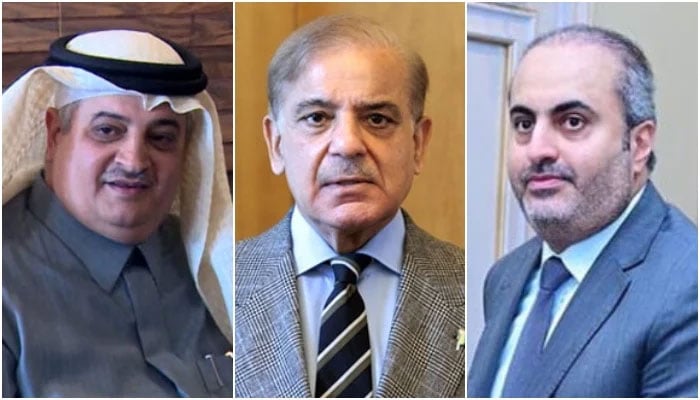
ISLAMABAD: Prime Minister Shehbaz Sharif held late-night telephone conversations on Monday with the ambassadors of Qatar and Saudi Arabia to express Pakistan’s deep concern over reports of missile attacks on a US military base in Qatar, reportedly carried out by Iran.
In separate calls with Ali Mubarak Ali Essa Al-Khater, ambassador of the State of Qatar, and Nawaf bin Saeed Al Malkiy, ambassador of the Kingdom of Saudi Arabia, the prime minister conveyed Pakistan’s solidarity with the governments and people of both nations amid rising regional tensions.
Speaking with the Qatari ambassador, Prime Minister Shehbaz expressed his deep concerns over the reported attack and expressed full support for Qatar in this challenging time. He emphasised the urgent need for de-escalation and stressed that all regional actors must work to restore peace and stability.
Ambassador Al-Khater thanked the prime minister for his swift outreach and expressed gratitude for Pakistan’s solidarity at this critical juncture.
In his call with the Saudi ambassador, Prime Minister Shehbaz again voiced grave concern over the reported missile strike and added that such developments pose a serious threat to regional peace. He reiterated Pakistan’s commitment to working closely with Saudi Arabia to help defuse tensions and support diplomatic solutions.
Ambassador Al Malkiy welcomed the prime minister’s timely initiative and emphasised the importance of coordinated efforts between Saudi Arabia and Pakistan to prevent further escalation in the Middle East. Both agreed on the need for close collaboration to promote peace in the region.
Earlier in the day, Prime Minister Shehbaz Sharif ordered for transitioning all transactions between the public and private sectors to a cashless model, and formation of three specialised committees -- the Digital Payments Innovation and Adoption Committee, the Digital Public Infrastructure Committee and the Government Payments Committee -- to promote cashless economy across the country.
These special sub-committees will present recommendations to facilitate payments between citizens and businesses, raise awareness about digital systems, activate the Pakistan Digital Authority, formulate a national digital master plan, and streamline transactions between the government and the private sector.
The prime minister was chairing a high-level meeting focused on promoting a cashless economy in Pakistan. He emphasised the importance of making digital transactions more affordable and accessible for the public compared to cash, as a means to promote a cashless system.
He also instructed that the RAAST digital payment system be established at the federal as well as across all provinces levels. “Establishing a digital transaction system is crucial for bringing transparency to the economy,” he said, adding that cashless systems are being prioritised in developed and successful economies around the world, and modern technology must be used to implement a robust digital payments infrastructure.
The prime minister noted that funds circulating through the banking system can be used for investment in government development projects.
During the briefing, the prime minister was updated on progress made toward implementing a nationwide cashless system. It was shared that currently, over 40 million users are benefiting from the RAAST system, and various initiatives are underway to increase this number.
All financial transactions of the federal government are now conducted through the RAAST system, and steps are being taken to expand it to the provincial level. The briefing also highlighted that Fintech is a key component of this ecosystem.
The Pakistan Digital Authority has been established and is actively working to transition the national economy toward a cashless model. It was also informed in the meeting that the Digital Public Infrastructure Committee will function under the leadership of the IT Ministry, while the Cashless Pakistan Steering Committee has been established within the PM Secretariat.
As part of the Smart Islamabad Pilot Project, the IT Ministry is taking steps to make Islamabad Pakistan’s first cashless city. The meeting was attended by Minister for Economic Affairs Ahad Khan Cheema, Minister for Petroleum Ali Pervaiz Malik, Minister for IT Shaza Fatima Khawaja, Minister for Climate Change Musadik Malik, the State Bank of Pakistan governor, FBR chairman and senior officials from relevant institutions.
Meanwhile, the prime minister met with Minister for Climate Change Dr Musadik Malik at the PM House, where matters related to the government climate policies and recent diplomatic efforts were discussed.
In the meeting, Dr Musadik Malik briefed the prime minister about the engagements of the diplomatic delegation.
Shehbaz paid tribute to Pakistan Peoples Party Chairman Bilawal Bhutto Zardari and other members of the delegation for successfully exposing India’s recent unprovoked military and water aggression before the world, and for their successful diplomatic tour of the United States and Europe.
During the meeting, the measures taken by the Ministry of Climate Change under the government’s initiatives to mitigate the adverse effects of climate change also came under discussion.






-
 James Van Der Beek's Friends Helped Fund Ranch Purchase Before His Death At 48
 -
 King Charles ‘very Much’ Wants Andrew To Testify At US Congress
 -
 Rosie O’Donnell Secretly Returned To US To Test Safety
 -
 Meghan Markle, Prince Harry Spotted On Date Night On Valentine’s Day
 -
 King Charles Butler Spills Valentine’s Day Dinner Blunders
 -
 Brooklyn Beckham Hits Back At Gordon Ramsay With Subtle Move Over Remark On His Personal Life
 -
 Meghan Markle Showcases Princess Lilibet Face On Valentine’s Day
 -
 Harry Styles Opens Up About Isolation After One Direction Split
 -
 Shamed Andrew Was ‘face To Face’ With Epstein Files, Mocked For Lying
 -
 Kanye West Projected To Explode Music Charts With 'Bully' After He Apologized Over Antisemitism
 -
 Leighton Meester Reflects On How Valentine’s Day Feels Like Now
 -
 Sarah Ferguson ‘won’t Let Go Without A Fight’ After Royal Exile
 -
 Adam Sandler Makes Brutal Confession: 'I Do Not Love Comedy First'
 -
 'Harry Potter' Star Rupert Grint Shares Where He Stands Politically
 -
 Drama Outside Nancy Guthrie's Home Unfolds Described As 'circus'
 -
 Marco Rubio Sends Message Of Unity To Europe