
Stocks may stay sensitive to geopolitical, fiscal developments
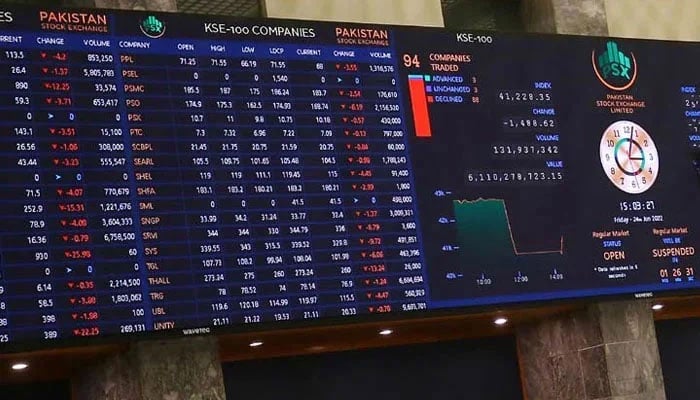
KARACHI: The coming week on the Pakistan Stock Exchange (PSX) is expected to remain volatile, driven by heightened geopolitical risks, particularly in the Middle East, and cautious investor sentiment ahead of key fiscal developments.
With efforts underway to secure the refinancing of $1.3 billion from Chinese banks before June 30 and the conclusion of the bidding process for Pakistan International Airlines (PIA) privatisation, the market will remain sensitive to economic and political cues. Additionally, movements in global oil prices and any shifts in monetary policy stance by global central banks will influence investor behaviour on the domestic front.
The benchmark KSE-100 index ended the week down by 1.74 per cent on a week-on-week basis, closing at 76,706 points, amid a broader decline driven by escalating geopolitical tensions and weakening macroeconomic indicators. The bearish sentiment mirrored global equity market weakness as tensions between Israel and Iran continued to weigh on investor confidence worldwide.
Nabeel Haroon, an analyst at Topline Securities, attributed the market’s decline to mounting geopolitical uncertainty. He noted that investor risk appetite diminished as the Israel-Iran conflict triggered distress across global financial markets, causing capital flight from riskier assets such as equities in emerging markets like Pakistan.
Average daily trading volumes dropped 9.4 per cent to 822 million shares, while the average daily traded value stood at Rs22 billion, reflecting investors' cautious stance. Syed Danyal Hussain, an analyst at JS Research, said the KSE-100 index fell by 3.5 per cent or 4,330 points from its recent high, largely due to surging global commodity prices and falling Asian markets.
Among key macroeconomic developments, the State Bank of Pakistan (SBP) held its policy rate steady at 11 per cent during its Monetary Policy Committee (MPC) meeting on Monday. Analysts viewed this decision as a cautious move amid inflationary concerns triggered by rising global oil prices. Brent crude prices climbed to $77 per barrel, marking a five-month high on the back of global supply-side fears.
The country’s external position showed signs of strain, as the current account for May 2025 recorded a deficit of $103 million, compared to a surplus of $47 million in April 2025. However, for the eleven months of FY25, the cumulative current account remained in surplus at $1.8 billion. Notably, exports in May fell by 19 per cent year-on-year, while imports rose by 9.0 per cent over the same period, raising concerns over trade balance sustainability.
On the fiscal side, the federal cabinet approved the largest-ever financial restructuring plan aimed at addressing the circular debt crisis in the power sector. The plan targets the retirement of Rs1.275 trillion in circular debt over the next six years, in an effort to restore financial viability and attract investment in the energy sector.
Further supporting external finances, Pakistan signed a $1 billion Syndicated Term Finance Facility (STFC) with commercial banks, backed by the Asian Development Bank (ADB). These banks are primarily based in the Middle East, and the arrangement is seen as a critical step in easing short-term external financing pressures. In addition, the government is working to finalise a refinancing deal worth $1.3 billion with Chinese banks by June 30.
In the domestic debt market, the government successfully raised Rs557 billion in a Pakistan Investment Bond (PIB) auction, against a target of Rs300 billion. Yields fell by 29 to 64 basis points across different tenors, signalling strong demand and improving investor sentiment towards longer-term sovereign debt.
Meanwhile, June 19 marked the deadline for the submission of Expressions of Interest (EOIs) for the acquisition of Pakistan International Airlines (PIA). The Privatisation Commission reported receiving five bids, indicating substantial interest in the national carrier’s divestment process, which is being closely watched as a test case for future privatisation initiatives.
With multiple economic and policy triggers on the horizon, the coming week is likely to remain sensitive, with investors eyeing both domestic fiscal manoeuvres and evolving global developments to gauge the market's near-term direction.






-
 Princess Eugenie Breaks Cover Amid Explosive Family Scandal
 -
 Will Kate And Anthony Have 'Bridgerton' Spin Off? Revealed
 -
 Schoolgirl Eaten Alive By Pigs After Brutal Assault By Farmworker
 -
 King Charles’ Statement About Epstein Carries A Secret Meaning: Here’s Why It Can Be An Invite To Police
 -
 Demi Lovato Delivers Heartbreaking Message To Fans About Her Concerts
 -
 Sweden's Princess Sofia Explains Why She Was Named In Epstein Files
 -
 Activist Shocks Fellow Conservatives: 'Bad Bunny Is Winner'
 -
 Noel Gallagher Challenges Critics Of Award Win To Face Him In Person
 -
 Minnesota Man Charged After $350m IRS Tax Scam Exposed
 -
 Meghan Markle 'terrified' Over Possible UK Return
 -
 Did Opiate Restrictions Lead To Blake Garrett's Death?
 -
 Royal Expert Reflects On Princess Eugenie, Beatrice 'priorities' Amid Strained Relationship With Sarah, Andrew
 -
 Prince William's 'concerning' Statement About Andrew Is Not Enough?
 -
 50 Cent Gets Called Out Over Using Slur For Cardi B
 -
 Scientists Discover Rare Form Of 'magnets' That Might Surprise You
 -
 Nancy Guthrie’s Kidnapper Will Be Caught Soon: Here’s Why