
Trump says Israel-Iran ceasefire possible ‘depending on circumstances’
Europe would not be able to help much in war between Iran and Israel, Trump adds
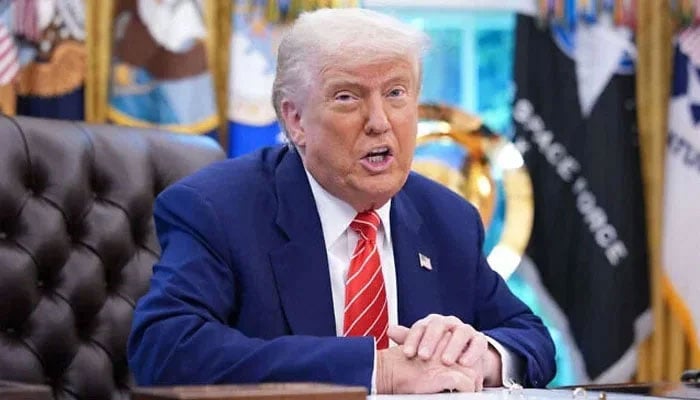
WASHINGTON: President Donald Trump said on Friday he might support a ceasefire in the week-old aerial conflict between US ally Israel and its regional rival Iran “depending on the circumstances”.
Asked by reporters if he would support a ceasefire while negotiations are ongoing, Trump said: “I might, depending on the circumstances”.
Europe would not be able to help much in the war between Iran and Israel, Trump added. “Iran doesn’t want to speak to Europe. They want to speak to us. Europe is not going to be able to help in this one,” Trump said.
Iran’s foreign minister met with European counterparts in Geneva on Friday for talks aimed at establishing a path back to diplomacy over Iran’s nuclear program.
European foreign ministers urged Iran to engage with Washington over its nuclear programme, but the talks ended with few signs of progress.
“Well, I’m not going to talk about ground forces, because the last thing you want to do is ground forces,” Trump said, when asked if ground forces would be needed to defeat Iran.
Trump and the White House say he will decide in the next two weeks whether the US will get involved in the Israel-Iran war. Trump has kept the world guessing on his plans, veering from proposing a swift diplomatic solution to suggesting Washington might join the fighting on Israel’s side.
In Geneva moot on Friday, there were few signs of progress after European foreign ministers met their Iranian counterpart in a bid to prevent conflict in the Middle East from escalating, although all signalled readiness to keep talking, despite major sticking points.
The foreign ministers of Germany, Britain, France, known as the E3, plus the EU, urged Iran to engage with the United States over its contentious nuclear programme even as Tehran has repeatedly insisted it will not open discussions with the Trump administration until Israeli strikes on Iran end.
The talks aimed to test Tehran’s willingness to negotiate a new nuclear deal despite there being no obvious prospect of Israel ceasing its attacks soon, diplomats said. “The Iranian Foreign Minister has expressed his willingness to continue discussions on the nuclear programme and more broadly on all issues, and we expect Iran to commit to the discussion, including with the United States, to reach a negotiated settlement,” said French Foreign Minister Jean-Noel Barrot.
For his part, Iranian Foreign Minister Abbas Araghchi said Iran was ready to consider diplomacy once Israel had ceased its attacks and been held accountable for its actions.
“In this regard, I made it crystal clear that Iran’s defence capabilities are not negotiable,” he said following the talks lasting around three hours in Geneva. No date for a follow-up meeting was announced despite Europeans underscoring the small window for diplomacy.
European ministers spoke beforehand with US Secretary of State Marco Rubio who signalled Washington was open to direct talks even as it mulls the strikes, diplomatic sources said.
Washington did not confirm that, though broadcaster CNN quoted a US official saying Trump supported diplomacy by allies that could bring Iran closer to a deal.
Britain’s foreign minister David Lammy said the European countries were eager to continue talks with Iran. “This is a perilous moment, and it is hugely important that we don’t see regional escalation of this conflict,” he said.
Two European diplomats said the E3 did not believe that Israel would accept a ceasefire in the near term and that it would be difficult for Iran and the US to resume negotiations. They said the idea was to begin a parallel negotiating track, initially without the US, on a new deal that would involve tougher inspections, and potentially on Iran’s ballistic missile programme, while allowing Tehran some notional enrichment capacity. The Trump administration is demanding Iran stop uranium enrichment altogether, whereas the E3 have in past talks left it some scope to enrich for civil ends in exchange for extremely strict international inspections. On Friday, French President Emmanuel Macron shifted closer to Trump’s position, saying that any new deal with Tehran needed to go towards zero enrichment. A senior Iranian official told Reuters Iran is ready to discuss limitations on its uranium enrichment but said the prospect of zero enrichment would undoubtedly be rejected.
In a speech at the United Nations in Geneva before the E3 meeting, Araghchi accused Israel of a “betrayal of diplomacy”, while Israel’s envoy in Geneva raised a “vehement objection” to the minister addressing the UN’s Human Rights Council.
UN Secretary-General Antonio Guterres warned that expansion of the Israel-Iran conflict could “ignite a fire no one can control” and called on both sides and potential parties to the conflict to “give peace a chance.”
The head of the UN nuclear watchdog agency, speaking at the same United Nations Security Council session, warned that attacks on nuclear facilities could result in the release of radiation “within and beyond boundaries” of Iran, and called for maximum restraint. Rafael Grossi, outlined Israeli attacks on nuclear facilities at Natanz, Isfahan and Arak. He said the level of radioactivity outside Iran’s Natanz site has remained unchanged and at normal levels. However, he said that within the facility there was both radiological and chemical contamination. He said the IAEA was not aware of any damage at Iran’s Fordow plant at this time. An attack on Iran’s Bushehr plant would be most serious.”
Pakistan’s Ambassador to UN Ambassador Asim Iftikhar Ahmad has said that Israel’s “unlawful strikes” against Iran occurred during diplomatic engagement on Iran’s nuclear issue. “These illegal actions must not be allowed to scuttle that dialogue. Parties must return to the path of negotiations, which is the only viable means to reach a sustainable agreement regarding the Iranian nuclear programme,” he said. He highlighted Iran’s negotiations with the US and EU, saying, “We hope that the diplomatic efforts and engagements will bear fruit.” The envoy added: “We reaffirm our longstanding position that all issues regarding Iran’s nuclear programme must be resolved peacefully through dialogue and diplomacy in accordance with the rights, international obligations and responsibilities of all parties concerned.”






-
 Travis Kelce Plays Key Role In Taylor Swift's 'Opalite' Remix
 -
 How Jennifer Aniston's 57th Birthday Went With Boyfriend Jim Curtis
 -
 JoJo Siwa Shares Inspiring Words With Young Changemakers
 -
 James Van Der Beek Loved Ones Breaks Silence After Fundraiser Hits $2.2M
 -
 Disney’s $336m 'Snow White' Remake Ends With $170m Box Office Loss: Report
 -
 Travis Kelce's Mom Donna Kelce Breaks Silence On His Retirement Plans
 -
 Premiere Date Of 'Spider-Noir' Featuring Nicolas Cage Announced
 -
 Pedro Pascal's Sister Reveals His Reaction To Her 'The Beauty' Role
 -
 Kate Middleton Proves She's True 'children's Princess' With THIS Move
 -
 Paul Anka Reveals How He Raised Son Ethan Differently From His Daughters
 -
 'A Very Special Visitor' Meets Queen Camilla At Clarence House
 -
 Jodie Turner Smith Shares One Strict Rule She Follows As A Mom
 -
 Hailey Bieber Reveals KEY To Balancing Motherhood With Career
 -
 Photo Of Jay-Z, Other Prominent Figures With Jeffrey Epstein Proven To Be Fake
 -
 Hillary Clinton's Munich Train Video Sparks Conspiracy Theories
 -
 Fans Slam Talk Show Host For 'cringe' Behavior In Chris Hemsworth Interview