
Exporters warn budget measures threaten $11bn value-added sector
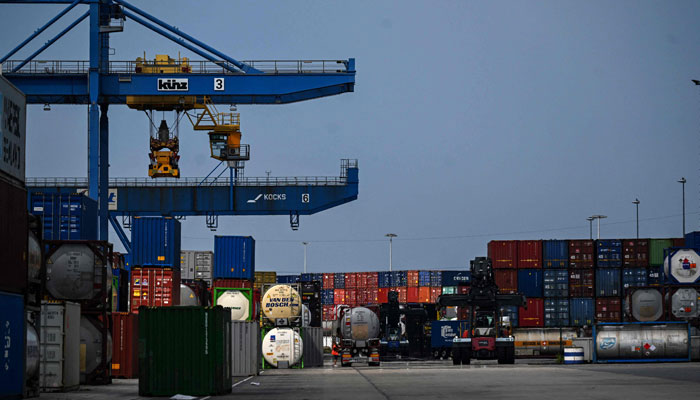
LAHORE: Pakistan’s $11 billion value-added export industry -- contributing nearly one-third of the country’s total exports -- has issued an urgent appeal to Prime Minister Shehbaz Sharif, warning that recent budgetary measures risk derailing the sector at a critical juncture.
In a joint statement, the Pakistan Readymade Garments Manufacturers and Exporters Association (PRGMEA), alongside leading export-oriented associations including PHMA, SIMAP, PSGMEA, PGMEA, PLGMEA, PCSUMEA, and the Sialkot Chamber of Commerce, demanded the immediate reinstatement of the final tax regime (FTR) and the restoration of the export facilitation scheme (EFS) to its original structure.
The appeal was backed by industry leaders, including PRGMEA Chairperson Dr Muhammad Ayyaz Uddin; former central chairperson of PRGMEA Sohail A Sheikh; President of the Sialkot Chamber of Commerce and Industry (SCCI) Ikram ul Haq; Chairperson of PSGMEA Khawaja Masud Akhtar -- whose company’s footballs are used in FIFA World Cup tournaments; Chairperson of SIMAP Zeeshan Tariq, Chairperson of PLGMEA Syed Ahtisham Mazhar; Chairperson of PHMA Abdul Hameed; former chairperson of PHMA Khawaja Mushraf; Chairperson of PGMEA Annas Raheel Barlas; Chairperson of PCSUMEA Muhammad Jamal Bhutta, as well as Majid Bhutta, Ansar Aziz Puri, Sheikh Luqman Amin and other prominent exporters.
They expressed serious concern that despite the government’s rhetoric around “export-led growth”, the practical measures fall far short. “The government consistently claims to support exports, but in reality, no department appears aligned with this goal,” they stated.
They noted that during the entire budget speech, the finance minister mentioned the word “export” only once -- and that too in a negative context while announcing duties on imported yarn under the EFS.
Addressing the prime minister directly, the joint statement urged the prime minister “to intervene without delay. If the current situation continues, Pakistan’s most dependable source of foreign exchange will face irreversible harm.”
They warned that in the present policy environment, the government’s “Uraan Pakistan” vision of boosting exports to $100 billion is unattainable.
The exporters clarified: “We are not seeking subsidies, exemptions or special treatment -- only a level playing field to compete globally. Current policies have significantly raised the cost of doing business and eroded ease of doing business.”
They called for urgent action to rebuild industry confidence and streamline procedures. “International buyers are demanding long-term clarity and consistency in the EFS framework. Pakistan is strategically positioned to benefit from global shifts away from China -- this opportunity must not be lost.”
They said the abolition of the FTR and the breakdown of the EFS had thrown the industry into disarray. The FTR, once a simple and predictable tax mechanism, has been replaced by cumbersome procedures, audits and refund delays -- particularly harming small and medium-sized exporters.
Meanwhile, the EFS -- previously essential for importing raw materials not produced locally or required by international buyers from nominated suppliers -- has been burdened with excessive conditions, restricting access to critical inputs and damaging export competitiveness.
Business leaders stressed that Pakistan must move beyond reliance on cotton and embrace a diversified, innovation-driven approach to value-added apparel exports.
“We do not have time for bureaucratic delays when international buyers are waiting. These policy shifts are making us uncompetitive, raising costs, and driving us out of global markets,” they said. The consequences, they warned, would be cancelled orders, factory closures, and widespread job losses.
The exporters reiterated that restoring the original FTR and EFS mechanisms would not cost the government anything, but would directly bolster exports and increase foreign exchange inflows. “This is not merely about survival -- it is about Pakistan’s economic stability. We are united and ready to cooperate, but we require urgent and decisive action from the government.”
“Pakistan stands at a crossroads. With the right policy support, our exporters can generate growth, employment, and stability. But time is running out -- and the damage has already begun.”






-
 Travis Kelce Plays Key Role In Taylor Swift's 'Opalite' Remix
 -
 How Jennifer Aniston's 57th Birthday Went With Boyfriend Jim Curtis
 -
 JoJo Siwa Shares Inspiring Words With Young Changemakers
 -
 James Van Der Beek Loved Ones Breaks Silence After Fundraiser Hits $2.2M
 -
 Disney’s $336m 'Snow White' Remake Ends With $170m Box Office Loss: Report
 -
 Travis Kelce's Mom Donna Kelce Breaks Silence On His Retirement Plans
 -
 Premiere Date Of 'Spider-Noir' Featuring Nicolas Cage Announced
 -
 Pedro Pascal's Sister Reveals His Reaction To Her 'The Beauty' Role
 -
 Kate Middleton Proves She's True 'children's Princess' With THIS Move
 -
 Paul Anka Reveals How He Raised Son Ethan Differently From His Daughters
 -
 'A Very Special Visitor' Meets Queen Camilla At Clarence House
 -
 Jodie Turner Smith Shares One Strict Rule She Follows As A Mom
 -
 Hailey Bieber Reveals KEY To Balancing Motherhood With Career
 -
 Photo Of Jay-Z, Other Prominent Figures With Jeffrey Epstein Proven To Be Fake
 -
 Hillary Clinton's Munich Train Video Sparks Conspiracy Theories
 -
 Fans Slam Talk Show Host For 'cringe' Behavior In Chris Hemsworth Interview