
Ustad Abu Bakr honoured for winning second prize in prestigious IRCICA Calligraphy Competition
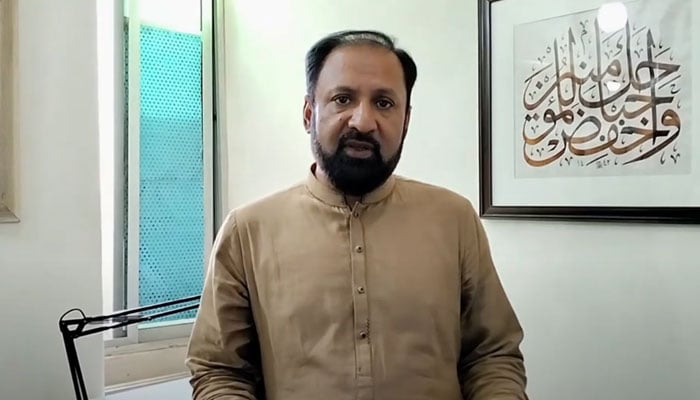
Danish-o-Ramish, an organisation committed to promoting classical arts, spirituality and mental well-being, organised an event on Wednesday to pay tribute to a leading Pakistani calligrapher, Ustad Abu Bakr, and congratulate him on his winning the second prize in the Sulus Jali category in the 13th International Calligraphy Competition recently held by the Research Centre For Islamic History, Art and Culture (abbreviated as IRCICA).
The IRCICA is a cultural wing of the Organisation of Islamic Conference headquartered in Istanbul. Its calligraphy competition is one of the most prestigious global competitions celebrating Islamic calligraphy.
Ustad Abu Bakr sent his artwork in the Sulus Jali script to the IRCICA and was awarded the second prize in the script at an event in Turkiye.
Dr Noman Baig of the Habib University introduced the calligrapher at the event hosted by the Danish-o-Ramish. He said Ustad Abu Bakr has represented Pakistan in various international calligraphy competitions. He won the second prize in a competition held by the Islamic University of Madinah in 2014. Later, he was awarded a special prize in an IRCICA competition and another special prize at a competition hosted in Qatar.
Calligraphy was a spiritual art as it required spiritual cleansing to perfect it, Dr Baig remarked. Later, Ustad Abu Bakr spoke about his journey in calligraphy. He said he started learning the art in 1989 on the wish of his father, who himself wanted to become a calligrapher but could not do so. He said he started learning the art from Ustad Anjum Mehmood in Faisalabad.
He said his teacher started to train him in the Naskh script, which is the script in which the Holy Quran is normally written. The teacher initially told him that it would take five years for him to learn the script. However, just after one year, Ustad Anjum was satisfied with his progress in Naskh and began to train him in the Nastaliq script.
Ustad Abu Bakr recalled that there was little technology available when he started to learn the art. He said people did not know about Muqahhar paper, which is a special paper for calligraphic art, and there was only one ink brand in just one colour.
He said people who had learnt the calligraphy at that time usually composed books or newspapers, etc. to earn their livelihoods, but when the computers arrived, the hand-composing was shifted to typing and many calligraphers switched their jobs. Ustad Abu Bakr said that even he was told to do something else as practising the art of calligraphy would lead him nowhere.
The calligrapher recalled opening an office to compose wedding invitation cards and soon shutting it down as he found that merely knowing how to write a script was not enough for the job and one needed to learn designing the card and making beautiful styles. He then worked with Ustad Anjum to learn designing.
Ustad Abu Bakr said after Ustad Anjum, Ustad Shafiq-Uz-Zaman Khan, who is the calligrapher of Masjid-e-Nabawi in the holy city of Madinah, was his second teacher in the calligraphic art. He learnt the Sulus script from him in Karachi where he lived for around three decades before shifting to Lahore in recent years.
Responding to questions of the audience, the calligrapher remarked that the art of calligraphy was surely not going to die as it was directly linked with the Holy Quran. He stated that new scripts were being created and some old styles were no longer practised.
To a question regarding various forms of the Nastaliq script, he said all the styles of Nastaliq being practised today were good and none of them should be disparaged. He lamented that the Lakhnavi Nastaliq, a style of Nastaliq developed in Lucknow, was a very beautiful script but it was now dead because there was no one who could carry that legacy forward.
Commenting on why some Pakistani calligraphers had started to denounce the Lahore or other Indo-Pakistani styles of Nastaliq in favour of the Iranian style, he said it was because the international competitions that were held in Turkiye and other countries only recognised the Iranian Nastaliq. He, however, added that we should not belittle our Nastaliq styles just because international competitions did not recognise them.







-
 King Charles ‘worried’ For Prince William As Heir Doesn’t Have Temperament To Be King
 -
 France Records Around 1,000 Excess Deaths During Deadly Heatwave
 -
 Kris Jenner Crowns Khloe Kardashian 'most Amazing Mother' In Birthday Tribute
 -
 David Beckham Melts Hearts With His Unseen Baby Snaps As Celebrated Mom Sandra
 -
 Which Countries Will Ban Grand Theft Auto VI At Launch?
 -
 Prince Harry’s ‘emotional Safe Haven’ In UK Revealed
 -
 North West Debuts Daring New Facial Piercings At Paris Fashion Week
 -
 Why Tech Firms Are Blaming AI For The Massive Surge In Device And Console Prices
 -
 Prince William’s Secret To A Successful Marriage With Kate Middleton Comes To Light
 -
 Google Gemini AI Capacity Shortage Delays Meta's AI Projects: Report
 -
 Holly Madison Reveals Why She Underwent Plastic Surgery After Pregnancies
 -
 Dean McDermott Expresses Gratitude As He Marks Three Years Of Sobriety
 -
 South Korea, Japan Deepen Defense Ties In Major Security Push
 -
 Andrew Mountbatten-Windsor’s Fears Over His Own Life And Life Span Turn Worrying: ‘You Can’t Erase This!’
 -
 Katy Perry's Long-awaited Return Ends In Disappointment
 -
 Eva Green Hospitalized After Injury On ‘Wednesday’ Set