
Children of exploitation
This year commemorates 25 years since adoption of ILO Convention No 182 on Worst Forms of Child Labour
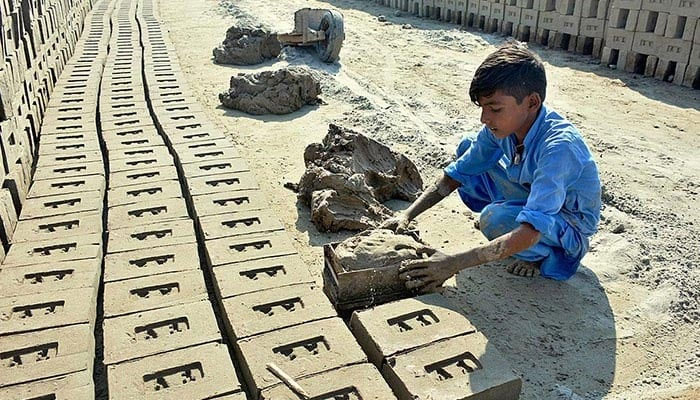
Today, the world marks the World Day Against Child Labour – a solemn reminder of the millions of children around the globe who are deprived of their childhoods, education and fundamental rights. The day is especially significant for countries like Pakistan, where child labour is not just an unfortunate reality but a deeply entrenched and widely normalised aspect of daily life. This year commemorates 25 years since the adoption of ILO Convention No 182 on the Worst Forms of Child Labour. Yet, for Pakistan, the challenge is to turn its commitments into real, visible change. Pakistan has ratified key international conventions on child labour and has a number of domestic laws aimed at curbing the practice. That would include the Employment of Children Act, the Factories Act and the Bonded Labour System Abolition Act. The constitution itself prohibits children under the age of 14 from working in factories or engaging in hazardous employment. Despite this, an estimated 10 to 12 million children are engaged in labour across the country, with thousands working in exploitative and often dangerous environments such as brick kilns, carpet weaving, domestic servitude, agriculture and street vending. In Punjab alone, over 126,000 children are estimated to work in brick kilns, many never having attended school. The discrepancy between law and practice is stark and unforgivable.
What makes this crisis all the more tragic is how it has become embedded in the social and economic fabric of the country. For many families living below the poverty line, sending their children to work is not a choice but a cruel necessity. With high inflation, low wages, inadequate social safety nets and limited access to quality education, poor households are forced to sacrifice their children’s futures just to survive the present. And while the structural factors that fuel child labour are formidable, the normalisation of child exploitation in homes, workshops, and markets is perhaps the most damning indictment of this collective moral failure. It is not uncommon to see children working in the homes of the wealthy, their presence scarcely raising eyebrows – the children trapped in a cycle of invisibility and subjected to violence, humiliation and neglect.
Ending child labour in Pakistan will require more than some annual pronouncements of principles. We need enforcement of existing laws, substantial investment in public education and child welfare and the political and societal will to treat child labour as a national emergency. There are reasons for hope – from the legacy of Iqbal Masih to the tireless work of civil society groups – but hope alone won’t take children out of labour. An all-of-stakeholder approach is needed to coordinate and promote children’s rights over economic expedience.







-
 Kylie Kelce Explains Why She Avoids Raising Kids With 'silver Spoon'
 -
 Meghan Markle Is Above Royal Family ‘empty Threats,’ Says Insider
 -
 Anne Hathaway Opens Up About 'defeated' Feeling As Working Mom
 -
 Shamed Andrew Should Testify In Epstein Case As ‘act Of Service’
 -
 What Really Happened Before Nicholas Brendon Was Found Dead At Home?
 -
 Sarah Ferguson Branded ‘most Famous Missing Person’ In UK Right Now
 -
 Why King Charles Does Not Need A Driving License? Expert Reveals
 -
 Did Graham Norton Really Sign NDAs For Taylor Swift’s Wedding?
 -
 ‘Polite’ King Charles Treats Staff Better Than ‘boorish’ Andrew
 -
 Princess Beatrice's Husband Raises Eyebrows With Deleted Instagram Post
 -
 Dua Lipa 'snubs' Priyanka Chopra
 -
 Will Taylor Frankie Paul Still Get Her 'Bachelorette' Salary?
 -
 'Harry Potter' Returns: First Glimpse Of HBO's New Series
 -
 Ryan Gosling Credits His Kids For Key Detail In New Role
 -
 Prince William, Kate Middleton Mark 'historic Moment'
 -
 Why Roberts Pattinson Says Couples 'ruin' Their Big Day Amid Suki Waterhouse Wedding Rumors?