
Kashmir diplomacy
Headwinds are strong, and India remains defiant, world order is fractured
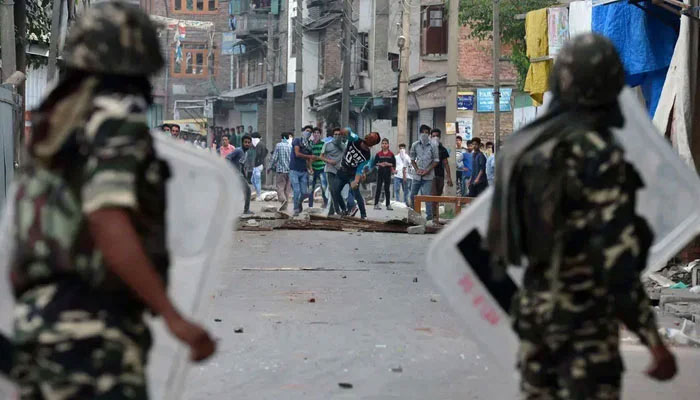
On May 11, President Trump opened a new door for diplomacy on Kashmir. In a Truth Social post, he praised the leadership of India and Pakistan for agreeing to a ceasefire and offered his help for a resolution to the Kashmir issue. Pakistan welcomed the statement as a diplomatic opening. India, by contrast, reacted with alarm, interpreting it as an affront to its rigid Kashmir policy.
The day before, US Secretary of State Marco Rubio announced that India and Pakistan had agreed to a ceasefire and talks at a neutral venue. The US State Department clarified that these would be bilateral, but India quickly distanced itself, denying any role for third-party mediation. This prompted fears in New Delhi about the re-hyphenation of India and Pakistan, the internationalisation of Kashmir, and perhaps most painfully, the exposure of its exaggerated military narrative.
Under domestic and international pressure, India’s leadership began spinning falsehoods, with Prime Minister Modi advocating a ‘new normal’ of perpetual hostility towards Pakistan. His flawed doctrine – erasing the line between state and non-state actors and weaponising the nuclear threat – ironically applies to India itself. Modi insisted on including ‘terrorism’ and Azad Kashmir in the bilateral agenda, a stark shift from India’s earlier posture after revoking Article 370, when it claimed the Kashmir dispute no longer existed and called for annexing Azad Kashmir and Gilgit-Baltistan.
Despite India’s denials, its acceptance of dialogue under international scrutiny implicitly recognises Kashmir as a dispute. While there’s scepticism about President Trump’s mediation offer due to India’s resistance, Pakistan must give diplomacy a genuine chance and capitalise on the space provided.
That said, we must be realistic. Headwinds are strong, and India remains defiant. The world order is fractured. International law is eroded, and the UN is largely marginalised. President Trump’s Kashmir mediation initiative in 2019 fizzled out quickly. We should approach this new window with pragmatic caution.
Historically, India annexed Jammu and Kashmir under fabricated legal pretexts, integrating it into its federation through constitution and later stripping its autonomy in 2019. Pakistan, though entitled under the 1947 Indian Independence Act, has never formally claimed the territory, instead relying on Article 257 of its constitution and a set of UN resolutions that have lacked enforcement mechanisms. Pakistan’s position is rooted in Wilsonian ideals; India’s rests on cold realpolitik.
India exploits this ambiguity by threatening to invade Azad Kashmir. Ironically, while it criminalises talk of independence in Indian-occupied Kashmir, it encourages the ‘third option’ on Pakistan’s side to divide the pro-Pakistan constituency in the region.
Pakistan must recalibrate its approach. There are three key steps we must take:
First, revisit the archives. Dust off previous proposals and track-two efforts, as well as UN resolutions, the Owen-Dixon plan, Bhutto–Swaran Singh talks, Musharraf’s four-point formula, and the 2015 ten-point agenda agreed with India’s External Affairs Minister. Let’s assess which of these ideas are still viable.
Second, avoid unilateral concessions. Some voices in Pakistan offer concessions prematurely, even before formal dialogue begins. India uses this behaviour to chip away at Pakistan’s position over time. We must hold our ground until we are at the negotiating table.
Third, involve the Kashmiri people. No solution should be endorsed without their consent. During talks around the four-point formula, leaders like Syed Ali Shah Gilani, a staunch advocate of Kashmir’s accession to Pakistan, were sidelined. That was a mistake. The people of Kashmir must remain central to any dialogue or settlement.
Parallel to this, we must also push for the restoration of the Indus Waters Treaty, which India has attempted to undermine. A three-pronged approach is essential: engage the Permanent Indus Commission; encourage China, as the uppermost riparian state, to exert pressure; and prepare our legal case for forums such as the World Bank, UN Security Council, and the International Court of Justice.
India often frames the entire conflict around ‘terrorism’, ignoring its own state-sponsored proxies destabilising Pakistan. We have documented proof of Indian involvement in terrorist attacks like the Samjhota Express, Jafar Express, and the Khuzdar school bus bombing. Yet global circles, especially in Washington, remain fixated on the 2008 Mumbai attacks, largely because we have failed to mainstream our counter-narrative.
Kashmir’s fate is tied to Pakistan’s strength – military, economic and diplomatic. Our economy, though improving, remains vulnerable. While promising, our true ambition should be to become one of the world’s top ten economies by 2047, as forecast by the World Bank.
Kashmir, ultimately, is more than a territorial dispute. It is the frontline of our civilisational contest with India. We must avoid haste and, instead, leverage long-term shifts in global geopolitics. China’s rise as a transcontinental power; and our partnership with it is a strategic asset for us. Pakistan must assert itself as a regional leader as the world transitions to a multipolar order. Our capacity to influence the Kashmir question hinges on understanding our adversary, discarding tokenism, and practising principled, hard-nosed diplomacy.
Kashmir remains a nuclear flashpoint. IIOJK is simmering and may erupt unpredictably. India, facing domestic instability and international scrutiny, could orchestrate another false flag operation. Modi, looking to repair his battered image, may be tempted to escalate tensions once again.
Meanwhile, our ties with China will grow, and we may see a reset with the US. Yet, crises in the Middle East will continue to dominate global attention, pushing Kashmir to the margins. The intensifying US–China rivalry will keep South Asia strategically relevant, but unless Pakistan actively leverages this space, Kashmir diplomacy risks slipping back into dormancy.
The writer is the former president of Azad Jammu and Kashmir.







-
 Patriots' WAGs Slam Cardi B Amid Plans For Super Bowl Party: She Is 'attention-seeker'
 -
 Martha Stewart On Surviving Rigorous Times Amid Upcoming Memoir Release
 -
 Prince Harry Seen As Crucial To Monarchy’s Future Amid Andrew, Fergie Scandal
 -
 Chris Robinson Spills The Beans On His, Kate Hudson's Son's Career Ambitions
 -
 18-month Old On Life-saving Medication Returned To ICE Detention
 -
 Major Hollywood Stars Descend On 2026 Super Bowl's Exclusive Party
 -
 Cardi B Says THIS About Bad Bunny's Grammy Statement
 -
 Sarah Ferguson's Silence A 'weakness Or Strategy'
 -
 Garrett Morris Raves About His '2 Broke Girls' Co-star Jennifer Coolidge
 -
 Winter Olympics 2026: When & Where To Watch The Iconic Ice Dance ?
 -
 Melissa Joan Hart Reflects On Social Challenges As A Child Actor
 -
 'Gossip Girl' Star Reveals Why She'll Never Return To Acting
 -
 Chicago Child, 8, Dead After 'months Of Abuse, Starvation', Two Arrested
 -
 Travis Kelce's True Feelings About Taylor Swift's Pal Ryan Reynolds Revealed
 -
 Michael Keaton Recalls Working With Catherine O'Hara In 'Beetlejuice'
 -
 King Charles, Princess Anne, Prince Edward Still Shield Andrew From Police