
Time to take extra care of infants, children
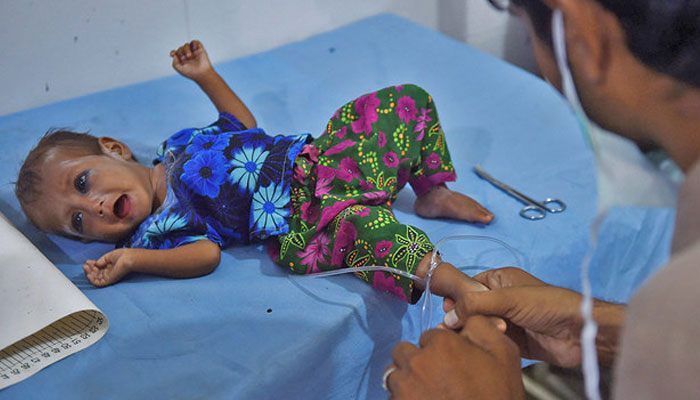
Rawalpindi : Both the private and public sector healthcare facilities in town including the three allied hospitals have started receiving a significant influx of child patients with gastroenteritis, diarrhoea and other water and food borne infections and according to health experts, the time has come for parents to take extra care of infants and children to avoid epidemics of cholera and diarrhoea in the coming days.
It is important that the pre-monsoon season is about to set in and above normal rainfall in the coming days is being expected in most parts of the country. According to health experts, if proper preventive measures are not taken by the parents well in time, the weather conditions may give a tremendous rise to certain infections among children and infants.
Studies reveal that in Pakistan, nearly 250,000 children under the age of five die each year due to diarrhoea, mainly because of the use of untreated and contaminated water and unhygienic food. The water-borne illnesses account for nearly 60 per cent of child deaths in Pakistan with approximately 630 children dying daily from diarrhoea.
According to health experts, at present, the trend of infections among children cannot be termed as an epidemic rather it is endemic, however, the trend might take the shape of an epidemic with continuous rain spells expected ahead. It is time to sensitize individuals, particularly parents to take extraordinary care in handling children and infants.
To avoid diarrhoea, children should be given water for drinking after boiling while boiled water should be used for preparing milk for infants. Water to be used for children and infants must be brought to ‘rolling boil’ for 5-10 minutes otherwise it might not be safe for a child to consume.
On hygiene, experts say that mothers must wash hands with soap before preparing milk for infants while children should be made habitual of washing hands with soap before and after eating and after going to the toilet. Fresh milk and food should be given to infants and small children each time and consumption of leftover food should be avoided.
Experts say that there is a need to educate mothers through public awareness campaigns on how to prevent summer and monsoon related infections and how to react in case a child gets an infection. Mothers should be informed that immediately after the incidence of diarrhoea (motion), a child should be given ORS (Oral Rehydration Salt) which certainly puts a patient out of danger. However as soon as a patient’s stool gets consistent, the ORS should immediately be stopped as a greater amount of Sodium in ORS might harm a healthy child.
It is necessary to create awareness among parents about various aspects of cholera, an acute infectious disease caused by the bacterium Vibrio cholerae that lives and multiplies its colonies in the small intestine. Studies reveal that in cholera, the watery motion resembles that of rice water and dehydration is much rapid as compared to diarrhoea. Health experts say that such a patient should immediately be taken to the nearest healthcare facility for treatment.
Massive watery diarrhoea is the major symptom of cholera that results in dehydration. Such dramatic water loss, if left untreated, causing severe dehydration leads to the thickening of the blood, circulatory collapse (shock) and death. Studies reveal that a good number of cholera victims die six hours after the onset of symptoms if not treated. Nearly 60 per cent of untreated patients die of the disease.
It is important that gastro, diarrhoea and cholera can be avoided by giving safe drinking water and hygienic food to infants and children and avoiding unhygienic living conditions. Experts say that families should have a clean and functioning lavatory and must avoid open defecation on ground, in or near water sources.







-
 JoJo Siwa Shares Inspiring Words With Young Changemakers
 -
 James Van Der Beek Loved Ones Breaks Silence After Fundraiser Hits $2.2M
 -
 Disney’s $336m 'Snow White' Remake Ends With $170m Box Office Loss: Report
 -
 Travis Kelce's Mom Donna Kelce Breaks Silence On His Retirement Plans
 -
 Premiere Date Of 'Spider-Noir' Featuring Nicolas Cage Announced
 -
 Pedro Pascal's Sister Reveals His Reaction To Her 'The Beauty' Role
 -
 Kate Middleton Proves She's True 'children's Princess' With THIS Move
 -
 Paul Anka Reveals How He Raised Son Ethan Differently From His Daughters
 -
 'A Very Special Visitor' Meets Queen Camilla At Clarence House
 -
 Jodie Turner Smith Shares One Strict Rule She Follows As A Mom
 -
 Hailey Bieber Reveals KEY To Balancing Motherhood With Career
 -
 Photo Of Jay-Z, Other Prominent Figures With Jeffrey Epstein Proven To Be Fake
 -
 Hillary Clinton's Munich Train Video Sparks Conspiracy Theories
 -
 Fans Slam Talk Show Host For 'cringe' Behavior In Chris Hemsworth Interview
 -
 Woman Jailed Over False 'crime In Space' Claim Against NASA Astronaut
 -
 James Van Der Beek’s Close Pal Reveals Family's Dire Need Of Donations