
Washington hails ‘substantive progress’ after trade talks with China
Chinese delegation was expected to speak to media Sunday evening
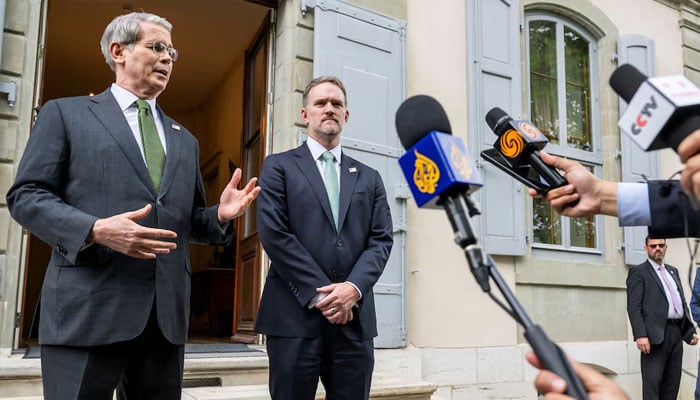
GENEVA: Washington expressed optimism at the end of a weekend of trade talks with China aimed to de-escalate trade tensions sparked by President Donald Trump’s aggressive tariff rollout.
“I’m happy to report that we’ve made substantial progress between the United States and China in the very important trade talks,” US Treasury Secretary Scott Bessent told reporters in Geneva.
“The talks were productive,” he said, taking no questions from the media, but promising a “complete briefing” on the outcome of the talks on Monday.
Trade Representative Jamieson Greer, who also took part in the two days of closed-door talks with Chinese Vice Premier He Lifeng, said that the differences between the sides were “not so large as maybe thought”.
After the first day of negotiations, Trump had posted on Truth Social that the discussions had been “very good,” describing them as “a total reset negotiated in a friendly, but constructive, manner”.
Beijing had yet to comment Sunday, but on Saturday Chinese state news agency Xinhua described the talks as “an important step in promoting the resolution of the issue”.
The Chinese delegation was expected to speak to the media Sunday evening.
The meetings marked the first time senior officials from the world’s two largest economies have met face-to-face to tackle the topic of trade since Trump slapped steep new levies on China last month, sparking a robust retaliation from Beijing.
“The talks reflect that the current state of the trade relations with these extremely high tariffs is ultimately in the interests of neither the United States nor China,” Citigroup global chief economist Nathan Sheets said. He called the tariffs a “lose-lose proposition”.
The tariffs imposed by Trump on the Asian manufacturing giant since the start of the year currently total 145 percent, with cumulative US duties on some Chinese goods reaching a staggering 245 percent.
In retaliation, China put 125-percent tariffs on US goods.
Ahead of the meeting at the discrete villa residence of the Swiss ambassador to the United Nations in Geneva, Trump signalled he might lower the tariffs, suggesting on social media that an “80% Tariff on China seems right!”
However, his press secretary Karoline Leavitt later clarified that the United States would not lower tariffs unilaterally. China would also need to make concessions, she said.
Going into the meeting, both sides played down expectations of a major change in trade relations.
Bessent underlined a focus on “de-escalation” and not a “big trade deal,” while Beijing insisted that the United States had to ease tariffs first.
The fact the talks are even happening “is good news for business, and for the financial markets,” said Gary Hufbauer, a senior non-resident fellow at the Peterson Institute for International Economics (PIIE).
But Hufbauer cautioned he was “very sceptical that there will be any return to something like normal US-China trade relations”. Even a tariff rate of 70 to 80 percent would still potentially halve bilateral trade, he said.
China’s vice premier went into the discussions buoyed by Friday’s news that China’s exports rose last month despite the trade war.
The unexpected development was attributed by experts to a re-routing of trade to Southeast Asia to mitigate US tariffs.
Among some of the more moderate Trump officials, such as Bessent and US Commerce Secretary Howard Lutnick, “there’s a realisation that China is better equipped to deal with this trade war than the US,” said Hufbauer.
The Geneva meeting comes after Trump unveiled a trade agreement with Britain, the first deal with any country since he unleashed his blitz of global tariffs.
The five-page, non-binding deal confirmed to nervous investors that the United States is willing to negotiate sector-specific relief from recent duties. But he maintained a 10-percent baseline levy on most British goods.
Following the US-UK trade announcement, analysts have voiced pessimism about the likelihood negotiations will lead to any significant changes in the US-China trade relationship.
“It’s nice that they’re talking. But my expectations for the actual outcomes of this first round of talks is pretty limited,” Sheets from Citigroup said.
In his Truth Social post, Trump said the talks had made “GREAT PROGRESS!!”
“We want to see, for the good of both China and the US, an opening up of China to American business,” he added.







-
 Kylie Kelce Explains Why She Avoids Raising Kids With 'silver Spoon'
 -
 Meghan Markle Is Above Royal Family ‘empty Threats,’ Says Insider
 -
 Anne Hathaway Opens Up About 'defeated' Feeling As Working Mom
 -
 Shamed Andrew Should Testify In Epstein Case As ‘act Of Service’
 -
 What Really Happened Before Nicholas Brendon Was Found Dead At Home?
 -
 Sarah Ferguson Branded ‘most Famous Missing Person’ In UK Right Now
 -
 Why King Charles Does Not Need A Driving License? Expert Reveals
 -
 Did Graham Norton Really Sign NDAs For Taylor Swift’s Wedding?
 -
 ‘Polite’ King Charles Treats Staff Better Than ‘boorish’ Andrew
 -
 Princess Beatrice's Husband Raises Eyebrows With Deleted Instagram Post
 -
 Dua Lipa 'snubs' Priyanka Chopra
 -
 Will Taylor Frankie Paul Still Get Her 'Bachelorette' Salary?
 -
 'Harry Potter' Returns: First Glimpse Of HBO's New Series
 -
 Ryan Gosling Credits His Kids For Key Detail In New Role
 -
 Prince William, Kate Middleton Mark 'historic Moment'
 -
 Why Roberts Pattinson Says Couples 'ruin' Their Big Day Amid Suki Waterhouse Wedding Rumors?