
SC allows trial of May 9 suspects in military courts
Court, by majority 5-2, allowed ICAs and set aside impugned judgment, dated 23-10-2023, rendered by SC bench
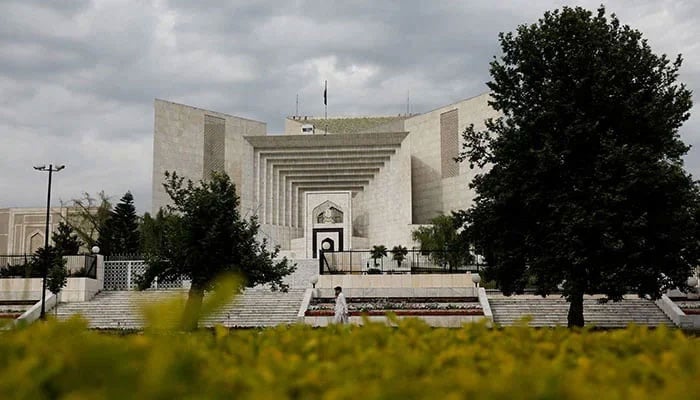
ISLAMABAD: The Supreme Court (SC) on Wednesday allowed trials of May 9 suspects in the military courts after restoring the clauses of Army Act 1952, which were earlier declared by the apex court ultra vires the Constitution and of no legal effect.
A seven-member constitutional bench of the apex court, headed by Justice Aminuddin Khan, announced the reserved judgment on the Intra-Court Appeals (ICAs) of federal government, Ministry of Defence, against the apex court judgment that had declared trial of civilians in the military courts as unconstitutional.
The Shuhada Foundation Balochistan as well as governments of Punjab and Balochistan had also filed the ICAs against the apex court judgment.
Other members of the bench included Justice Jamal Khan Mandokhail, Justice Muhammad Ali Mazhar, Justice Hasan Azhar Rizvi, Justice Musarrat Hilali, Justice Naeem Akhter Afghan and Justice Shahid Bilal Hassan.
The court, by majority 5-2, allowed the ICAs and set aside the impugned judgment, dated 23-10-2023, rendered by the SC bench.
“For reasons to be recorded later, subject to augmentation and explication in detail, the aforesaid ICA(s) are allowed by majority of 5 (comprising J. Aminuddin Khan, J. Muhammad Ali Mazhar, J. Syed Hasan Azhar Rizvi, J. Musarrat Hilali, and J. Shahid Bilal Hassan)”, Justice Aminuddin Khan announced a short order in the court.
Similarly, Justice Jamal Mandokhail and Justice Naeem Afghan dismissed the aforesaid ICAs, holding that the convictions and sentences awarded to civilians by courts martial for occurrence of May 9, 2023, are declared to be without jurisdiction, hence, the same are set aside.
Justice Mandokhail and Justice Afghan held that the accused under custody should be treated as under-trial prisoners and their cases stand transferred to the courts concerned of competent jurisdiction for trial.
The court restored the sub clauses (i) & (ii) of clause (d) of subsection (1) of Section 2 of the Pakistan Army Act, 1952 and subsection (4) of Section 59 of the Pakistan Army Act, 1952 that were earlier declared by the apex court judgment in 2023 ultra vires the Constitution and of no legal effect.
The majority judgment also referred to the government/parliament for considering and making necessary amendments/legislation in the Pakistan Army Act, 1952, and allied Rules within a period of 45 days in order to provide an independent right of appeal in the high court against the conviction awarded to the persons by the court martial/military court.
The majority five judges in ICAs Wednesday, however, set aside the impugned judgment after restoring sub clauses (i) & (ii) of Clause (d) of subsection (1) of Section 2 of the Pakistan Army Act, 1952 and subsection (4) of Section 59 of the Pakistan Army Act, 1952
“With due deference to the impugned judgment, such provisions in our view could not be declared ultra vires on the anvil or bedrock of sub-article 5 of Article 8 of the Constitution, which only provides that the rights conferred by the said Chapter (Fundamental Rights) shall not be suspended except as expressly provided by the Constitution, thus it does not control or preponderate upon the rigors of sub-article 3 of the said Article,” said the majority judgment.
The court noted that there was, in fact, no question with regard to the suspension of any fundamental right involved within the sphere of influence or realm of Article 233 of the Constitution.
The court noted that according to statistics shared by the AGP during the course of his arguments, 39 military installations, army works/establishments at various places (23 in Punjab, 8 in KP, 7 in Sindh and 1 in Balochistan) including GHQ, Corps Commander House Lahore (which is also a camp office), Mianwali Air Base, and ISI Offices/setup in Sargodha, Faisalabad, and Rawalpindi were targeted/attacked on May 9, 2023.
“He argued that all attacks were made by design and occurred on one and the same day, within a span of four to six hours, across the country,” said the judgment, adding that according to the AGP, the incidents left an indelible mark and represented the darkest moments in the nation’s history.
The court noted that the counsel representing the respondents never refuted or denied the factum of such incidents, but they candidly and forthrightly argued, from beginning to end, that though the accused/convicts have committed offences, they should be tried by anti-terrorism courts and not through court martial or by military courts, as that violated the right to a fair trial as envisioned under Article 10-A of the Constitution, and under sub-article (3) of Article 175 of the Constitution, military courts could not exercise judicial functions in the cases of civilians (the argument with regard to the applicability of sub-article (3) of Article 175 of the Constitution.
“Whereas, the learned counsel for the appellants maintained that due to the striking down of the law in question, no action can be taken even against the hard-core criminals and terrorists involved in the attacks on army installations and/or against the martyrdom of innocent civilians and personnel of the armed forces and even in the present situation, no action can be taken in the national security and interest against the persons accused of espionage or spies of enemy countries for the offences mentioned in sub-clause (ii) of clause (d) of subsection (1) of Section 2 of the Pakistan Army Act, 1952,” said the judgment.
The court held that no doubt, all such miscreants, lawbreakers, and perpetrators of such incidents are liable to be punished on proving their guilt, subject to right of appeal against their conviction.
“An independent right to appeal before an independent forum is also a basic limb of the doctrine of due process and the right to a fair trial, as enshrined and envisioned under Article 10-A of the Constitution,” added the judgment.
The court directed that any independent right to appeal be introduced through necessary legal amendments within 45 days. Furthermore, it held that, pursuant to clause (viii) of its short order, the limitation period for filing appeals by convicted persons shall begin from the date the amendments are officially notified. The convictions will remain subject to the final decision of the high court on appeal.
Regarding ongoing or future petitions challenging orders by anti-terrorism courts, including the transfer of accused to military courts, the court clarified that such cases shall be decided by the high courts on their own merits.
The court instructed its office to transmit a copy of the short order to the AGP, secretary National Assembly, secretary Ministry of Law and Justice, secretary Ministry of Defence, and secretary Law and Justice Commission to ensure compliance.
However, Justice Jamal Mandokhail and Justice Naeem Afghan dismissed the instant appeals, stating that the Pakistan Army Act, 1952 is a disciplinary statute intended solely for the regulation and discipline of armed forces personnel, in line with Article 8(3)(a) of the Constitution. As such, it does not apply to civilians or override their fundamental rights.
The judges held that the inclusion of clause (d) in Section 2(1) of the Army Act, which extends military jurisdiction to civilians, does not serve the Act’s intended purpose and thus cannot be shielded from constitutional scrutiny under Article 8.
Meanwhile, Leader of the Opposition in the National Assembly Omar Ayub Khan alleged that the Supreme Court of Pakistan gave a ‘weaponised decision’, allowing the military courts to hold trials of the civilians. He took to his ‘X’ social media account to react to the apex court verdict and wrote, “The decision has been given on a day when purportedly the installed regime and the establishment want to build national cohesion”.
Once again, he charged that a weaponised decision given by the Supreme Court allowing the military trials of the civilians will be used for targeting IK (Imran Khan) and PTI. He contended that the judges who have ruled in favour of allowing civilians trial in military courts will not be remembered kindly by history.
Meanwhile, PTI Secretary General Salman Akram Raja said that today the Constitution was attacked and under the court decision, military officers can try civilians. He told a news conference here that under the apex court decision, military officers can try civilians, whereas this provision was declared unconstitutional by a five-member bench in October 2023.
Referring to the development, PTI’s senior lawyer Babar Awan claimed that a new constitutional crisis has arisen in Pakistan.







-
 Offset Hospitalized: Everything To Know From Police Statements To Fears For His Family
 -
 Penny Lancaster Pokes Fun At Time With Rod Stewart
 -
 Richard Gadd Breaks Silence On 'Baby Reindeer' Lawsuit Drama
 -
 Kim Kardashian 'targeted Slapping' Video Sparks Hilarious Reactions
 -
 Where Will Andrew Mountbatten-Windsor Be Buried Once He Passes Away?
 -
 Meghan Markle Receives Support As Bizarre Easter Egg Criticism Backfires
 -
 Can Aging Be Reversed? First Human Trials Set To Begin
 -
 Kanye West Blocked From UK As Explosive Decision Announced
 -
 Minimal Upgrades For IPhone 18 And Air 2 Leak: A Letdown For Apple Fans?
 -
 Kate Middleton Sends Strong Message To Meghan Markle After 'shameless Stunts'
 -
 Arnold Schwarzenegger's Biggest Fear Triggers As He Gets Ready To Play Dream Role
 -
 Universal Music Faces Massive $64 Billion Takeover Bid
 -
 Sarah Ferguson Is Meeting With Andrew: Inside Secret Trips That Are Making William Mad
 -
 France: One Dead After High-speed Train Collides With Lorry Carrying Military Equipment
 -
 Chris Martin's Fears Grow As Daughter Apple Martin Opts For 'very Bad Path'
 -
 Cardi B Under Spotlight For Post Before Offset Shooting