
IHC judges’ transfers not approved by cabinet, SC told
Justice Muhammad Ali Mazhar asked whether there were any conditions for executive to use this power
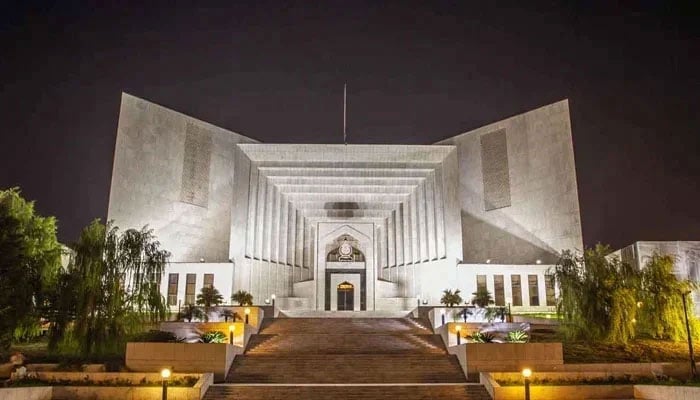
ISLAMABAD: The Supreme Court Wednesday adjourned until May 7 hearing into a case related to the transfer of judges to the Islamabad High Court (IHC) as well as the judges’ seniority issue.
A five-member constitutional bench — headed by Justice Muhammad Ali Mazhar — heard the identical petitions of six judges of IHC and Lahore High Court Bar Association (LHCBA) and Lahore Bar Association in the matter. Justice Naeem Akhtar Afghan, Justice Shahid Bilal, Justice Shakeel Ahmed and Justice Salahuddin Panhwar were the other members of the bench.
Continuing his arguments, Munir A Malik, counsel for six judges of Islamabad High Court (IHC), submitted that the summary for the judges’ transfer was not approved by the cabinet. He submitted that the summary sent by the Ministry of Law carried inconsistencies, reflecting the government’s incompetence and lack of seriousness. He claimed that judges were transferred as part of a planned effort to take control of the Islamabad High Court. Malik submitted that Article 200(1) could not be read in isolation and must be linked to subsection (2). He submitted that a judge’s transfer was an executive action, and the question was how the executive should exercise this power.
Justice Muhammad Ali Mazhar asked whether there were any conditions for the executive to use this power. Munir A. Malik responded that the executive’s authority in judges’ transfer was subject to judicial review.
The petitioners’ counsel submitted that the summary was sent by the Ministry of Law to the prime minister, who then advised the president but the cabinet’s approval was not taken. The Article 90 declares the prime minister as the chief executive, who makes policies and ensures their implementation. He submitted that the prime minister appointed the law minister after consulting parliament. Justice Naeem Akhtar Afghan remarked that Rule 60 being referred to may not pertain to transfers. Munir A. Malik maintained that Article 90 gives this authority to the chief executive.
Meanwhile, Justice Muhammad Ali Mazhar asked if the counsel could complete his arguments on Wednesday, to which he replied that he could not, but would try to finish in the next hearing. Justice Mazhar noted that if arguments conclude today, another lawyer could begin on Monday. One member of the bench needs to travel to Karachi, hence the hearing is scheduled for 9:30am as May 1 is a holiday; the next hearing cannot be scheduled before Monday. The final hearing of the military courts case is set for Monday as well.
Munir A. Malik argued that the summary for the judges’ transfer contained contradictions adding that the law secretary wrote to the chief justice of Islamabad High Court that there was no judge from Sindh, and the same was conveyed to the chief justice of Pakistan.
Justice Mazhar asked if he was implying that Justice Saman Riffat of the High Court was from Sindh. Clarifying, he said she was from Karachi. Justice Salahuddin Panhwar remarked that the original summary mentioned “Interior Sindh,” and the confusion may have arisen from that mistake, as Karachi is generally listed separately from interior Sindh.
Munir A. Malik argued that errors in the summary reflect the government’s negligence and non-seriousness. Malik cited Qazi Faez Isa’s presidential reference case, stating that the Supreme Court had ruled that the president should apply an independent mind in judicial matters.
He argued that the summaries for judges’ transfer were approved by the president and prime minister the same day and that there was no consultation with the judiciary beforehand.
Justice Mazhar, however, remarked that three chief justices had agreed to the judges’ transfer. Chief Justice Yahya Afridi had discussed the federal aspect of the Islamabad High Court in detail.
Munir A. Malik contended that the summary did not mention oath or seniority at the time it was sent adding that the notification issued afterward stated that a new oath was not necessary.
Justice Muhammad Ali Mazhar, however, noted that Article 200 was cited in the notification, implying some level of consultation among the judges. Munir A. Malik submitted that the justification for the transfers was to ensure proportional representation from Punjab, with claims that only one judge from Punjab was in the Islamabad High Court.
However, Malik contended that Justices Aamer Farooq, Babar Sattar and Ijaz Ishaq Khan all had Punjab domicile. Munir A Malik further contended that the transfers were part of a premeditated plan to take control of the Islamabad High Court (IHC).
Later, the court adjourned the hearing until May 7 wherein Munir A. Malik will continue his arguments. Meanwhile, Munir A Malik submitted the response of five judges of Islamabad High Court on the transfer of judges to IHC. It was stated that the federal government misrepresented the facts regarding the judges’ transfer adding that it was falsely claimed during consultations that all the provinces were not represented in the Islamabad High Court.
The five judges of IHC in their response submitted that the chief justice was also not informed that the new judges would assume their positions without taking oath. “The timing of Justice Aamer Farooq’s transfer right after being proposed for the Supreme Court is significant,” it was further submitted. The five IHC judges further stated that they were not raising a personal issue before the Supreme Court but were questioning whether a high court could be affected by the federal government in such a malicious way.







-
 Melania Trump Appears With Humanoid Robot At White House
 -
 ‘Addictive By Design’: Meta, YouTube Found Liable In Historic Verdict
 -
 Bruce Willis' Mom Marlene Makes Another Family Amid Son's Battle With Dementia
 -
 Roblox Safety Warning For Parents: Developer Says Kids Need 24/7 Monitoring
 -
 Chelsea Handler Explains Why She Dates Younger Men
 -
 Chappell Roan's Security Guard Takes 'full Responsibility' For His Interaction With Jorginho's Daughter?
 -
 Rosalía Cuts Concert Short Over Sudden Illness, Fans Shocked
 -
 'Buffy' Star Nicholas Brendon's Death Case Takes Massive Turn
 -
 FKA Twigs Takes Legal Stand Against Ex Shia LaBeouf
 -
 ‘Progressive’ Kate Middleton Snubs Outdated Royal Etiquette
 -
 Kylie Kelce Explains Why She Avoids Raising Kids With 'silver Spoon'
 -
 Meghan Markle Is Above Royal Family ‘empty Threats,’ Says Insider
 -
 Anne Hathaway Opens Up About 'defeated' Feeling As Working Mom
 -
 Shamed Andrew Should Testify In Epstein Case As ‘act Of Service’
 -
 What Really Happened Before Nicholas Brendon Was Found Dead At Home?
 -
 Sarah Ferguson Branded ‘most Famous Missing Person’ In UK Right Now