
‘Global financing gap is injustice of climate change’
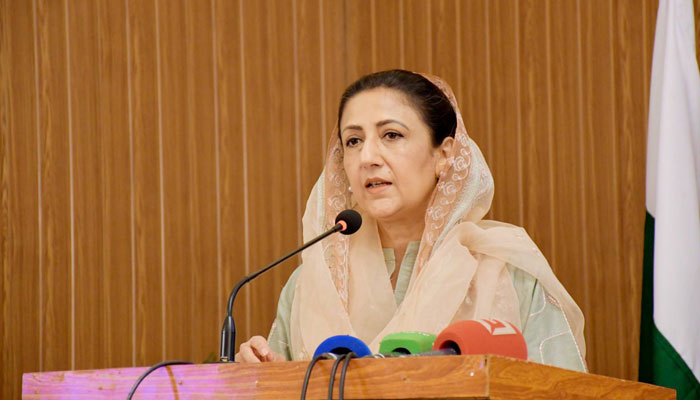
Islamabad:Dr Shezra Mansab Ali Khan Kharal, Minister of State for Climate Change and Environmental Coordination, speaking on Pakistan’s climate diplomacy priorities has called attention to the global financing gap as the injustice of climate change cannot be overstated.
Dr Kharal was giving a pre-COP seminar on 'Resource-conflict nexus' as part of a strategic lead-up to COP30 in Brazil under its 'Strengthening Regional Climate Resilience' programme organised here by Institute of Regional Studies (IRS).
Dr Kharal opined that the countries who have emitted the most must step up. She highlighted new national policies including Carbon Market Policy 2024, National Adaptation Plan 2025, Green Taxonomy 2025 and blended finance models that her Ministry is actively working towards implementing. She gave an overview of Pakistan’s upcoming COP30 focus on finance, just transition and agency for the Global South. She also proposed the formation of regional task forces led by think tanks such as IRS.
Senator Sitara Ayaz, Secretary-General, International Parliamentarians Congress (IPC), who chaired the session, urged regional cooperation on shared environmental risks like glacier melt, smog and heatwaves, stating that the climate has no borders. She stressed the need to sensitise parliamentarians and build governance frameworks that reflect the realities of a warming fragmented world.
Dr Khalid Mehmood Shafi, Director Environmental Security, ISSRA-NDU, described climate change as a security threat, emphasising the role of militaries in adaptation and the urgency of including military emissions in global datasets. Abdulhadi Achakzai, CEO, Environmental Protection Trainings and Development Organisation (EPTDO), Afghanistan, highlighted Afghanistan’s rising climate vulnerability from droughts to flash floods and widespread water scarcity.
Manoj Kumar Jain, renewable energy and development specialist, India, discussed how basic resources such as land, air and water are becoming flashpoints and advocated for energy transition and effective resource governance to prevent green conflict.
Faheem Sardar, economic security expert, analysed the geopolitical dimensions of climate finance emphasising Pakistan’s need for strategic clarity and practical, smart negotiations given its wealth of mineral resources. Nadira Panjwani, philanthropist and development advocate, traced the long arc of resource conflicts from ancient rivalries to contemporary disputes over the Indus waters.
Jauhar Saleem, President, IRS, reiterated the critical role of institutional dialogue. Reflecting on recent extreme weather in Islamabad, he warned that finite resources and escalating conflict are converging dangerously, stating that we must understand not only what resources we have, but how they are to be distributed, governed and contested.







-
 Blake Lively Breaks Silence After Judge Dropped Her Major Claims Against Justin Baldoni
 -
 Queen Camilla, King Charles ‘private Date Nights’ Laid Bare By Insider
 -
 Tom Brady Reveals How Family Life Changed His Strict Diet
 -
 King Charles Powerful Enough To Stop Emerging ‘WW 3’ With US Visit
 -
 Meghan Markle Melts Hearts With Thoughtful Gift To Friend After Baby Arrival
 -
 Kylie Kelce Explains Why She Doesn't Like Losing Control
 -
 King Charles Decides To Skip Easter Message
 -
 King Charles ‘ridiculous’ Pranks On Staff Spilt By Butler
 -
 Jamie Lee Curtis Recalls 'harshest' And 'most Beautiful' Week Of Her Life
 -
 Prince Harry Talks About ‘hard Days’ As He Discusses Social Media
 -
 Camila Morrone: Dua Lipa 'lookalike' Hits New Heights After Netflix Series
 -
 Blake Lively Lawsuit Against Justin Baldoni Takes Dramatic Turn After Judge's Ruling
 -
 Royal Maundy Service 2026: King Charles And Queen Camilla In Pictures
 -
 Chris Pratt Shares Sad Update About 'Jurassic World'
 -
 Gucci Mane Robbery, Kidnapping: DoJ Makes Statement On Pooh Shiesty And Big30 Involvement
 -
 Why King Charles Gave Meghan Markle ‘ultimate Refusal’