
Citizens struggle as govt withdraws subsidies
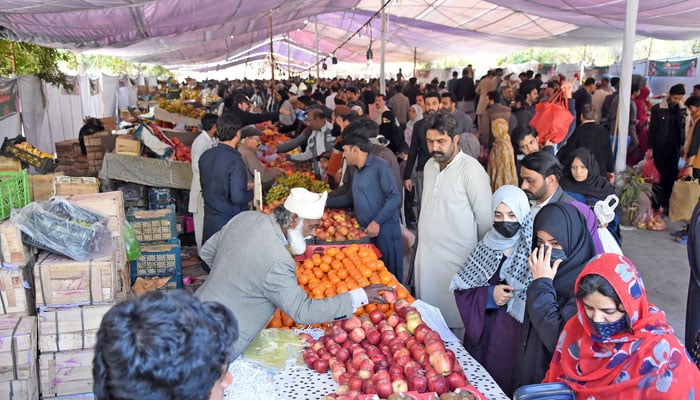
Rawalpindi:For the first time, people in Rawalpindi observed the holy month of Ramazan without any relief or subsidized essentials. Low-income families returned empty-handed from Utility Stores Corporation (USC), where the government had previously provided staple food items such as flour (atta), ghee, pulses, gram flour (besan), rice, and sugar at discounted rates. This year, however, the poor found themselves knocking on every door for help—only to be met with disappointment—despite the government’s claims of ensuring maximum relief during Ramazan.
In previous years, the Punjab government established Ramazan Sasta Bazaars to provide affordable essentials. However, this time, the local administration failed to set up even a single dedicated relief bazaar. Instead, three existing markets—Haidri Chowk Bazaar, Shamsabad Bazaar, and Chur Bazaar—were merely rebranded as Ramazan Sasta Bazaars, though prices remained exorbitantly high. These three markets had been operational for over a decade, serving as regular marketplaces for residents. Without any official relief package, the concept of Sasta Bazaars was reduced to a mere label. It is worth noting that in previous years, the local administration, on the directives of the Punjab government, had set up six designated Ramazan Sasta Bazaars at Adiala Road, Chungi No. 22, Gulzar-e-Quaid, Committee Chowk, Chakri Road, and Khayaban-e-Sir Syed. Along with the three regular bazaars, a total of nine subsidized markets were operational. This year, however, not a single one was established.
Assistant Director Agriculture (ADA) and Bazaar In-Charge Muhammad Jabbar confirmed to The News that the local administration did not establish any new Ramazan Sasta Bazaar in Rawalpindi this year. "We simply declared three existing markets as Ramazan Sasta Bazaars. Without subsidies from the Punjab government, how could we provide affordable essentials?" he stated. He added that while the Punjab government claimed to offer Rs10,000 in cash relief to poor families, no direct relief was provided in the form of subsidized food items.
However, a critical question remains: how many people actually received the Rs10,000 relief? Estimates suggest that only 5% of eligible families benefited, while the remaining 95% were left to struggle with skyrocketing prices. In 2024, the federal government withdrew all subsidies on essential food items at USC outlets, leaving millions of impoverished citizens without access to affordable groceries. Previously, the government provided subsidies on five key staples: flour, ghee, sugar, pulses, and rice. The abrupt discontinuation of these subsidies forced people to face unbearable price hikes.
For instance, the price of 1 kilogram of subsidized ghee surged from Rs380 to Rs450, while branded ghee in the open market was being sold at Rs570. A 10-kilogram bag of subsidized flour, which previously cost Rs648, now sells for Rs820. The price of 1 kilogram of subsidized sugar jumped from Rs109 to Rs160. Rice prices climbed from Rs320 to Rs340 per kilogram, and pulses witnessed a sharp increase—Daal Chana rose from Rs240 to Rs400 per kilogram, Daal Moong from Rs310 to Rs330, and white channa from Rs355 to Rs380. Similarly, gram flour (besan), which was available at USC stores for Rs220 per kilogram, now costs Rs400 in open market shops.
For many, USC had been a refuge from inflation. Now, it offers little to no difference in price compared to the open market.







-
 'Mortified' Princess Eugenie, Beatrice Plan Interview To Finally Speak Truth In Sarah Ferguson, Andrew-Epstein Scandal
 -
 Lewis Hamilton Spent Years Trying To Catch Kim Kardashian's Attention?
 -
 Royal Strategy Revealed As King Charles, Prince William Issue Statements On Andrew Row
 -
 Inside Will Smith's Struggle To Revive His Career After Infamous Oscar Incident
 -
 What’s Coming Out Of Meghan Markle’s War Against Prince William? Inside People’s Unease
 -
 Australia Seeks Urgent Meeting With Roblox Over 'Disturbing' Content Complaints
 -
 Epstein Case: Ghislaine Maxwell Invokes Fifth, Refuses To Testify Before US Congress
 -
 Ferrari Luce: First Electric Sports Car Unveiled With Enzo V12 Revival
 -
 Chappell Roan Parts Ways With Wasserman Music Over CEO's Ties With Epstein
 -
 Andrew Mountbatten Windsor Publically Shamed After Brother And Nephew Change Decades Old Royal Rule
 -
 Jon Stewart On Bad Bunny's Super Bowl Performance: 'Killed It''
 -
 Savannah Guthrie Receives Massive Support From Reese Witherspoon, Jennifer Garner After Desperate Plea
 -
 Celebrities Take Sides As Brooklyn Beckham’s Feud With David, Victoria Heats Up
 -
 Prince Harry Reacts As Beatrice, Eugenie's Names Surface In Epstein Emails
 -
 Cyprus Joins European AI Race: What It Means For Greek LLMs And Regional Innovation
 -
 Amazon Soon To Launch 'AI Content' Marketplace, Says Report