
Two-judge bench withdraws contempt notice to SC addl registrar
Court says that there was no evidence to suggest that additional registrar had any personal interest in matter
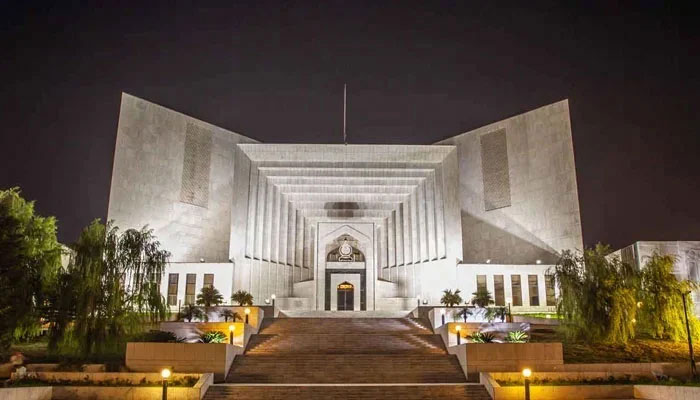
ISLAMABAD: The Supreme Court (SC) Monday discharged the show-cause notice issued to Additional Registrar (Judicial) Nazar Abbas regarding contempt proceedings and referred the matter to the chief justice of Pakistan (CJP) for convening the full court.
A two-member SC member comprising Justice Syed Mansoor Ali Shah and Justice Aqeel Ahmed Abbasi announced a reserved verdict on the show-cause notice, issued to the additional registrar (judicial) for contempt of court in a bench’s powers case.
“The alleged contemnor’s failure to fix the case before the bench specified in the court order does not constitute a contumacious act on his part and we find that he did not deliberately avoid fixation of the cases before the bench, as directed in the court order,” said a 19-page verdict.
The court held that there is no evidence to suggest that he had any personal interest in the matter or had connived with any of the parties to the case, nor did he act with the intention of causing damage to any of the parties to the case and there was no indication of mala fide intent in his actions.
The court declared that in the absence of any such factors or elements of contumacy, his conduct could not be considered contumacious, nor can it be said to have suffered from mala fides, requiring contempt proceedings against him.
“For these reasons, by accepting his explanation, the show-cause notice issued to him for contempt proceedings is discharged,” the court held.
The court noted that it has become evident from the record that in compliance with the court order dated January 16, 2025, the alleged contemner initiated a note on the same day — January 16, 2025 — regarding constitution of a special bench comprising the judges mentioned in the said order.
However, the committee constituted under Section 2 of the Act, by a majority comprising CJP Aminuddin Khan, passed an order on January 17, 2025, withdrawing the cases from the regular bench and directing that they be placed before the committee constituted under Article 191A of the Constitution for fixation before the constitutional bench.
“We find that the alleged contemner did what he could to comply with the court order. As stated in his written reply, he had no authority to constitute the bench of judges as mentioned in the court order,” the court held, adding that at the most, he could inform the competent authority, which was done by him not only in a timely manner but also with a proposal for constitution of a special bench comprising judges specified in the court order, for fixation of cases before it as directed.
“The alleged contemner’s failure to fix the case before the bench specified in the court order, therefore, does not constitute a contumacious act on his part.”
The court, however, held that the committees, constituted under Section 2 of the Supreme Court (Practice and Procedure) Act and under Article 191A of the Constitution, could not undo the effect of a judicial order and withdraw a part-heard case from a bench through an administrative order unless the bench itself refers the case to the committees for its assignment to another bench for some justifiable reason.
The court held that both the committees were not legally authorised to take administrative decisions dated January 17, 2025 in violation of the judicial order.
“In this background, it appears that the matter has to proceed further against the members of the two committees; however, judicial propriety and decorum demand that the said question be considered and decided by the full court of the Supreme Court so that it was authoritatively decided once and for all,” said the judgment.
The court noted that the matter of contempt proceedings against the registrar of a high court was treated with such gravity that a larger bench of 14 judges was convened to adjudicate upon it.
“Therefore, in our view, this issue is even more serious, warranting the collective and institutional deliberation of all judges of this court. Consequently, we refer this matter to the chief justice for convening of the full court to deliberate and decide on this important issue,” said the judgment.
The court, however, clarified that it had not referred the matter to the committee constituted under Section 2 of the Act, as its authority was limited to constituting benches of the Supreme Court, adding that the full court of the Supreme Court was constituted by the Constitution itself under Article 176.
“The distinction between the benches of a court and the full court is well-established and constitutionally recognised in the provisions of Article 203J(2)(c) and (d) of the Constitution and the responsibility of convening the full court conventionally falls within the domain of the chief justice,” says the judgment.
The court held that it was the administrative decisions of the committees that illegally nullified the judicial orders and unlawfully deprived the regular bench of its judicial power to decide the jurisdictional question raised before it.
The noted that such jurisdictional questions, as contended by Khawaja Haris Ahmad, learned amicus curie does not fall within the ambit of Clauses (3) and (5) of Article 191A of the Constitution.
As both the above questions have been answered in the negative. “We are sanguine that the office shall fix the main case i.e. CPLA No. 836-K of 2020, etc., before the original three-member bench comprising Syed Mansoor Ali Shah, Ayesha A. Malik, and Irfan Saadat Khan, in the first week of February 2025.”
The court noted that the three-member bench that passed the order dated January 13, 2025 was not deliberating on the constitutionality of the law challenged in those cases but was addressing the jurisdictional question, which every court inherently has the power to adjudicate.
The court further noted that the bench, which had previously referred such cases to the constitutional bench, was confronted with the principles governing a court’s inherent power to decide jurisdictional questions.
“When the argument was prima facie supported by the referred precedents of the cases of Pir Sabir Shah, Fazlul Quader Chowdhry and Marbury, the bench decided to adjudicate the jurisdictional matter after obtaining full assistance from the learned counsel for the parties, and the cases were adjourned to allow for further preparation and assistance on the jurisdictional issue”, says the judgment.
The court held that in Pir Sabir Shah case, the court addressed the jurisdictional question of whether appeals filed before it under Section 8-B of the Political Parties Act, 1962, were competent and whether that provision was ultra vires the Constitution.
“Similarly, in Fazlul Quader Chowdhry, the court dealt with the question of whether Clause (4) of Article 224 of the 1962 Constitution, which barred all courts from questioning the validity of constitutional amendments, was ultra vires the Constitution,” the court held adding that the principle emerging from these cases is that if a dispute arises concerning a court’s jurisdiction over a particular matter, the court has the power to hear and determine that dispute—even if its conclusion leads to the finding that it lacks jurisdiction.
The court noted that based on this principle, the bench that passed the order dated January 13, 2025 was acting within its jurisdiction, adding that if ultimately, it had determined that Article 191A validly excluded its jurisdiction, it would have transferred the cases to the constitutional bench in accordance with Clause (5) of Article 191A of the Constitution, and would not have proceeded to address the matter of the constitutionality of the law challenged in those cases. Before parting with the judgment, the court acknowledged and appreciated the invaluable assistance rendered to it by all the learned amici curiae, especially on such short notice.







-
 'Buffy' Star Nicholas Brendon's Death Case Takes Massive Turn
 -
 FKA Twigs Takes Legal Stand Against Ex Shia LaBeouf
 -
 ‘Progressive’ Kate Middleton Snubs Outdated Royal Etiquette
 -
 Kylie Kelce Explains Why She Avoids Raising Kids With 'silver Spoon'
 -
 Meghan Markle Is Above Royal Family ‘empty Threats,’ Says Insider
 -
 Anne Hathaway Opens Up About 'defeated' Feeling As Working Mom
 -
 Shamed Andrew Should Testify In Epstein Case As ‘act Of Service’
 -
 What Really Happened Before Nicholas Brendon Was Found Dead At Home?
 -
 Sarah Ferguson Branded ‘most Famous Missing Person’ In UK Right Now
 -
 Why King Charles Does Not Need A Driving License? Expert Reveals
 -
 Did Graham Norton Really Sign NDAs For Taylor Swift’s Wedding?
 -
 ‘Polite’ King Charles Treats Staff Better Than ‘boorish’ Andrew
 -
 Princess Beatrice's Husband Raises Eyebrows With Deleted Instagram Post
 -
 Dua Lipa 'snubs' Priyanka Chopra
 -
 Will Taylor Frankie Paul Still Get Her 'Bachelorette' Salary?
 -
 'Harry Potter' Returns: First Glimpse Of HBO's New Series