
Govt mulls changing buyback tariff for solar rooftops
Gross-metering mechanism may replace existing net-metering system
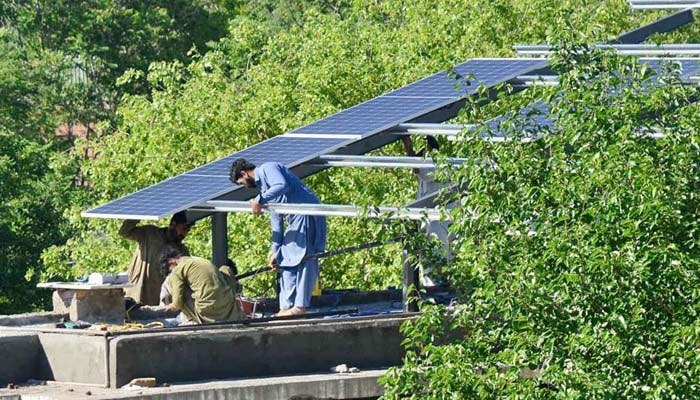
ISLAMABAD: The government is planning to change the buyback tariff of solar rooftop consumers as the existing net metering system has put a colossal burden of Rs103 billion on the system which has been passed to consumers having grid electricity only.
Under the new policy, the national grid will buy electricity from rooftop solar consumers at Rs8-9 per unit instead of the current rate of Rs21 per unit. More importantly, the gross-metering mechanism may replace the existing net-metering system.
As per the existing tariff, those who have installed solar systems on their roof under the net-metering system, are selling their units to the grid at Rs21 per unit, but during the night-time or rainy days, they get electricity from the grid at the rate of Rs42 per unit. This means those who are connected to the grid under a net metering system are getting back their whole investment on their solar panels in 18-24 months’ time.
“The relevant authorities want the introduction of the new policy under which solar consumers will get back their investment on rooftop solar panels in 4-5 years, not in two years,” one of the top officials of the Energy Ministry told The News.
The gross metering differs from the net metering in terms of the working strategy. In gross metering, the electricity that is produced by the solar system, one cannot use it directly. Two electric meters operate in this regard. The first one allows the export of all the generative electricity to the grid station, while the other calculates the units of imported electricity. The tariff prices of both electric meters are different from each other. The prices of the units that import are higher as compared to the units that export. Therefore, one cannot get a zero electricity bill. One has to pay at least a little, but not a zero.
The net metering first fulfills the system’s desire and provides the required load, and then it is fed back to the grid station if the system generates an excessive amount of electricity. It takes a little electricity from the grid station only when solar does not produce electricity. The gross metering exports all the generated electricity to the grid at very low rates, and one will purchase these units at an official price. The profit margin in this system is very, very low. Therefore, it is not suitable for solar systems.
The official document about the impact of net metering on the system available with The News reveals that the high-income strata of society followed by the upper middle class took advantage of the policy and managed to install solar systems on their roofs and are now enjoying the cheaper electricity with a payback period of 18-24 months of their total investment. However, this system has caused a burden of Rs103 billion on the system owing to which the system has passed this burden in the form of Rs1.03 per unit in the tariff on to those who are not using net-metering system, as they are unable to install rooftop solar panels. “This is how the high-income groups are benefiting from the policy and underprivileged consumers are paying more in the tariffs.”
Officials said they are going to finalise the new solar policy, maybe, in the month of February under which the gross metering system may be introduced and the buyback tariffs would be decreased to Rs8-9 per unit as the solar prices have come down and the new solar power plants are now being installed at Rs8-9 per unit per the bids for the solar power plant which K Electric has received. “So the government has decided that those who will have solar panels systems on their roofs will sell units to the grid at Rs8-9 per unit under the gross-metering system.”
According to the government report available with The News, in 2024, the high-income consumers have transferred the burden of Rs103 billion to the underprivileged consumers just because of the government’s inability to come up with policy intervention on time.
The official documents reveal that the high-income strata of society, living in posh areas in 8 big cities of the country, has taken advantage of the decreasing prices of solar technology and not only managed to scale down their electricity cost by 35 percent per month, but they caused the transfer of the burden of the Rs103 billion to consumers who have not installed rooftop solarisation systems.
The top mandarins of the Power Division feared if the new policy is not introduced on time, then in the next 10 years, the burden on the system because of the existing rooftop solar policy would escalate to Rs503 billion, which would be passed on to poor consumers. “We have pinpointed the flaws of the existing policy to top decision-makers, but the government because of the political compulsions is showing hesitance from bringing the required changes in the existing policy.”
When contacted, the spokesman of the Power Division responded, “The figures of Rs102 billion in 2024 are correct as per data and the estimated 10 years burden figures of Rs503 billion is also correct and we are working on a viable plan to rationalise it to the reasonable benefit of all stakeholders.” However, when asked, if the government is planning to decrease the rates of rooftop solar power from Rs21 to Rs8-9per unit while selling to the grid, he said that a viable plan to avoid the burden on grid consumers in the future is on cards.
However, as per the documents, in the year, 2021, there were connections of solar net metering of 321 MW of electricity which have now increased to 3,277 MWs in three years in 2024. The official documents also show that solar connections with net metering can go up to 12,377 MWs of electricity by the year 2034.
The documents also reveal that 80 percent consumers of Lahore, Karachi, Islamabad, Gujranwala, Faisalabad, Multan, Peshawar, Sialkot and Rawalpindi have joined the net metering system. So far the net metering consumers have increased to 226,440 in numbers which are just 0.6 percent of the total electricity consumers that stand at 37 million.
Experts say that the responsibility rests with the government to change the existing policy to save consumers which fall in lower middle and under-privileged class. The experts also opine that the solar system facility should be continued but there is a need to make it non-exploitative and balanced.
Keeping in view the evolution to the solar technology making it further cheaper, the tariff of rooftop solar panels should be decreased accordingly. Here comes the role of NEPRA, which should come forward on its own and lower the rooftop solar rates as per the dwindling prices of the solar panels in the market.







-
 Real Reason Why Meghan Markle Wants To Shift Base Closer To Hollywood
 -
 JoJo Siwa Reflects On Family Bond As She Celebrates 'best Year' With Beau Chris Hughes
 -
 Sarah Ferguson Leaves Los Angeles Amid Fears Of Epstein Investigation
 -
 Shamed Andrew Has Divided ‘loyalties’ Within The Royal Family
 -
 Prince Harry Gets ‘gut Punch’ Amid String Of Legal Matters
 -
 Justin Bieber Drops Heartfelt Message For Wife Hailey, Son Jack On Coachella Stage
 -
 Andrew Still Considered Important Part Of Royal Family Despite Charles, William Clear Distance
 -
 James McAvoy Gets Candid About Hollywood Fears Of Aging And Why He Is Not Losing Sleep
 -
 Where Is Sarah Ferguson Now? Insider Weighs In Amid King Charles, William’s Confusion
 -
 Prince William Takes Big Step To Prevent Prince Harry-like Struggles For His Kids
 -
 Scarlett Johansson Exposes Hollywood's Dark Past: 'It Was Tough'
 -
 Prince Harry’s Friend Hits Back Against ‘spiteful’ Agenda Against Army Vet
 -
 Prince Harry Lays Bare Thoughts About Andrew’s ‘shameful Scandal’: ‘With A Young Woman!’
 -
 Justin Bieber Coachella Moment Goes Viral Over YouTube Use
 -
 UK Watchdog Rushes To Evaluate Risks Of Anthropic’s Latest AI Model
 -
 New ‘GDI’ Metric Tracks Which Countries Lead AI Race