
Shehbaz launches ambitious five-year plan to revitalise economy
"Uraan Pakistan" aims to achieve sustainable export-led economic growth
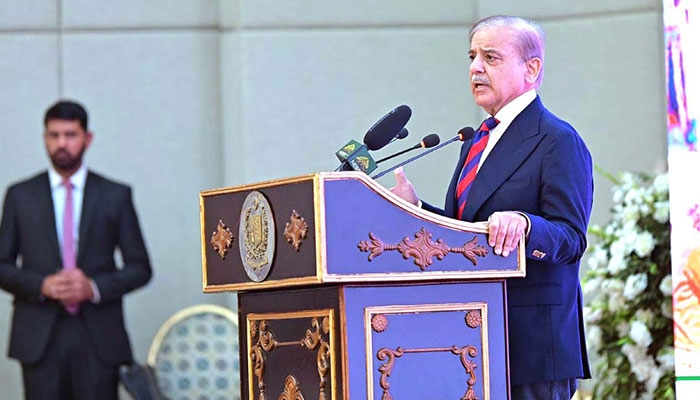
ISLAMABAD: Prime Minister Shehbaz Sharif has unveiled “Uraan Pakistan,” a comprehensive five-year National Economic Transformation plan aimed at revitalizing Pakistan’s economy. This homegrown initiative seeks to attract a staggering $10 billion in annual foreign investment, while also fostering a conducive environment to stimulate local investment.
The ‘Uraan Pakistan’ aims to achieve sustainable export-led economic growth based on 5Es – exports, e-Pakistan, environment, energy, equity, and empowerment. It aims for a sustainable GDP growth rate of six percent by 2028, one million jobs annually, and $10 billion in private investment per year. Prime Minister Shehbaz Sharif launched the logo, website and book on Uraan Pakistan. Shehbaz said the five-year plan’s success, which specifically focuses on developing IT, agriculture, exports and mining and mineral sectors, was linked with national unity, political harmony and collective efforts by all stakeholders, including political parties, institutions and people. “Privatization and outsourcing are vital to save huge losses for which political dialogue is utmost necessary,” he said. He also reiterated his call for the Charter of Economy among the political parties, as both the political and economic stability were interlinked.
Deputy Prime Minister and Foreign Minister Ishaq Dar, Finance Minister Muhammad Aurangzeb, Minister for Planning Ahsan Iqbal, other federal ministers, Balochistan and KP governors, Punjab Chief Minister Maryam Nawaz Sharif, provincial ministers, diplomats, businessmen, experts and professionals were also present at the event.
He said the homegrown national economic plan (2024-29) would focus on boosting growth through targeted investment and reforms. “The journey from instability to development and from stability to a strong economy has witnessed several challenges,” he said. He credited achieving macroeconomic stability due to the teamwork of the federal cabinet, deputy prime minister, provincial chief ministers and institutions. He particularly mentioned that he had never experienced the kind of cooperation that he received from the Chief of the Army Staff. He recalled that in 2023, the government struggled hard to conclude the IMF programme. To avert default, it was the PMLN and the coalition partners who sacrificed their politics over national interests. At the same time, he also mentioned how the leadership of a political party made a futile attempt to sabotage the IMF programme.
Shehbaz also advocated a Charter of Economy among the political parties, as both political and economic stability are interlinked. He also referred to the prudent economic policies of former Prime Minister Nawaz Sharif saying said ex-Indian Prime Minister the late Manmohan Singh adopted them to overturn the Indian economy. He also defended re-negotiations with IPPs saying that it was time the elite class also sacrificed for the country. He noted that sustainable development could not be achieved with costly electricity saying that he wished to cut taxes by 10 to 15 percent. Furthermore, inputs would have to be made cheaper, investment would have to be encouraged and import curbs would have to be removed to encourage competition, efficiency and export-led growth.
Addressing next, Deputy Prime Minister Ishaq Dar recalled that in 2013, when Pakistan was on the verge of default, the PMLN government under the leadership of former prime minister Nawaz Sharif worked hard to bring the country out of the crisis. He said in 2017, the economy posted 6% growth, and inflation was as low as 4pc. The government that won elections based on three Es (electricity, economy, extremism), delivered successfully and achieved all the three Es. Dar pointed out that the PDM government, led by PM Shehbaz Sharif, brought the country out of default situation. “All we need to do is unity, and hard work, and Prime Minister Shehbaz Sharif is leading from the front,” DPM Ishaq Dar said.
Federal Minister for Finance and Revenue, Senator Muhammad Aurangzeb said the plan is accompanied by a comprehensive implementation mechanism to hit the export target of $60 billion by fiscal year 2028. He said that Prime Minister Shehbaz Sharif established a delivery unit to coordinate the implementation of sectoral plans and roadmaps. He said Pakistan recorded a fiscal surplus for the first time in 24 years, inflation reduced from 38 percent to 5 percent, policy rate came down from 22 percent to 13 percent while Pakistan’s stock market at present is second best performer in the world. Aurangzeb said that the five-year plan would stimulate the private sector, exports and optimise the public debt.
He said the plan is to achieve 6 percent annual GDP growth by 2028. The finance minister said tax reform is the hallmark of this five-year programme through which the government wants to achieve 13.5 percent tax-to-GDP ratio. He said the transformation of Federal Board of Revenue (FBR) and the separation of tax policy from tax collection were government priorities. He said exploration of new markets, diversification of exports and lowering the exchange rate were the keys to sustainable export-led economic growth.
Aurangzeb said that after 24 years, we achieved a sustainable economic surplus and a foreign account surplus in the current fiscal year 2024-25 . He said the journey for sustainable economic growth has started, adding all the economic indicators were showing positive results.Minister for Planning Ahsan Iqbal described the Special Investment Facilitation Council (SIFC) and CPEC-5Cs (Corridors) framework as two ‘golden opportunities’ for Pakistan to transform its 5E framework into a reality. “They are very well aligned with our 5Es (Exports, Equity and Empowerment, E-Pakistan, Environment & Climate Change, and Energy and Infrastructure) framework, and are helpful in its implementation,” he said.
Under this segment of the 5Es, he said macroeconomic reforms for export-led economic growth would be implemented, along with efforts to augment productivity, quality and innovation for global competitiveness, improve investment climate, diversify product mix and market access, promote SMEs, entrepreneurship, and cluster-based development and enhance the national brand – Made in Pakistan.


