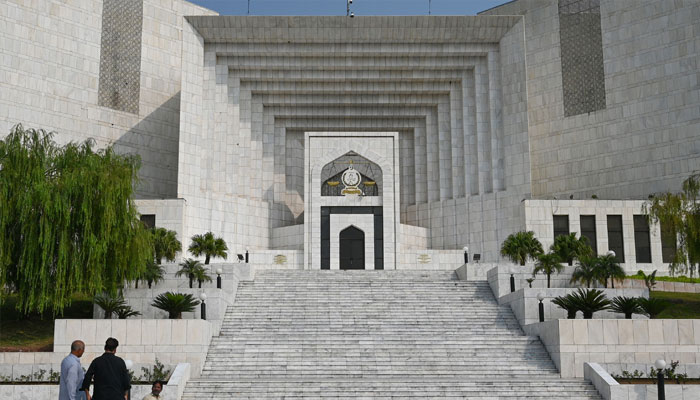
The Supreme Court (SC) has proposed amendments to civil and criminal laws and called for introducing effective case management for early disposal and cleaning of the backlog of both civil and criminal cases.
Issuing judgment with regard to a property dispute, the SC’s two-member bench comprising Justice Mohammad Ali Mazhar and Justice Syed Hasan Azhar Rizvi observed that mere criticism for the sake of criticism, either for exploitation or seeking mileage, does not resolve the glitches from any system unless some concrete and sincere efforts are made for improvisation, with inventiveness, to eliminate the deficiencies which, most of the time, become instrumental in the delay of disposal.
The apex court observed that the function of the court is to administer substantial justice between the parties after providing ample opportunity for hearing which is a significant component and virtue of a fair trial, whereas the procedure serves as a machinery with the object of facilitating and not obstructing the administration of justice.
The SC observed that it ought to be construed liberally and, as far as possible, technical objections should not be allowed to defeat substantial justice. The apex court observed that by and large, the criticism and condemnation by the public at large for delays in the disposal of cases, particularly civil suits, is directed solely at the courts, without acknowledging that the parties and their advocates are also equally responsible and accountable for such delays.
The bench observed that frequent filing of adjournment applications is, in fact, a major cause of delay. The judgment read that there are several crucial aspects which need to be doctored for convalescing and recuperating the public confidence. The apex court observed that it is high time for courts to maintain proper in-built case management systems across the board, even at the grassroots level.
The SC proposed that the method of first in, first out ought to be incorporated in the CPC under the nomenclature of “case management” with stage-wise, dedicated timelines of each step of proceedings, including provision for case aging and time-limits for disposal of interlocutory applications from the original to the appellate stage, and it should be implemented across the board with penal consequences of non-compliance, which may include but not be limited to imposing compensatory/exemplary costs.
The bench observed that a separate chapter with the same nomenclature ought to be incorporated in the Code of Criminal Procedure too, with dedicated stage-wise timelines for proceedings and deciding of cases by the courts from the trial to the appellate stage.
The SC observed that if such proposed chapters are made part of the statutes, it will really not only become a laissez-faire for fast-moving disposal of cases in accordance with the law, but also make it easier for the high courts to ensure compliance with certain norms of accountability (both in civil and criminal cases) under their jurisdiction of superintendence, while vetting monthly or quarterly disposal reports submitted to them by the subordinate judiciary.
The apex court observed that the proposed amendments, if brought in, will also strengthen the confidence of the public in the judiciary and prove to be a milestone, if implemented staunchly and unwaveringly, surely with positive results in the early disposal and cleaning of the backlog of both civil and criminal cases by the courts with the help of the fraternity of lawyers/litigants.
The apex court also invited the attention of the federal and provincial legislature and leave it to their fine sense of judgment and wisdom to consider the matter at hand, which has great significance and a direct impact on the expeditious and prompt flow of the administration of justice.
The SC observed that under the Article 202 of the Constitution, subject to the Constitution and law, the high court may make rules regulating the practice and procedure of the court or of any court subordinate to it, while under the Article 203, each high court has been conferred and vested with the powers to supervise and control all courts subordinate to it.
The SC observed that it is the need of the hour, rather a pressing priority, to incorporate a proper stage-wise case management system in the CPC, from the date of admission of suit till its culmination with dedicated timelines for stage-by-stage proceedings to be complied with, by the courts and parties both.
The bench observed that in exercise of the powers conferred under the Articles 202 and 203 of the Constitution, the high courts can also frame and amend the rules to make the system more effective and meaningful for its subordinate judiciary.
The court observed that a certain timeline is also required to be integrated in the Code of Criminal Procedure Code 1898 (CrPC) where much of the delay is only caused due to the non-submission of the reports under the Section 173 of the CrPC, and even if a report is filed by the investigation officer, much time is consumed by the courts for framing of charge for the reason that it is not properly regulated or controlled with any dedicated timeline of completing the tasks of framing of charge, completion of evidence and recording statements of the accused under the Section 342 of the CrPC.
The apex court also directed its office to send a copy of judgment to the attorney general of Pakistan, advocates general of all the provinces and Islamabad, and the secretary of the Law & Justice Commission of Pakistan to bring this matter to the attention of those in the corridors of power in the larger public interest.