
Modern pressures burden Pakistan’s donkey business
Jittering donkey carts have long been essential for aftermarket transport from megapolis’s south wholesale bazaars
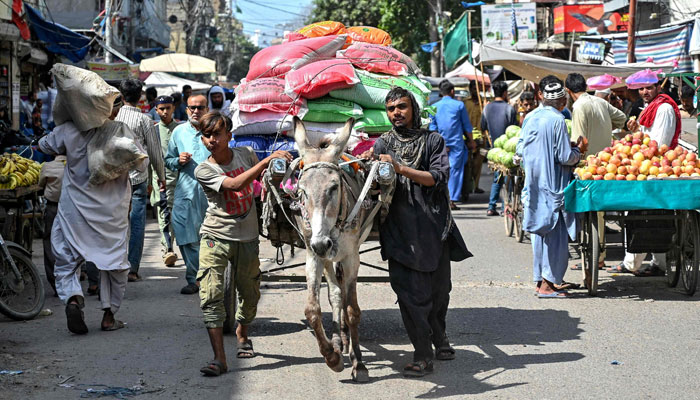
KARACHI: Droves of braying donkeys were once the backbone of country’s commercial hub Karachi, but growing upkeep costs and the surging sprawl of the city are putting them out to pasture.
Jittering donkey carts have long been essential for aftermarket transport from the megapolis’s south wholesale bazaars, nested in narrow streets preventing regular vehicles from accessing their trove of wares.
For low-income workers, the beasts of burden provided a path to financial stability — their resilience, low overheads and integral role guaranteeing a modest and stable profit to live off.
But punishing inflation has made feed costly whilst the city has exploded in size, accommodating around 50 times more people today than before the country’s independence in 1947, with vast distances testing the animal’s limits.
“We continued the work of our fathers, but I want my kids to study and do something else,” said Mohammad Atif, the warden of a donkey called Raja — meaning “King”.
The 27-year-old spends up to 750 rupees ($2.70) on hay for Raja per day. It used to cost just 200 rupees, the same amount Atif pays for a plate of food he splits with a colleague on increasingly common slow days.
“Now you can’t make a living in this line of work,” Atif told AFP in the colonial-era Bolton Market where everything from spices and water to cutlery and construction equipment is sold.
A good shift may earn him up to Rs4,000, far short of the expenses of his dependents and donkey.
There are just shy of six million donkeys in the country, according to government estimates, one for every 40 people in the country.
Local animal broker Aslam Shah told AFP the majority were in Karachi, which exploded into a megacity of more than 20 million people after mass migration in the partition of Pakistan and India.
But the 69-year-old said they’re no longer a desired commodity at an animal market held each Sunday.
“Sometimes weeks and months go by without us selling a single one,” he said.
Bolton Market springs to life at mid-morning as shopkeepers lift their shutters, and housewives in apartments above lower baskets from their balconies to collect orders of foodstuffs.
As customers prepare to leave, post-sale negotiations begin on who will win the work of hauling shopping away. But most donkey carts are empty with their owners and animals idle.
The carts were once so dominant on roads that the government issued them licence plates.
But the metropolis has sprawled with expressways and overpasses off-limits to animal carriages.
“I have been told there is lots to carry and that I would have to travel to the other side of the city to deliver goods,” said 21-year-old Ali Usman, in envy of a three-wheeled motorised rickshaw being loaded with rice sacks.
“It will take me three to four hours,” he said. “In this time, the rickshaw will have made two trips so the work has not been given to me.”
Noman Farhat, a wholesaler at Empress Market, built in 1884, said he tries to give some work to donkey owners every day — a small act of mercy despite their impracticality.
“They are a part of our culture, and I would be loathe to see them go out of business,” he said.
One Karachi animal welfare activist who asked to remain anonymous said increasingly long journeys and poor road conditions are knackering the animals.
“Due to a lack of resources, donkey owners use rope or a piece of cloth in place of proper harnesses leading to severe chaffing and skin wounds,” she said.
Mistreatment can also cause muzzle mutilation that restricts eating, she said.
But some stubbornly believe donkeys will remain at the heart of the city.
“Despite the harsh conditions they often face, these animals are an essential part of the informal economy,” said Sheema Khan, manager of Benji Project animal shelter.
“It is still the cheapest form of transport,” she said.
At a wholesale market, pointing to his two sons and grandson loading rice and wheat onto their carts, Ghulam Rasool is inclined to agree. “This work will never end, it will endure till doomsday,” said the 76-year-old.
“So what if there are two or three days of no work? There will always be someone who needs us.”






-
 Costco $20 Rule Explained As Employee Pay Climbs Across North America
 -
 Strange Incident Happened At Nancy Guthrie's Home On Abduction's 10th Day
 -
 Tumbler Ridge School Lockdown Underway As RCMP Investigate School Shooting
 -
 Britney Spears Quietly Parts Ways With Her Music Catalog: Report
 -
 Princess Diana Bodyguard Suspected ‘she Could Die’: Here’s How
 -
 King Charles Makes It ‘absolutely Clear’ He Wants To Solve Royal Crisis
 -
 Royal Family Warned To ‘have Answers’ Amid Weak Standing
 -
 Marc Anthony On Why Bad Bunny’s Super Bowl Show Mattered
 -
 Kid Rock Gets Honest About Bad Bunny’s Performance At Super Bowl
 -
 Kylie Jenner Reveals Real Story Behind Her 'The Moment' Casting
 -
 Jaafar Jackson Breaks Silence On Becoming Michael Jackson
 -
 Eva Mendes Reveals One Costar She Envied Ryan Gosling Over
 -
 Halsey Marks Fiancé Avan Jogia's Birthday With Emotional Note
 -
 China: Stunning Drone Show Lights Up Night Sky Ahead Of Spring Festival 2026
 -
 Andrew's Epstein Scandal: Will King Charles Abdicate Following King Edward's Footsteps?
 -
 Billy Joel Leaves Loved Ones Worried With His 'dangerous' Comeback