
Nuclear power has helpful role to fight global warming: IAEA chief
DUBAI: It would be a mistake to reject nuclear power because of problems at a handful of projects, Rafael Grossi, head of the International Atomic Energy Agency said in an interview with AFP.
Grossi was speaking at the COP28 conference in Dubai, where 20 countries led by the United States called Saturday for nuclear power capacity to be tripled by 2050 to fight global warming.
Supporters of atomic power say it is an essential source of reliable emissions-free energy. But detractors point to the risks and high costs of massive nuclear projects at a time when the price of renewable energies continues to fall.
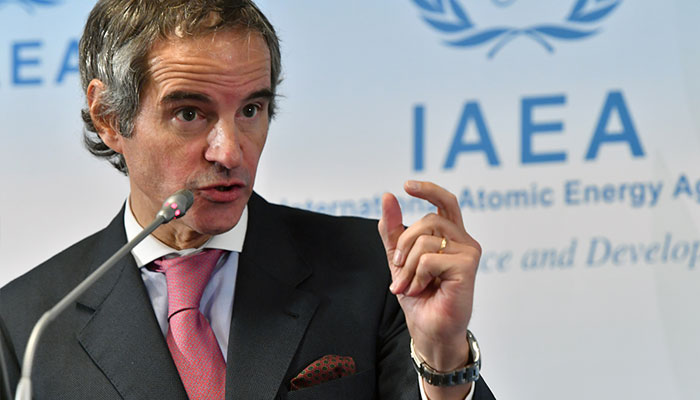
“There is work to do,” Grossi admitted, citing the financing needs of countries that wish to extend their nuclear plants, such as Brazil, Argentina, and South Africa.
Grossi said countries tempted to take the nuclear leap, including Morocco, Senegal, Kenya and the Philippines, face similar challenges.
“There are statutes in some international lending organisations that exclude financing for nuclear,” the Argentinian director general said. “I think that is completely obsolete. It does not correspond to any scientific or technological criteria.” The World Bank, for instance, has not financed a nuclear project since 1959. “I think, and I hope there will be an evolution” in their thinking, Grossi said.
Some environmentalists argue that with certain nuclear projects already 10 years behind schedule, they are simply too costly and will not be ready in time to respond to climate challenges.
But rejecting all nuclear projects because of these setbacks would be “an error”, Grossi insisted. “Look, here in the Emirates... there was no nuclear here a decade ago and now there are four reactors,” meeting about a quarter of the country´s electricity demands.
The nuclear industry is resting much of its hopes on small modular reactors (SMR), which are less powerful but easier to construct. There are concerns that less developed countries might not have the means to keep these installations safe and avoid proliferation. “It is a legitimate question, but that is why we were created,” Grossi responded, pointing to the flag of his agency, which carries atomic symbols on a United Nations blue background.
“Any country wanting to develop a nuclear programme must follow a full procedure and draw up an agreement with the Agency,” he said. “In principle, that means the risk of proliferation should not exist.”
For example, the Emirates had to complete 19 steps while developing its civil nuclear programme, including setting up an independent supervisory body.







-
 Kate Hudson Explains Why Acting Isn't Discussed At Home
 -
 Prince William, Kate Middleton Epstein Statement Was AI Generated, Says Expert
 -
 Sarah Ferguson On Her Way To Hurt 'only Two People Who Care About Her'
 -
 World’s Top PC Maker Sounds Alarm Over Memory Chip Shortage
 -
 King Charles Is ‘clearly Worried’ Andrew Has Tarnished Royal Image
 -
 Royal Family Loses 'loyal' Worker After King Charles Disliked His Work?
 -
 James Van Der Beek's Quiet Sacrifice Before Death Comes To Light
 -
 Suspect Kills Six Across Florida Before Taking His Own Life
 -
 AI Helps Researchers Identify 2,000-year-old Roman Board Game Stone
 -
 Inside Kate Middleton, Prince William’s Nightmare Facing Andrew Mountbatten-Windsor
 -
 Margaret Qualley Shares Heartfelt Confession About Husband Jack Antonoff: 'My Person'
 -
 Savannah Guthrie Shares Sweet Childhood Video With Missing Mom Nancy: Watch
 -
 Over $1.5 Million Raised To Support Van Der Beek's Family
 -
 Paul Anthony Kelly Opens Up On 'nervousness' Of Playing JFK Jr.
 -
 Diana Once Used Salad Dressing As A Weapon Against Charles: Inside Their Fight From A Staffers Eyes
 -
 Video Of Brad Pitt, Tom Cruise 'fighting' Over Epstein Shocks Hollywood Fans