
Chevron to buy US Hess for $53 billion in latest oil megadeal
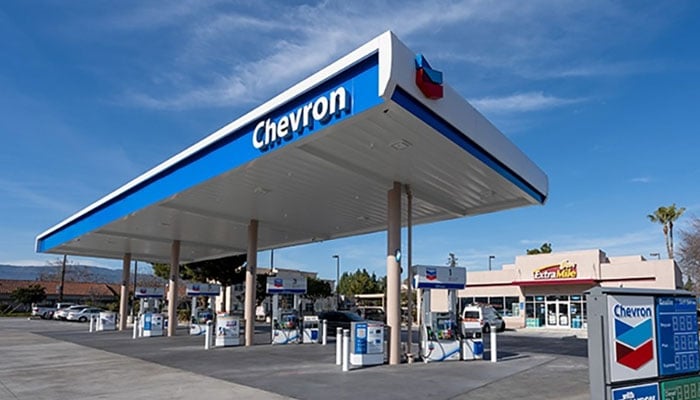
LONDON/NEW YORK: Chevron has agreed to buy US oil and gas producer Hess in a $53bn all-stock deal, doubling down on its bet that demand for fossil fuels will remain robust for decades to come.
The deal — the biggest in Chevron’s history — gives Hess an enterprise value, including debt, of $60 billion and delivers the supermajor a foothold in Guyana, home to the biggest oil discovery of the past decade.
It comes as a rush of merger and acquisition activity begins to sweep through the US energy sector as companies look to deploy the bumper profits created by the energy crisis. Chevron’s rival ExxonMobil agreed to acquire Texas shale producer Pioneer Natural Resources earlier this month for an enterprise value of $64 billion.
Mike Wirth, Chevron chief executive, said the oil industry was entering a consolidation phase and the Hess deal offered the company a “unique and compelling opportunity” to bulk up its offshore presence through the Guyana assets while also entering the Bakken shale formation of North Dakota, a prolific though declining basin.
“Ours is an industry, especially as you get into the shale patch, that was due for some consolidation,” he said on Monday. “We’ve got too many CEOs per BOE [barrels of oil equivalent] when you look across the whole spectrum.”
Shares of Chevron, the second most valuable western oil producer, with a market capitalisation on Friday of $318 billion, fell 3 percent. Shares in Hess, whose market capitalisation was $50 billion, rose 0.3 percent. The proposed sale price represents a 10 percent premium over the average of Hess’s shares over the previous 20 days, but only a 5 percent premium over its close on Friday.
The oil and gas industry is facing an uncertain future as developed countries attempt to sharply reduce their reliance on fossil fuels. But Chevron and ExxonMobil, the US energy majors, have bet heavily on what they argue will be the long-term resilience of oil and gas demand.
The stance is in contrast to some European energy majors, such as BP and TotalEnergies, which are increasing investments in renewable energy at a faster pace than their US peers.
The Hess acquisition will increase Chevron’s oil and gas output by more than 10 percent. Chevron produced almost 3mn barrels of oil equivalent a day in the second quarter, while Hess produced 387,000 boepd — up from 344,000 in 2022 as production has increased in Guyana.
Alex Beeker, analyst at Wood Mackenzie, said Chevron’s purchase of Hess helped to diversify Chevron’s portfolio of oil assets, which until now have been very concentrated in the Permian Basin of Texas and New Mexico.
“Chevron, when compared to Exxon and the European majors, is underweight deepwater assets and they have been looking for a while to spread out this concentration risk,” he said.
In an interview with the Financial Times that took place last month, Wirth defended the company’s plans to continue growing its output of oil and gas, arguing that Chevron was “not selling a product that is evil. We’re selling a product that’s good.”
He criticised forecasts from the International Energy Agency, the developed world’s energy watchdog, showing fossil fuel demand peaking before the end of this decade.
“I don’t think they’re remotely right,” Wirth told the Financial Times. “You can build scenarios, but we live in the real world, and have to allocate capital to meet real-world demands.”
Hess’s assets include a 30 per cent stake in a 6.6mn-acre, 11bn-barrel offshore oil exploration scheme in Guyana — where ExxonMobil is the lead operator — and the 465,000-acre Bakken shale project.
Hess’s chief executive John Hess, who is expected to join Chevron’s board, said the merger would create a “premier integrated energy company”.
The relatively small premium for Hess partly reflects the fact its shares were close to an all-time high, according to analysts. John Hess’s change of heart regarding a sale may be another reason.
“Hess has been touted as a potential target for the supermajors for some time. It had been mainly the stance of John Hess as a non-seller that was perceived as the reason why this has not happened before,” said Mark Kelly at MKP Advisors. “Entering his 70th year, it seems he has got to the point where he sees [the] transition [of] Hess to a new ownership structure is appropriate.”
Analysts said they did not expect significant antitrust issues with the deal, given the limited overlap between the companies’ assets.
Guyana’s production has soared from nothing before 2019 to an average of 260,000 barrels a day last year, according to the US Energy Information Administration, and is expected to approach 480,000 b/d next year. Wood Mackenzie forecasts peak production of 1.5mn b/d of production by 2033 — more than that of many Opec countries.
As part of the deal, which is expected to close in the first half of next year, Chevron said it would issue about 317mn shares. The companies estimated cost savings of about $1bn within a year of closing, while Chevron said it expected to increase asset sales and raise proceeds of between $10bn and $15bn by the end of 2028, before tax. The combined company’s capital expenditures would be between $19 billion and $22 billion.
Prior to the announcement, Wirth had told the FT that big deals were “more difficult today”, noting that companies were better run than they were when Chevron bought Texaco for $36 billion in 2000. “Could it happen? I think it probably could,” he said, but he highlighted the regulatory and integration challenges associated with big deals.







-
 Chloe Bailey Recalls Hilariously ‘toxic’ Behavior After She Caught Ex Cheating
 -
 Lil Wayne Apologizes To Fans After Skipping His Own Concert
 -
 1.7 Million Planned Satellites Could Devastate Astronomy, Scientists Warn
 -
 OpenAI Seeks To Hand Trump Administration A 5% Stake Under New Proposal: Here’s Why
 -
 Sadie Sink Names Famous Shakespeare Character She Is 'really Drawn To'
 -
 Jennifer Aniston's Latest Post Says It All About Jim Curtis Romance
 -
 Karlie Kloss Shares Rare Insights Into Her Relationship With Trump Family
 -
 Judge Dismisses Taylor Frankie Paul's Ex Tate's Restraining Order Request: Here's Why
 -
 'Next Gen NYC' Star Ava Dash Sets Record Straight On Kyle Cooke Dating Rumors
 -
 'Malcolm In The Middle' Star Frankie Muniz Announces Split From Wife Paige
 -
 'KPop Demon Hunters' Star Arden Cho Ties Knot With Surgeon Fiance
 -
 Country Music Star Battling Cancer Opens Up About Personal Struggles
 -
 Chloe Bailey Makes Honest Confession About Comparisons With ‘Little Mermaid’ Star Halle
 -
 Drake Heads To Classroom But Not To Take Classes: Here’s Why
 -
 Kanye West Beats Exhaustion With Insane Work Ethic Leaves Fans Speechless
 -
 Prince Harry Still ‘craves’ Protection As UK Trip Turns Uncertain