
Dollar hits all-time high at Rs185.23
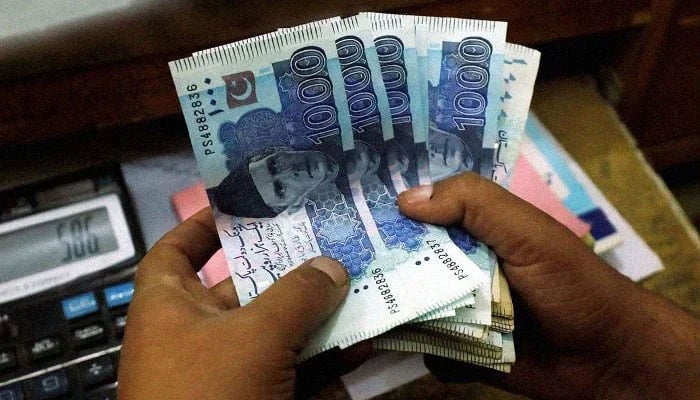
KARACHI: The rupee weakened to a new record low against the dollar on Tuesday, as investors worried about the political situation and economy, adding pressure on the central bank to rescue the falling currency.
Traders said the rupee hit an all-time low at 185.40 per dollar in the interbank market. By the end of trade, it had pared losses and closed at Rs185.23. It ended at Rs184.09 on Friday. The local unit depreciated by 1.14 rupees or 0.62 percent.
Analysts said the country’s persistent political turmoil and a weak economic outlook would further drag on the rupee in the coming days. The local unit had lost 4.4 percent versus the greenback since the beginning of March and fallen 17.33 percent this fiscal year.
The rupee dropped by 0.53 percent against the dollar in the open market. It marked a fresh record closing low of 186.50 to the dollar, compared with 185.50 in the previous session. The statement from the International Monetary Fund that it would engage with the new government on policies failed to calm investors’ nerves.
The pressure is mounting on the State Bank of Pakistan to intervene to stop the rupee’s dive. But analysts said the central bank was unlikely to defend the currency and that support for the rupee would come from building up of the foreign exchange reserves, and the early resolution of the constitutional crisis and the formation of the caretaker government who would take difficult and unpopular decisions and negotiate with the IMF for the revival of a $6 billion loan programme.
After being recovered from the pandemic, the economic growth moderated to a sustainable pace. However, the delay in a deal by the IMF to disburse over $960 million in funds to the country amid IMF’s reservations about the prime minister’s relief package and amnesty scheme, and political tension after the National Assembly dissolution have created uncertainties, especially about the economy.
The foreign exchange reserves held by the SBP had declined 19.5 percent to $12 billion in the week ending March 25. These reserves were enough to pay 1.82 months of imports. “There is an overwhelming pressure on the rupee. Deteriorating reserves, outflow of portfolio investment, the highest expected current account deficit of $20 billion and now the IMF postponing its programme and current tranche are all adding up,” said Eman Khan, an analyst from Tresmark, which tracks financial markets.
“While the Central Bank is currently not intervening, absence of leadership at the government level means the SBP will be reluctant to use its precious dollars to defend the currency,”Khan said.
“The currency market is one way right now, and without any significant inflows expected in the coming days,” Khan said and added the rupee is expected to fall further. “It seems like the Central Bank is only controlling the rate of fall without giving it major support. Negative real interest rates, lack of dollar supply and rising inflation have also become headwinds for the currency.”
Zafar Paracha, secretary-general of Exchange Companies Association of Pakistan (ECAP), said all eyes were on the Supreme Court of Pakistan on how it tackled the constitutional crisis that had political and economic implications for the country.
“The pressure on the rupee will continue till the political crisis is eased,” Paracha said. “Even the rupee is on its losing streak, the rupee has not been too volatile, as it was in the past. This is just because of the SBP’s efforts.”Paracha added.
Inflation rose to 12.7 percent in March from 12.2 percent in the previous month. The nine-month FY2022 inflation clocked in at 10.8 percent, compared to 8.3 percent in the same period last year.
High global commodity prices and the external debt payments have depleted forex reserves and the current account and trade deficits are widening. Trade gap increased 70 percent year-on-year to $35.39 billion in July-March FY2022. The current account deficit reached $12.1 billion in July-February. That compared with a surplus of $994 million in the same period last year.
Pakistan default risk as measured by five-year credit default swaps is also increasing, as the political turmoil is causing losses to the country’s bonds and currency. The rollover of the syndicated loan facility from China is being processed and is expected shortly, according to the SBP.
The United Arab Emirates has also rolled over $2 billion debt for one year. These debt rollovers are expected to stabilise the forex reserves and help ease pressure on the local currency.


