
Sudan frees several civilian leaders
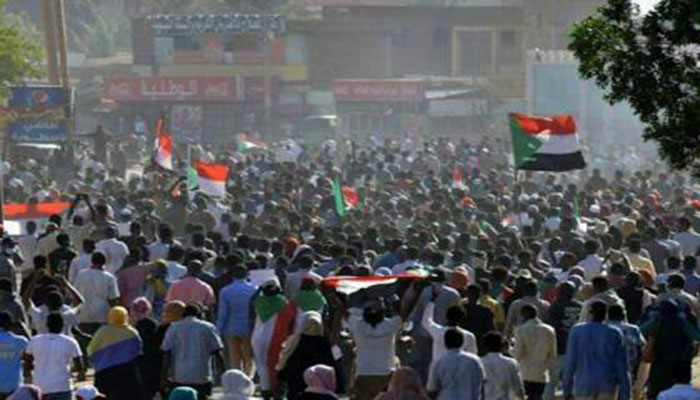
KHARTOUM: Sudanese authorities have released several civilian leaders detained since last month’s military coup, one of the former captives said on Monday, amid efforts to restore a fragile transition process towards full democracy.
"I was released late yesterday evening," following a deal to reverse the military takeover, the head of Sudan’s Congress Party, Omar al-Degeir, who was among civilians arrested in the army’s October 25 power grab, told AFP.
"I was in solitary confinement and completely cut off from the world throughout this period." The Congress Party, however, slammed Sunday’s deal, saying it "explicitly legitimised the continuation of the coup regime".
Other civilian politicians were also released, including Sedeeq al-Sadiq al-Mahdi of the Umma Party, Sudan’s largest political group. Prime Minister Abdalla Hamdok’s advisor Yasser Arman, a leading figure of Sudan’s mainstream civilian bloc, Forces for Freedom and Change, was among those freed, according to Degeir.
But other key civilian figures and ministers deposed in the coup have yet to be freed. Top general Abdel Fattah al-Burhan last month declared a state of emergency and ousted the government, in a move that upended a two-year transition to civilian rule.
It triggered a wave of mass street protests in which at least 41 people have been killed, according to a pro-democracy doctors’ union. But on Sunday, Hamdok -- who had been placed under effective house arrest -- was released.
He and Burhan then formally signed the 14-point deal that provided for the premier’s reinstatement and for political detainees to be freed. However, analysts warn the move simply "whitewashes" the coup, as it remains unclear how much power Hamdok’s government will yield.
The cabinet will moreover still be under oversight of a ruling council led by the military. Thousands of demonstrators in multiple rallies rejected the deal, shouting, "No to military power" and demanding that the armed forces fully withdraw from government.
The deal was welcomed by the international community, including the United Nations and African Union, as well as the so-called Troika of Britain, Norway and the United States. It was also greeted by Saudi Arabia and Egypt, which have strong ties with the Sudanese military.





-
 Sweden's Princess Sofia Explains Why She Was Named In Epstein Files
 -
 Activist Shocks Fellow Conservatives: 'Bad Bunny Is Winner'
 -
 Noel Gallagher Challenges Critics Of Award Win To Face Him In Person
 -
 Minnesota Man Charged After $350m IRS Tax Scam Exposed
 -
 Meghan Markle 'terrified' Over Possible UK Return
 -
 Did Opiate Restrictions Lead To Blake Garrett's Death?
 -
 Royal Expert Reflects On Princess Eugenie, Beatrice 'priorities' Amid Strained Relationship With Sarah, Andrew
 -
 Prince William's 'concerning' Statement About Andrew Is Not Enough?
 -
 50 Cent Gets Called Out Over Using Slur For Cardi B
 -
 Scientists Discover Rare Form Of 'magnets' That Might Surprise You
 -
 Nancy Guthrie’s Kidnapper Will Be Caught Soon: Here’s Why
 -
 AI Innovation Could Make Trade Secrets More Valuable Than Patents, Says Billionaire Investor
 -
 King Charles Heckling: Calls For 10 BAFTAs And A Knighthood For Sign Language Interpreter
 -
 Royal Expert On Andrew, Sarah Ferguson’s ‘entitled’ Behaviour Since Marriage
 -
 Kim Kardashian Leaves Meghan Markle 'upset' With Latest 'cheap Shot'
 -
 Instagram And YouTube Accused Of Engineering Addiction In Children’s Brains