
Kulbhushan Jadhav’s case: Justice Seth’s verdict benefited Pakistan in ICJ
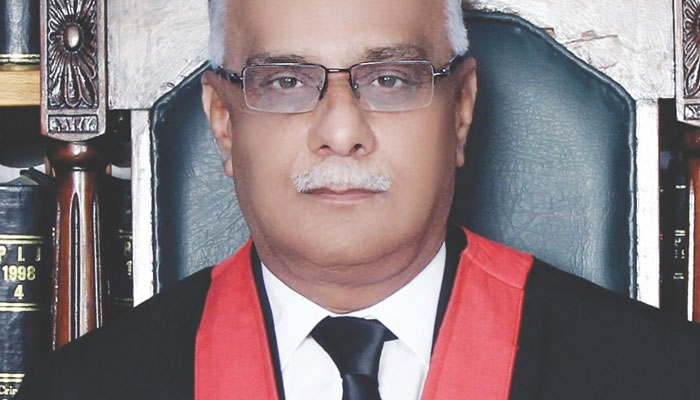
ISLAMABAD: A landmark judgement of the Peshawar High Court (PHC) Chief Justice, Waqar Ahmad Seth, who is under severe attack from the government for handing death sentence to Pervez Musharraf, had greatly helped Pakistan in the verdict delivered by the International Court of Justice (ICJ) in Indian spy Kulbhushan Jadhav’s case.
The ruling, authored by Justice Seth as part of a two-judge bench, which was pronounced in November 2018, had set aside military courts imposed sentences of 74 convicts, 50 of them have been awarded death penalty. The judgement profusely quoted from several Supreme Court judgements to back up its finding to order release of the accused.
The Imran Khan government had produced the judgement in the ICJ to establish that the sentences imposed by the military courts were subject to review by the superior courts. One of the reasons, the ICJ cited for not quashing the capital punishment given to Kulbhushan Jadhav by a military court was that the review was being done by Pakistan’s superior judiciary and an apt example was the verdict written by Justice Seth.
Accordingly, the ICJ only suspended and did not strike down Kulbhushan Jadhav’s death sentence as the spy too has the right to seek review.
In its July 17, 2019, judgement, the ICJ said that it takes note of the 2018 PHC decision, which, it added, held that it had the legal mandate positively to interfere with decisions of military courts “if the case of the prosecution was based, firstly, on no evidence, secondly, insufficient evidence, thirdly, absence of jurisdiction, finally malice of facts & law” (Abdur Rashid et al. v. Federation of Pakistan, High Court of Peshawar, Writ Petition 536-P of 2018, 18 October 2018, pp. 147-148).
The Pakistan government has appealed the decision and the case was still pending at the close of the oral proceedings in the present case, it pointed out.
The judgement also said that the Pakistan’s counsel assured the ICH that the high court’s exercise “effective review jurisdiction”, giving as an example, the 2018 PHC decision. The ICJ points out that respect for the principles of a fair trial is of cardinal importance in any review and reconsideration, and that, in the circumstances of the present case, it is essential for the review and reconsideration of the conviction and sentence of Jadhav to be effective.
It considers that the violation of the rights set forth in Article 36, paragraph 1, of the Vienna Convention, and its implications for the principles of a fair trial, should be fully examined and properly addressed during the review and reconsideration process. In particular, any potential prejudice and the implications for the evidence and the right of defence of the accused should receive close scrutiny during the review and reconsideration.
The ICJ verdict further said that the court takes full cognizance of the representations made by Pakistan. During the oral proceedings, the Agent of Pakistan declared that the Pakistan Constitution guarantees, as a fundamental right, the right to a fair trial; that the right to a fair trial is “absolute” and “cannot be taken away”; and that all trials are conducted accordingly and, if not, “the process of judicial review is always available”.
It said while acknowledging that the PHC judgement appears to have taken “a broader view”, India stresses that the Pakistan government has filed an appeal against that judgement and that the Supreme Court has suspended its operation pending the appeal.
According to the ICJ verdict, Pakistan maintains that the appropriate remedy in this case would be, at most, effective review and reconsideration of the conviction and sentence of the accused, taking into account the potential effects of any violation of Article 36 of the Vienna Convention. Islamabad referred to the decision rendered by the PHC in 2018, which set aside more than 70 convictions and sentences handed down by military courts. Pakistan contended that its domestic legal system provides for an established and defined process whereby the civil courts can undertake a substantive review of the decisions of military tribunals, in order to ensure procedural fairness has been afforded to the accused, and that its courts are well suited to carrying out a review and reconsideration that gives full weight to the effect of any violation of Article 36 of the Vienna Convention.


