JI rally highlights menace of drug addiction afflicting Rehri Goth
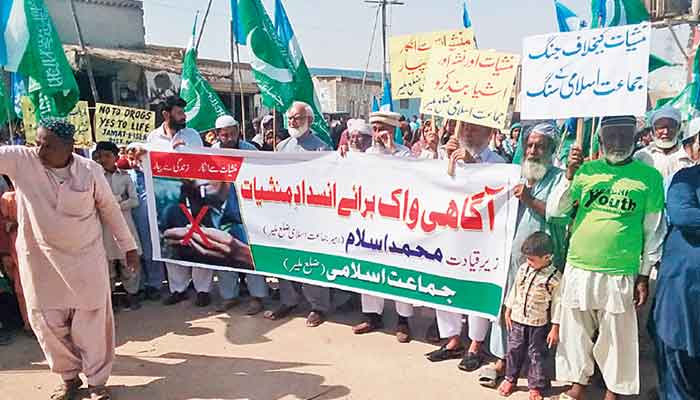
In the coastal village of Rehri Goth, a fishing settlement considered a hub of drug selling, the Jamaat-e-Islami District Malir on Sunday afternoon organised a rally aimed at pressuring the authorities and police to take action against drug peddling and to create awareness.
After restructuring its organisation in the city by splitting it in ten districts last month, the JI has been focusing on issue-based politics and agitations and Rehri Goth’s Sunday rally was a part of that.
Along with JI members across the district, a large number of residents of coastal villages of Rehri Goth, Chashma Goth and Ibrahim Haidri joined the rally to show their support to the campaign against drug peddling.
Muhammad Islam, the JI’s district chief, said that the rally was part of the party’s strategy to run an effective campaign against drug peddling across the district. “District Malir is notorious for drug selling where dozens of drug dens have been operating in various parts, including Sherpao Colony, Muslim Abad, Quaidabad, Pipri, and Chashma Goth, under the patronage of the ruling Pakistan Peoples Party and police,” Islam, who also contested the National Assembly election in the last general polls from the area, told The News. “We want drug abuse to end in the district and the residents addicted to drugs should be treated at de-addiction centre.”
Residents’ response
Residents of Rehri Goth welcomed the JI’s move to raise the issue of drug peddling, which is snatching precious lives, and joined the protest in a large number. In the village, one can see dozens of drug addicts, most of them youths self-injecting heroin along the streets.
Kamal Shah, a leader who is also campaigning against drug abuse, said that around 150 people had died in Rehri Goth during the past few months because of self-injecting. “Every family here has lost a son or two to drugs as they are sold openly,” Shah told The News.
He said that other political parties did not focus on Rehri Goth and other coastal areas because they believed that they would not get votes in the general or local government polls from there.
In Rehri Goth, influential Jats, who are considered coastal fuedal lords, have been dominating politics, security and everyday life for the past several decades. They are part of the ruling Pakistan Peoples Party and Rafiq Dawood Jat is the vice-chairman of District Council Karachi, a separate borough for the city’s coastal and rural areas.
However, the JI leaders said that they are not afraid of anyone and would raise the issues of people at every cost. In the past, the JI was the only party that raised voice over the murder of a local woman activist, Mai Hawa, at the hands of influentials in Rehri Goth.
Public issues
After its failure in the general elections in 2018 and the local government polls in 2015, the JI has revamped its organisational structure and now asked its district leaders and public aid committees to raise public issues.
For several years, the JI based its party structure in Karachi on the division of the city in five districts – South, East, West, Central and Bin Qasim – which was in accordance with a former administrative division of the city. However, due to the rise in the city’s population and addition of new districts to Karachi, the party has decided to increase its districts in the metropolis from five to 10.
Islam, who heads the party in District Malir, agrees. “Our district leadership has prioritised a list of public issues, such as land grabbing and poor local government governance, and for resolving them, we will pressure the government at every forum,” he said.
Political analysts believe that it is only the JI that has raised issues of the residents of the city in the past several decades. “It is only the JI that has raised its voice for public issues, such as K-Electric’s loadshedding and overbilling, protesting against the National Database and Registration Authority for blocking national identity cards of various ethnic communities, illegal occupation of public parks in the recent past,” said Abdul Jabbar Nasir, a veteran journalist covering political parties extensively.
But he said that parties ran their politics on other issues. “The JI’s efforts at portraying itself as an entity that fights for the rights of Karachi’s citizens have not been successful in gaining them any significant amount of votes,” Nasir told The News.
He said that the JI drew its support from the Urdu-speaking middle classes, but after the emergence of the Muttahida Qaumi Movement, ethnic politics took it away from it. “It would be hard for the JI to get back its lost support base in Karachi, but its activism on public issues makes it relevant to the city’s politics,” he said.







-
 Kate Middleton Is More Relaxed In 'Wellington Boots Than Diamond Tiara'
 -
 Gaten Matarazzo Addresses Important Fans Query About 'Stranger Things'
 -
 Prince William's Latest Move Reveals Rift Is Strong With Prince Harry
 -
 Princess Eugenie Becomes Second Royal After Meghan To Feature In Viral Trend
 -
 Carol Burnett Sings Praises Of Late Jimmy Stewart: 'He Had THIS'
 -
 Kate Middleton Dashes Through Rain At Windsor Castle
 -
 Dave Filoni, Who Oversaw Pedro Pascal's 'The Mandalorian' Named President Of 'Star Wars' Studio Lucasfilm
 -
 Is Sean Penn Dating A Guy?
 -
 Sebastian Stan's Godmother Gives Him New Title
 -
 Alison Arngrim Reflects On 'Little House On The Prairie' Audition For THIS Reason
 -
 Spencer Pratt Reflects On Rare Bond With Meryl Streep's Daughter
 -
 'Stranger Things' Star Gaten Matarazzo Recalls Uncomfortable Situation
 -
 Gaten Matarazzo On Unbreakable Bonds Of 'Stranger Things'
 -
 Beyonce, Jay-Z's Daughter Blue Ivy Carter's Massive Fortune Taking Shape At 14?
 -
 Meghan Markle Fulfills Fan Wish As She Joins Viral 2106 Trend
 -
 Selena Gomez Proves Point With New Makeup-free Selfie On Social Media