
‘18% GST on solar panels a misstep’
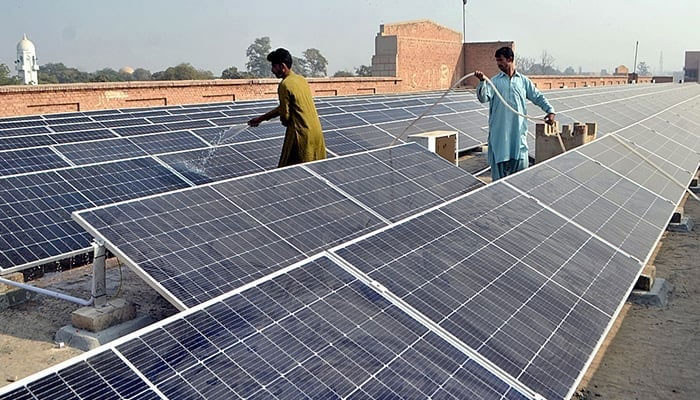
Islamabad : Dr Abid Qaiyum Suleri, Executive Director, SDPI, has said that the budget’s regressive taxation structure, particularly the 18% General Sales Tax (GST) on solar panels, is a “misstep” that undermines Pakistan’s climate ambitions and Nationally Determined Contributions (NDCs).
Dr Suleri was addressing a post-budget media briefing organised by Sustainable Development Policy Institute (SDPI) here Friday.
Dr Suleri said that this move contradicts the newly introduced carbon levy and global commitments to phase out fossil fuels.
He highlighted Pakistan’s pressing fiscal constraints saying that the government has only Rs11 trillion at its disposal amid massive debt repayments and increasing defence needs.
He said that India’s $80 billion defence budget dwarfs Pakistan’s $7 billion. The government is compelled to ramp up defence spending, especially after recent tensions with India, but this comes at the cost of development expenditure, he regretted.
The budget reflects an increase in pension expenditures over salaries and development allocations have seen cuts despite pressing needs, he added. “The allocation for dams remains ‘business as usual,’ even as the Indus Waters Treaty stands suspended. Water should be treated with the same urgency as defence,” Dr Suleri suggested.
Dr Sajid Amin Javed, Deputy Executive Director, SDPI, pointed out that the budget was designed to meet short-term IMF targets but lacked long-term structural reforms. The focus is clearly on meeting the conditions for the next IMF tranche rather than steering economic transformation, he said.
With Rs600 billion in new taxes, mostly indirect, and inflation expected to stay high, he warned that the budget will squeeze the salaried class while offering tax breaks to sectors like real estate and large retailers. The expected growth rate of 4.2% may realistically fall between 3.5% to 3.7% amid global uncertainties, particularly the Iran-Israel conflict’s impact on oil prices. Dr Amin noted that the agriculture sector, critical to Pakistan’s economy, remains underprioritised.
Dr Shafqat Munir, SDPI Deputy Executive Director, acknowledged the tough economic conditions under which the budget was framed, stating that every government tries to cut the cloth according to the size. He welcomed the 6% budget allocation for climate-related commitments and the 8.6% of development funding directed at climate adaptation. However, he pointed out the contradictions that jmposing 18% GST on solar panels while introducing a carbon levy of Rs2.5 per litre sends mixed signals.
Highlighting the global decline in humanitarian aid, he urged Pakistan to invest in anticipatory resilience and disaster risk reduction, calling this budget the first to meaningfully acknowledge climate impacts.







-
 Alicia Keys Celebrates 25 Years Of Breakout Single ‘Fallin’’
 -
 Akinola Davies Jr. Gives His Immigrant Parents A Shoutout In 2026 BAFTAs Acceptance Speech
 -
 Princess Beatrice, Eugenie Told 'first Thing They Should Do' After Andrew Arrest
 -
 Jennifer Garner Reveals What Her Kids Think Of Her Acting Career
 -
 Prince William Should Focus On 'family Business' After Andrew Blunder
 -
 Katherine Schwarzenegger Pratt 'brought To Tears' By Sister-in-law's Gesture
 -
 Prince William Makes Bold Claim About Britain's Creative Industry At BAFTA
 -
 Andrew Mountbatten Windsor Insulting 'catchphrase' That Degarded Staff
 -
 Kate Middleton, Princess Beatrice 'undercurrent Tension' Comes To Surface
 -
 'Grey's Anatomy' Alum Katherine Heigl Reveals Why She Stayed Silent After Eric Dane Loss
 -
 Host Alan Cumming Thanks BAFTAs Audience For Understanding After Tourette’s Interruption From Activist
 -
 Jennifer Garner Reveals Why Reunion With Judy Greer Makes Fans 'lose Their Minds'
 -
 Chris Hemsworth Makes Shocking Confession About His Kids' Reaction To His Fame
 -
 Wiz Khalifa Reveals Unconventional Birthday Punch Tradition With Teenage Son In New Video
 -
 BAFTAs 2026: Kerry Washington Makes Debut In Custom Prada Gown
 -
 Jennifer Lopez Gets Emotional As Twins Max And Emme Turn 18