
Pak N-deterrence remains cornerstone of stability: NCA Adviser Kidwai
Pakistan’s conventional deterrent, particularly its air force, has become central to regional deterrence dynamics
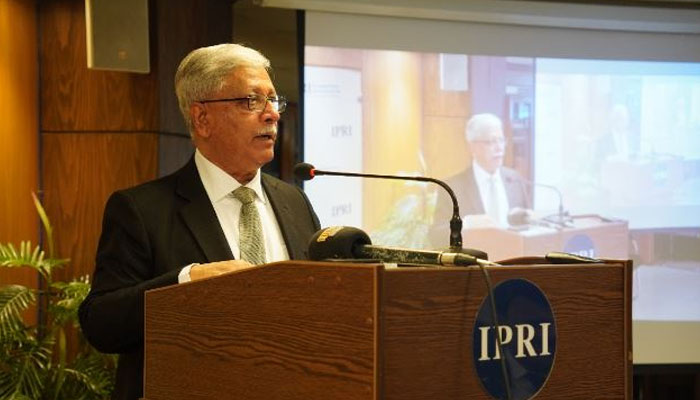
ISLAMABAD: Discussing India’s so-called ‘New Normal’ doctrine, Advisor to the National Command Authority (NCA), Lieutenant-General (retd) Khalid Ahmed Kidwai, on Wednesday described the 87-hour conflict as a critical test of both conventional and nuclear deterrence, as well as the role of modern technologies in contemporary warfare.
Speaking at an event marking the 27th anniversary of Pakistan’s nuclear tests, Lt-Gen Kidwai — also the former Director General of the Strategic Plans Division (SPD) — reaffirmed that Pakistan’s nuclear capability remains the cornerstone of its national security, ensuring strategic stability and restoring balance in South Asia.
Addressing a seminar at the Institute of Strategic Studies Islamabad (ISSI), Kidwai emphasised that the defining feature of the evolving strategic landscape in South Asia is the reversal of regional air superiority. He asserted that the Pakistan Air Force (PAF), through its decisive performance, advanced Chinese technology, and integrated multi-domain tactics, emerged as the dominant air power in the region. This marked shift validates Pakistan’s conventional deterrence as a credible and effective complement to its robust nuclear arsenal.
Outlining the core tenets of what he termed the “new normal” in South Asia’s strategic environment, Kidwai stated: “Air superiority has decisively shifted in Pakistan’s favour”, with the PAF now leading as the dominant regional air power.
Pakistan’s conventional deterrent, particularly its air force, has become central to regional deterrence dynamics. Pakistan’s credible nuclear capability continues to constrain India’s political and military manoeuvrability, thereby ensuring strategic stability. Any Indian aggression will be met with a calibrated, escalated response — as promised by Field Marshal Asim Munir under the doctrine of ‘quid pro quo plus’.
India’s recurring pattern of seeking ceasefires following intense Pakistani retaliation has become a consistent outcome. International diplomatic interventions are expected to continue playing a role in de-escalating crises and preserving stability. Pakistan reserves the right to respond conventionally to any terror attacks, reflecting a reciprocal posture in line with India’s own declared doctrines.
Kidwai further emphasised that Pakistan’s nuclear weapons programme remains a bedrock of its national security and a guarantor of peace and stability in South Asia. He pointed to two key moments where India’s BJP-led government tested Pakistan’s resolve: the airstrike on mainland Pakistan in February 2019 and the incursion into Azad Kashmir in May 2025. In both instances, he noted, India was strategically outmanoeuvred, reaffirming the credibility of Pakistan’s deterrent posture—both conventional and nuclear.
He concluded by highlighting Pakistan’s unwavering commitment to safeguarding its sovereignty amid emerging technological threats and regional instability. Despite the strategic shift favouring Pakistan, Kidwai also stressed the importance of dialogue. He urged both Pakistan and India to seize the diplomatic opening provided by former US President Donald Trump’s initiative and to engage in meaningful talks to resolve long-standing disputes.
Former foreign secretary and ISSI Director General, Ambassador Sohail Mahmood, recalled Pakistan’s decisive response to India’s nuclear provocations in 1998, which re-established deterrence and restored strategic balance in South Asia. He emphasised that Pakistan’s nuclear journey was not a matter of choice, but a necessity born of existential security imperatives.
Ambassador Mahmood highlighted Pakistan’s responsible conduct as a nuclear-armed state over the past 27 years and outlined five key pillars of its national nuclear policy:
1. A credible and operationalised deterrent;
2. An impeccable nuclear safety and security regime;
3. A growing track record of peaceful nuclear applications;
4. Responsible international behaviour;
5. Consistent nuclear diplomacy aimed at combating discrimination and correcting misperceptions.
He cautioned that the regional security landscape is becoming increasingly volatile, fuelled by disruptive technologies and India’s destabilising posture — including the development of MIRVs, sea-based deterrents, and counterforce strategies.
Referring to India’s post-Pahalgam misadventure, Ambassador Mahmood praised Pakistan’s calibrated and measured response while warning of New Delhi’s strategic recklessness, driven by Hindutva ideology and electoral expediency.
He reaffirmed that Pakistan’s full spectrum deterrence under the doctrine of credible minimum deterrence ensures there is no space for aggression below the nuclear threshold.
“Deterrence is not about fear — it is about stability, responsibility, and peace through strength,” he stressed, reiterating Pakistan’s unwavering commitment to its strategic posture, exercised with clarity, restraint, and resolve to safeguard its sovereignty and maintain regional stability.







-
 Melania Trump Appears With Humanoid Robot At White House
 -
 ‘Addictive By Design’: Meta, YouTube Found Liable In Historic Verdict
 -
 Bruce Willis' Mom Marlene Makes Another Family Amid Son's Battle With Dementia
 -
 Roblox Safety Warning For Parents: Developer Says Kids Need 24/7 Monitoring
 -
 Chelsea Handler Explains Why She Dates Younger Men
 -
 Chappell Roan's Security Guard Takes 'full Responsibility' For His Interaction With Jorginho's Daughter?
 -
 Rosalía Cuts Concert Short Over Sudden Illness, Fans Shocked
 -
 'Buffy' Star Nicholas Brendon's Death Case Takes Massive Turn
 -
 FKA Twigs Takes Legal Stand Against Ex Shia LaBeouf
 -
 ‘Progressive’ Kate Middleton Snubs Outdated Royal Etiquette
 -
 Kylie Kelce Explains Why She Avoids Raising Kids With 'silver Spoon'
 -
 Meghan Markle Is Above Royal Family ‘empty Threats,’ Says Insider
 -
 Anne Hathaway Opens Up About 'defeated' Feeling As Working Mom
 -
 Shamed Andrew Should Testify In Epstein Case As ‘act Of Service’
 -
 What Really Happened Before Nicholas Brendon Was Found Dead At Home?
 -
 Sarah Ferguson Branded ‘most Famous Missing Person’ In UK Right Now