
Investors look to soft data for direction amid trade policy chaos
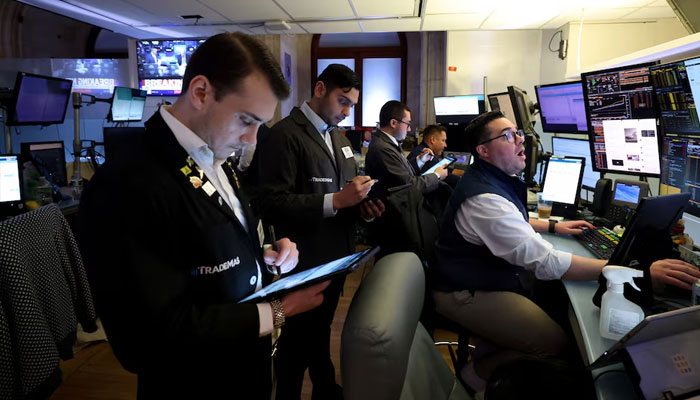
Whipsawing US trade policies are forcing some investors to lean more on anecdotal data to help them make decisions, as concrete official indicators become out-of-date too quickly in the rapidly changing environment.
Dramatic shifts in policy, such as US President Donald Trump’s tariff announcements last month, mean so-called hard indicators, including quantitative metrics like unemployment rates, job creation, retail sales and prices, are of limited use when they are released. That is prompting investors to increasingly take cues from sentiment surveys or anecdotal “soft data”, which may be more subjective but offer a more up-to-date read on conditions.
“The lack of tangible information on a real-time basis means we have to rely on what the soft data is telling us,” said Jack Ablin, chief investment officer at Cresset Capital.He said he was preparing a client presentation based almost entirely on data about consumer sentiment, investor outlook and business confidence levels. “I can’t think of too many environments that have been like this.”
Trump’s tariff plans, first announced on April 2 and modified, expanded and rescinded many times in the weeks since then, have shaken up business as usual on Wall Street. While hard data on employment and consumer prices suggest the economy remains resilient, soft data paints a different picture on consumer confidence and the level of business activity in both services and manufacturing.
Investors look at both data sources, although in times of pronounced uncertainty tilt in favour of soft data.“It’s all about the soft data: if consumers aren’t feeling good, they won’t spend and then the economy will suffer,” said Jason Britton, chief investment officer of Reflection Asset Management, adding that consumer sentiment surveys are published “in nearly real time” rather than with a lag.
“If you want to know what the future might look like, then you want to look at the soft data,” agreed Malcolm Polley, chief investment strategist for Stratos Investment Management. But he added, “don’t pay attention to it in a vacuum or it just becomes noise.”
PLAYING CATCHUP
Signals sent by hard and soft data can diverge and sometimes fail to paint an accurate picture of what lies ahead. In 2022, when consumer sentiment surveys showed plunging confidence, forecasts of a recession abounded. But a tight labour market and stronger household balance sheets meant consumers kept spending and no recession materialised. Liz Ann Sonders, chief investment strategist at Charles Schwab, expects the hard data this time around to confirm the worsening in conditions but notes there will be a lot of noise to cut through. “We’re going to see a lot of funky data that you’re going to have to go through with a fine-tooth comb,” she said. Some market participants are seeking soft data beyond traditional surveys.
“During times of uncertainty like this, every event or data point has a very large influence on prices and causes volatility,” said Campbell Harvey, a professor of finance at Duke University’s Fuqua School of Business. “So that’s why you need to go above and beyond” in the pursuit of new data inputs. Harvey is paying more attention to alternative indicators, such as those offered by Polymarket, a blockchain-backed prediction market.
Polymarket users wager on everything from the likelihood of a recession to the price of eggs. Harvey says these are worth heeding because believes such bets are made by people based on their conversations with business partners, suppliers and customers.







-
 Prince Harry Warns Meghan Markle To 'step Back'
 -
 Selena Gomez Explains Why She Thought Lupus Was 'life-or-death'
 -
 New Zealand Flood Crisis: State Of Emergency Declared As North Island Braces For More Storms
 -
 Nancy Guthrie Case: Mystery Deepens As Unknown DNA Found At Property
 -
 James Van Der Beek's Brother Breaks Silence On Actor's Tragic Death
 -
 Megan Thee Stallion On New Romance With Klay Thompson: 'I'm Comfy'
 -
 Nicole Kidman Celebrates Galentine’s Day Months After Keith Urban Split
 -
 Justin Bieber Unveils Hailey Bieber As First Face Of SKYLRK In Intimate Campaign Debut
 -
 Caitlin O’Connor Says Fiance Joe Manganiello Has Changed Valentine’s Day For Her
 -
 Rachel Zoe Sends Out Message For Womne With Her Post-divorce Diamond Ring
 -
 James Van Der Beek's Final Conversation With Director Roger Avary Laid Bare: 'We Cried'
 -
 Jaden Smith Walks Out Of Interview After Kanye West Question At Film Premiere
 -
 Michelle Obama Gets Candid About Spontaneous Decision At Piercings Tattoo
 -
 Why Halle Berry Wasn't Ready For Marriage After Van Hunt Popped Question? Source
 -
 Bunnie Xo Shares Raw Confession After Year-long IVF Struggle
 -
 Brooks Nader Reveals Why She Quit Fillers After Years