
FBR counsel will continue arguments in super tax case today
A five-member constitutional bench headed by Justice Aminuddin Khan heard the case
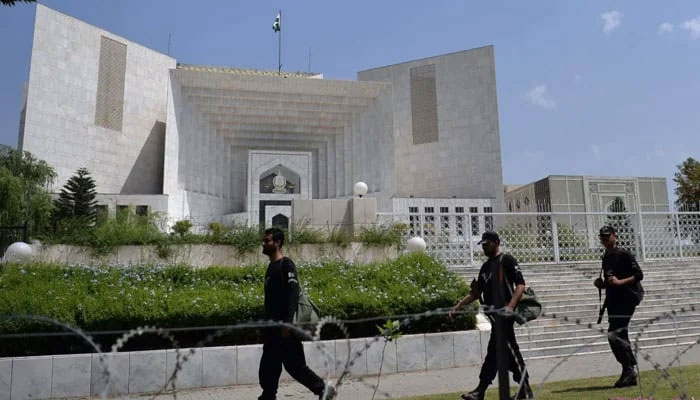
ISLAMABAD: The Supreme Court adjourned for today (Tuesday) the hearing into super tax case after the counsel for the Federal Board of Revenue (FBR) could not conclude his arguments.
A five-member constitutional bench headed by Justice Aminuddin Khan heard the case. During the proceedings, FBR’s counsel Raza Rabbani appeared before the court and submitted that he would brief the court on various points, specifically Section 4B and 4D of the Income Tax Ordinance 2001.
He argued that the Supreme Court can review tax principles and is hearing these appeals under Article 185 of the Constitution.
Justice Jamal Mandokhail asked Raza Rabbani whether the tax was imposed under Article 73 of the Constitution. Rabbani responded that the entire taxation process is laid out in Article 73 of the Constitution. He submitted that the finance committee first decides on the budget, which is then sent to the Upper House (Senate) of the Parliament for approval.
It is pertinent to mention here that Article 73 of the Constitution relates to Procedure with respect to Money Bills.Justice Mandokhail remarked that Makhdoom Ali Khan, counsel for the companies had focused primarily on Section 4B.
Rabbani clarified that Section 4B is not for local purposes but for local bodies, and it explicitly states that super tax will be used for the rehabilitation of damaged houses, with no specific region defined.
He added that super tax and income tax are different; super tax is imposed for a specific purpose. Justice Mandokhail inquired how the funds collected from the super tax are distributed and whether it can be imposed without legislation.
Rabbani responded that legislation had been passed regarding super tax, and all funds go into the federal consolidated budget.
Justice Mandokhail remarked that the usage of the federal consolidated fund is detailed in Article 75 of the Constitution, adding that during budget formation, the federal government is aware of its financial standing.
Article 75 of the Constitution talks about the President’s assent to Bills which states that when a Bill is not presented to the President for assent, the President shall, within ten days assent to the Bill or in the case of a Bill other than a Money Bill, returns the Bill to the Majlis-e-Shoora (Parliament) with a message requesting that the Bill, or any specified provision thereof, be reconsidered and that any amendment specified in the message be considered.
Rabbani submitted that the preamble of the 2016 Act mentions that the funds will go into the federal consolidated budget. Later, the court adjourned the hearing until today (Tuesday) wherein Raza Rabbani will continue his arguments.







-
 Prince William Steps In To Help Farmer's Awareness Mission
 -
 Queen Elizabeth Tied To Andrew's Sexual Abuse Case Settlement: Report
 -
 Mark Ruffalo Urges Fans To Boycott Top AI Company Boycott
 -
 Prince William Joins Esports Battle In Saudi Arabia
 -
 Princess Beatrice, Eugenie Are Being Ripped Apart: ‘Their Relationship Is Fully Fractured’
 -
 Arden Cho Shares Update On Search For ‘perfect’ Wedding Dress Ahead Of Italy Ceremony
 -
 Ariana Madix Goes Unfiltered About Dating Life
 -
 Prince William Closes Saudi Arabia Visit With Rare Desert Shot
 -
 Priyanka Chopra Breaks Silence On Rumors Questioning Marriage To Nick Jonas
 -
 'King Charles Acts Fast Or Face Existential Crisis' Over Andrew Scandal
 -
 Brooklyn Beckham Charging Nearly £300 In Ticket Cost For Burger Festival
 -
 Prince William Makes Unexpected Stop At Local Market In Saudi Arabia
 -
 Zayn Malik Shares Important Update About His Love Life
 -
 James Van Der Beek's Celebrity Pals Pen Touching Tribute After His Death
 -
 Kate Middleton, William Are Holding Onto Their Hats As Worse Gets Threatened: Behind The Veil Of Shame
 -
 British Soap Awards Scrapped Again As ITV Confirms 2026 Hiatus