
National gas network at risk as line pack pressure hits 5bcf again
Line pack data reveals how line pack pressure has increased in last nine days from April 24 to May 2, 2025
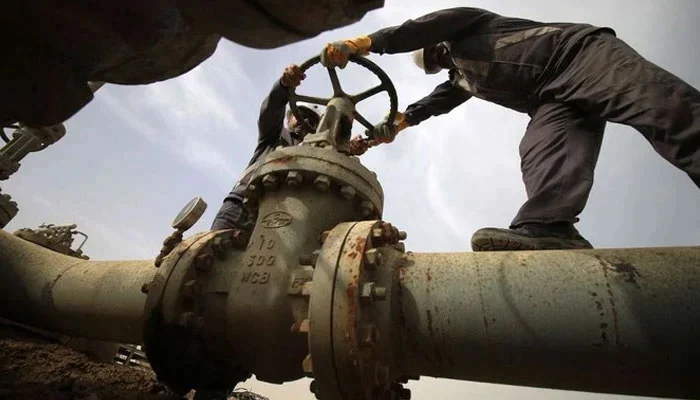
ISLAMABAD: The authorities of the Petroleum Division have alarmingly reduced the local gas intake by 264mmcfd, putting the existing gas fields at risk of losing the required natural pressure when they are made functional again.
The authorities have scaled down the local gas intake in the system to manage the gas line pack pressure which has surged again to 5.12 billion cubic feet (bcf) from 4.6 bcf, putting the existence of the whole gas transmission network of the country in extreme jeopardy.
Every month, one term LNG cargo from an Italian company, ENI, is diverted to the international market because of the massive decline in gas consumption in the country, even then the line pack has crossed the dangerous figure of 5bcf.
The exploration and production (E&P) companies have time and again cautioned the authorities that the practice of decreasing local gas flows to safeguard the gas transmission system is perilous.
The E&P companies, according to officials, argued that sometimes wells nearing depletion if compelled to reduce natural gas flows would cause irreparable damage, and the wells cannot be recharged to their original flow levels. “They require capital-intensive investment through artificial lift methods to resume production.”
In the past, the officials said, many wells braved huge damages because of the reduction in their gas outflows and they could not be recharged and this is how many E&P companies braved mammoth losses.
“Yes, we have reduced the local gas intake and are diverting one LNG cargo a month to the international market just to cope with the line pack issue, but this issue is still unresolved as line pack pressure as of today (May02, 2025) has crossed the danger figure of 5bcf.
At this pressure the national gas transmission pipeline may burst at any time putting the country’s commercial and industrial activities at halt and leading to a power outage as well, a senior official told The News.
He said, “We are left with no option but to reduce the local gas intake as the power sector is not using the RLNG for power generation against its demand.”
However, the Power Division says that it runs the RLNG-based power plants as per the Economic Merit Order (EMO). It first runs those plants, which are cheaper or must-run power plants and then comes the turn of RLNG based power plants.
Sui Northern says that continuous less RLNG consumption by the power sector against their allocation is causing high pressures across the transmission system.
The line pack data available with this scribe reveals how the line pack pressure has increased in the last nine days from April 24 to May 2, 2025.On April 24, 2025, the line pack pressure stood at 4.6 bcf with local gas intake of 718mmcf which increased to 4.8bcf on April 25 with slight reduction in local gas flow in the system to 701mmcf, but on April 26, the line pack pressure surged to 5.036bcf with more reduction of gas outflow from local gas filed to 582 bcf and from April 26 onward the line pack pressure remained over 5bcf with massive decline in local gas to just 450mmcf.
The data shows that the Power Division has decreased the RLNG gas consumption to 435 mmcf from 600mmcf as the cost of the power generation on RLNG stands at Rs26 per unit owing to which the basket price increases.
The public power sector often uses less imported gas for power generation on the plea that the hike in use of RLNG for power generation causes the increase in the power tariff in the head of monthly fuel charge adjustment.
But it is pertinent to mention that the two long-term LNG supply agreements with Qatar and one contract with ENI were inked and two LNG terminals were erected and one RLNG pipeline was laid down just for the 4 LNG power plants installed in Punjab, but the Power Division does not utilise the four RLNG power plants at the optimum level.
On top of that, export and non-export sectors in Punjab have scaled down the use of RLNG by 50 percent and in Sindh by 25 percent mainly because the cost of RLNG after the imposition of 5 per cent off-grid levy has increased to Rs4291 per MMBTU which is at $15.38 higher than the spot price in the international market.
The higher cost of RLNG for the export sector and higher price of the Power Sector coupled with low GDP growth has led to the reduction of RLNG completion by 150 mmcfd a day.
The reduction in imported gas consumption is the main cause of the line pack pressure. Qatar has already deferred the import of 5 cargos to 2026 which were to arrive in 2025 and likewise from February to June, 2025, the government has diverted 5 RLNG cargoes, one cargo a month to the international market. But the monster of the line pack issue continues to be there.







-
 Lizzo Shares Fun Story Behind Her Social Media Moniker
 -
 Prince William Expands His Plans For ‘shelter Built Homes’
 -
 Meghan Markle, Prince Harry Given ‘absolutely Nothing’ By Royals For Key Reason
 -
 Rami Malek Feels 'honored' After Receiving Standing Ovation At Cannes Film Festival For 'The Man I Love'
 -
 Kate Middleton And Prince William ‘carry The Whole Thing’ In Royal Family
 -
 Alex Rodriguez And Jaclyn Cordeiro Breakup After 3 Years
 -
 Mandy Moore Opens Up About First Marriage To Ryan Adams
 -
 Meta Settles First US Case Tied To Youth Mental Health
 -
 Timothée Chalamet’s Family Clears Up Ballet Confusion
 -
 International Court Of Justice Rules Workers Have Right To Strike Under Key Labour Law Treaty
 -
 Prince William Unveils Bold New Vision
 -
 'If I Do Attend, 'I Get Killed': President Trump On Son's Wedding
 -
 Prince William Shares Emotional Update From Cornwall Development Site
 -
 'Avatar: The Last Airbender' Season 2 Unleashes Explosive Earth Kingdom Chaos
 -
 Fans React To Netflix Ending 'Emily In Paris'
 -
 Old Kim Kardashian Video Linked To SKIMS Drug Shipment Case