
The urgency of restraint
FM highlighted deep concerns over India’s destabilising actions and inflammatory rhetoric in wake of April 22 incident
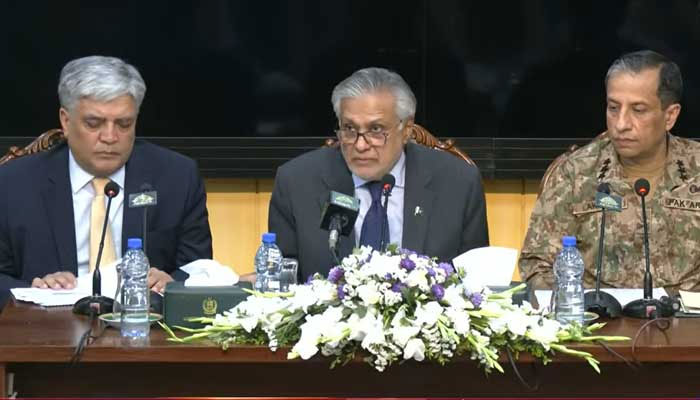
At a press briefing on Wednesday, alongside Director-General of Inter-Services Public Relations Lt-Gen Ahmed Sharif Chaudhry, Foreign Minister Ishaq Dar issued a stern warning to India, cautioning against any military misadventure. While reiterating that Pakistan would not initiate any escalatory measures, Dar emphasised that the country would respond decisively to any provocation. His remarks come amid rising tensions following the Pahalgam attack in Indian Illegally Occupied Jammu and Kashmir (IIOJK). The foreign minister highlighted Pakistan’s deep concerns over India’s destabilising actions and inflammatory rhetoric in the wake of the April 22 incident. Dar strongly condemned the targeting of innocent civilians at Pahalgam and emphasised Pakistan’s empathy, stating that a country that has suffered greatly at the hands of terrorism understands the pain such violence inflicts. He further clarified that Pakistan had, in fact, condemned the Pahalgam attack at multiple forums: “We have condemned it at the international forum where a responsible party, one of the 15 members of the UN Security Council, is present". He also said that Pakistan’s highest security forum, the National Security Committee (NSC), has also condemned it and that Pakistan has denounced terrorism in all its forms and manifestations, adding: “The prime minister issued a clear statement and even offered an independent inquiry. The suggestion that we did not condemn the attack is completely false”.
The foreign minister is right to push back against attempts to paint Pakistan as complicit or indifferent. The country has consistently condemned terrorism and expressed solidarity with the victims. Some analysts believe Pakistan was compelled to restate its position after US Secretary of State Marco Rubio urged Pakistan to denounce the attack and cooperate in an investigation. In a phone call with Prime Minister Shehbaz Sharif, Rubio reportedly emphasised the need for condemnation and de-escalation. In a separate call with Indian External Affairs Minister Subrahmanyam Jaishankar, Rubio expressed solidarity with India and advised caution. Experts suggest that Washington may be playing a mediating role to prevent conflict, amid fears that Indian Prime Minister Narendra Modi could order a cross-border strike into Pakistani territory. This concern was echoed by Information Minister Attaullah Tarar, who had said on Wednesday morning that Pakistan had “credible intelligence” suggesting India was planning a military strike within the next 24 to 36 hours. Tarar’s unusually timed statement would not have been made without serious intelligence backing.
Across the border, Modi appears increasingly boxed in by his own extremist and jingoistic narrative. Within minutes of the Pahalgam attack, Indian media outlets began pointing fingers at Pakistan and clamouring for retaliation. This kind of rhetoric only fuels tensions and threatens the fragile stability of the South Asian region. At home, India has also turned its aggression inward, targeting its Muslim minority – especially Kashmiris – with renewed hostility. This is symptomatic of a government whose anti-Muslim bigotry is no longer covert but instead is unapologetically institutionalised. The international community must recognise that Pakistan, so far, has responded with restraint, grace and a commitment to international norms. India, in contrast, continues to display belligerence. The unilateral use of force without evidence or justification is not only reckless but also illegal under international law. A war between two nuclear-armed neighbours would have catastrophic consequences, not only for the region but also for the global economy. The people of both countries would bear the brunt of any conflict, with their economies, livelihoods and futures jeopardised by the actions of a few. Both nations, particularly India, must exercise caution and responsibility. Peace, diplomacy and mutual respect remain the only viable options for long-term stability in South Asia.







-
 Prince Harry, King Charles Planning Something That ‘could Change Everything’ For Archie, Lilibet
 -
 Courtney Love Gives Rare Insights Into Friendship With Lana Del Rey
 -
 Brian Littrell Accused Of Using Homophobic Slur After Video Shown In Trespassing Dispute
 -
 From Human To Machine: 15% Of American Accept AI In Leadership Roles
 -
 Singapore Confirms First Local Spread Of Mutated Monkeypox Clade Ib Strain
 -
 Kristi Noem Claims She Was ‘blindsided By ‘crossdressing’ News: Insider Talks Suspicion
 -
 Royal Expert Lifts Lid On Why Meghan Missed Queen Elizabeth II’s Final Moments
 -
 Lily Collins Marks Quiet Milestone As 14-month-old Daughter Tove Grows Fast
 -
 Cardi B Reveals Biggest Weakness And Fans Didn't See That Coming
 -
 World Autism Awareness Day: Celebrating Different Minds, Shaping A Shared Future
 -
 Hollywood Stars Hesitant To Work With Prince Harry, Meghan Markle: Here’s Why
 -
 Cher Makes Son Chaz Bono Question His Worth With 'cheap Power Move'
 -
 Brazil Approves Law Giving Separated Couples Joint Custody Of Pets
 -
 Princesses Beatrice And Eugenie Hit With Urgent Warning Over King Charles' Invitation
 -
 RAYE Unveils Why Her ‘every Blood Cell Is Exhausted’
 -
 From AI Self-preservation To ‘peer Preservation’: New Study Raises Alarm Over Hidden Risks