
Dar, Rubio discuss tariffs, immigration in icebreaker phone call
US secretary and deputy prime minister underscored importance of continued cooperation on counterterrorism
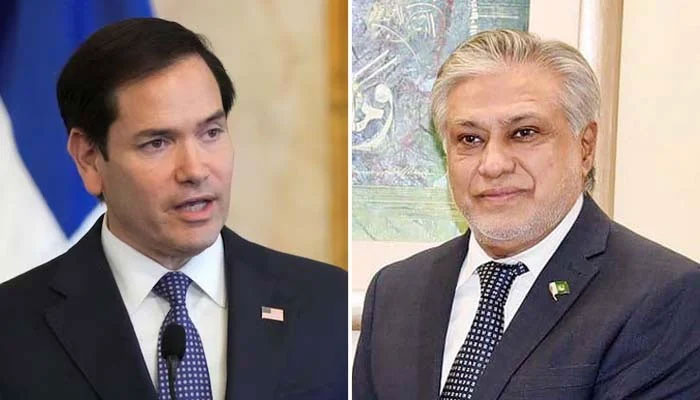
WASHINGTON/ISLAMABAD: In a major diplomatic development, Secretary of State Marco Rubio Monday held a telephone
conversation with Deputy Prime Minister/ Foreign Minister Ishaq Dar where they discussed US reciprocal tariffs on Pakistan and how to make progress toward a fair and balanced trade relationship.
Secretary Rubio thanked Pakistan for the arrest and transfer to the United States of ISIS-K operative Mohammad Sharifullah, said State Department Spokesperson Tammy Bruce.
The US secretary and deputy prime minister underscored the importance of continued cooperation on counterterrorism.
Rubio also emphasised the importance of Pakistan’s cooperation on law enforcement and addressing illegal immigration.The secretary raised prospects for engagement on critical minerals and expressed interest in expanding commercial opportunities for US companies.
The US secretary and deputy prime minister Dar agreed to working together to address global challenges during Pakistan’s two-year tenure as a non-permanent member of the United Nations Security Council that began on January 1, the State Department spokesperson concluded.
The call from Marco Rubio came as Pakistan prepares to send a high-level delegation to Washington to discuss the United States recent decision to impose a 29 percent tariff on Pakistani goods in an attempt to reset trade ties.
During the call, Dar reiterated Pakistan’s commitment to strengthening its partnership with the United States and emphasised the importance of strengthening cooperation in areas such as trade, investment and counterterrorism, said a statement issued by the Pakistan’s Foreign Office.
“Secretary Rubio reciprocated the desire to collaborate with Pakistan in trade and investment in various sectors, especially critical minerals. He said that cooperation in economy and trade would be the hall-mark of future relations between the two countries,” the FO quoted the US secretary of state.
Rubio’s emphasis on “critical minerals” comes in the wake of a US delegation arriving in Islamabad, headed by Eric Meyer, a Senior Bureau Official (SBO) for the Bureau of South and Central Asian Affairs, who would lead an interagency delegation to participate in the Pakistan Minerals Investment Forum commencing today (Tuesday). Eric Meyer is also expected to discuss, according to the Foreign Office, counterterrorism cooperation.
FM Dar also highlighted Pakistan’s efforts in successfully fighting terrorism during 2013-18, which caused Pakistan huge economic and human losses.
Dar and Rubio also discussed the situation in Afghanistan. “Secretary Rubio agreed on the need to resolve the issue of US Military equipment left behind in Afghanistan,” said the FO.
Earlier President Trump had also demanded from the Taliban to return this US equipment, a demand that was refused by the Kabul regime.
Islamabad has all along been saying that the “presence of US advance weapons in Afghanistan, left behind in the aftermath of withdrawal of its troops has been an issue of profound concert for the safety and security of Pakistan and its citizens”.
However, it was not clear that while discussing terrorism and Afghanistan during the phone call, the issue of the TTP using Afghan soil to carry out terrorist attacks against Pakistan was raised or not.
Secretary of State Rubio made special mention of and appreciated Pakistan’s efforts in the fight against terrorism and expressed the US desire to further enhance counterterrorism cooperation, added the FO statement.
During the phone call both sides agreed to remain in close contact and to work together to advance the shared interests of both countries.
The telephone call from the US secretary of state is the second high level direct telephone contact between the Trump administration and Foreign Minister Dar.
Earlier, Ishaq Dar, received a telephone call from the United States National Security Advisor (NSA) Michael Waltz on March 5.
During the conversation, when Pakistan had arrested and deported an Afghan terrorist Sharifullah, the US NSA conveyed President Trump’s appreciation for Pakistan’s efforts in countering terrorism and reaffirmed Washington’s commitment to further strengthening bilateral ties, the statement said.
Senator Dar, in response, reaffirmed Pakistan’s unwavering commitment to working closely with the United States in the fight against terrorism, and Pakistan’s resolve to continue collaboration with Washington in intelligence sharing and counterterrorism operations to maintain regional peace.
In a related development, Co-Chairmen of the Pakistan Caucus in the US Congress Republican Jack Bergman and Democrat Tom Suozzi would officially visit Pakistan this week.
They would meet Prime Minister Shehbaz Sharif, Chief of Army Staff General Asim Munir and other top government functionaries.
Meanwhile, in a significant move to address concerns arising from US tariff policies, Federal Minister for Commerce Jam Kamal Khan chaired a high-level meeting with top exporters from a wide range of sectors to discuss Pakistan’s strategy and response, said a press release issued here.
The meeting was attended by representatives from all major export industries, including textiles, garments, leather, surgical instruments, services, fruits & vegetables, rice, footwear and others.
This broad participation underscored the need for a coordinated national effort to navigate global trade challenges.
The minister reaffirmed the Ministry of Commerce’s proactive role in addressing the issue, assuring exporters of the government’s full support. He emphasised that the ministry was actively working on a comprehensive strategy aimed at achieving a mutually beneficial outcome with the United States.
Highlighting the importance of collaboration, the minister announced that the private sector would play a key role in shaping this strategy. “Our trade officers and ambassadors in the US are in continuous contact with the relevant authorities to ensure that Pakistan’s concerns are effectively communicated,” he added.
During the meeting, the minister sought input from exporters and industry representatives to help craft a robust and forward-looking strategy.
He took the private sector into full confidence, reinforcing the government’s commitment to a collaborative approach.
Meanwhile, chairing a high-level meeting to review progress on the government’s wide-ranging reforms in the maritime sector, Prime Minister Shehbaz Sharif said that the reforms in maritime and energy sectors would boost trade, reduce costs, and unlock Pakistan’s economic potential.
He emphasised that comprehensive efforts were underway to transform Pakistan’s port infrastructure, streamline Customs operations, and strengthen the country’s maritime economy for long-term national benefit.
He hailed the task force on maritime reforms for its diligent work and praised their efforts in preparing a comprehensive set of recommendations that aim to end decades-long stagnation in the sector.
“Pakistan has been blessed with a long coastline and vast maritime resources. With the right reforms, we can unlock immense economic potential and bring our ports to global competitive standards,” Shehbaz said.
The prime minister stated that the benefits of significant reductions in global petroleum prices would be passed on to the economy’s development and the public, with various options currently under consideration.
“Our domestic industry will become more competitive due to lower electricity prices, production costs will decrease, employment opportunities will increase, and exports will grow.”
Just as the public benefited from reductions in electricity prices, decisions would continue to be made in the interest of the economy and the people, he added.
The meeting reviewed a detailed presentation on the roadmap for maritime sector reforms.The participants of the meeting were briefed on introduction of the Pakistan Maritime Port Act, unifying regulations across all ports, creation of a national dredging plan, including the formation of a National Dredging Company to serve ports across the country.
The forum also discussed modernisation of the Pakistan National Shipping Corporation (PNSC) with a 25-year rehabilitation plan and inclusion of the private sector through public-private partnerships. It was informed that a hazardous waste disposal plant was set up in Gadani to manage chemical and industrial waste.
The prime minister instructed the authorities concerned to accelerate installation of modern scanning systems at all ports, and expedite Customs clearance procedures, particularly in red and yellow channels.
He also directed that a plan be developed to quickly auction long-held containers to free up port space and improve efficiency.
The meeting was attended by Ishaq Dar, Chief of Army Staff General Syed Asim Munir, federal ministers Khawaja Asif, Ahsan Iqbal, Azam Nazir Tarar, Ahad Khan Cheema, Junaid Anwar, Advisor to the PM Syed Tauqeer Shah, the State Bank of Pakistan governor and other senior officials from relevant ministries and institutions.


