
Constitutional Bench told: Punjab makes Holy Quran teaching compulsory in schools
A five-member constitutional bench, headed by Justice Aminuddin Khan hears case
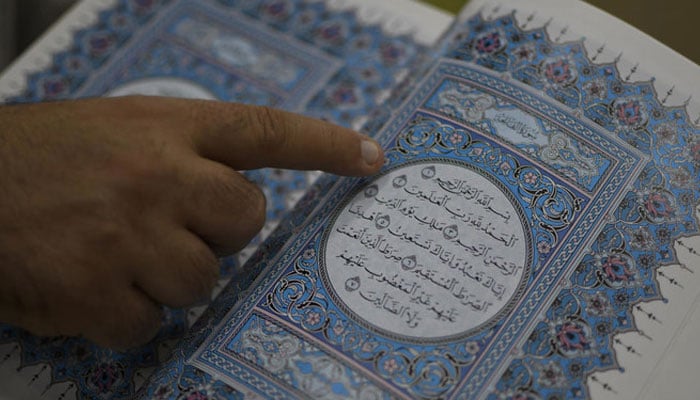
ISLAMABAD: The federal government and the governments of Punjab and Balochistan on Wednesday filed their response in the Supreme Court on the constitutional petition seeking legislation to make the teaching of the Holy Quran compulsory in educational institutions.
A five-member constitutional bench, headed by Justice Aminuddin Khan and comprising Justices Jamal Khan Mandokhail, Justice Naeem Akhtar Afghan, Justice Muhammad Hashim Khan Kakar, and Justice Aamer Farooq, heard the case. The governments of Sindh and Khyber Pakhtunkhwa (KP) however, sought more time to submit their replies.
Justice Jamal Khan Mandokhail while addressing the petitioner Aneeq Khattana said that according to the federal government’s response, steps have already been taken to introduce Quranic education “Why should the court interfere in legislation if the government is already working on it,” Justice Mandokhail asked. The petitioner, however, responded that if the governments were actively working on this, he wouldn’t have been pursuing this case for the past five years. He submitted that as per the law, only a consensus-based translation of the Holy Quran can be implemented adding that the federal government must approve the translation. “No province or the federal government has attached any official notification in their responses,” he contended.
Justice Jamal Khan Mandokhail however, remarked that when a child is born, they first learn their mother tongue, then Urdu and English adding that nowadays, everyone is chasing to learn Chinese. “What more do you want to teach children,” Justice Mandokhail asked the petitioner.
The petitioner, however, referred to Article 31 of the Constitution and submitted that the Quran’s education and religious studies are distinct from other learning. Later, the court allowed the governments of Sindh and Khyber Pakhtunkhwa to submit their respective replies and adjourned the case for date-in-office (indefinite period).
In its reply, the Government of Punjab prayed to the apex court to dismiss the plea to the extent that the provincial government has promulgated “The Punjab Compulsory Teaching of the Holy Quran Act, 2018.
It submitted that certain amendments have been made in the Act through Amendment Act, 2021 adding that according to the Act, it is mandatory to teach Naazrah Quran from Grades I to V and the Translation of the Holy Quran from Grades VI to XII to all students of public and private schools in Punjab. Therefore, the Government of Punjab has fulfilled its Constitutional obligation,” the reply submitted.







-
 Isla Fisher Shares Why Life Feels 'liberated' After Sacha Baron Cohen Divorce
 -
 Cybercrime: British Man Charged In Dubai For Allegedly Filming Missiles In Breach Of UAE Rules
 -
 Amazon Withdraws From Drone Trade Group 'Prime Air' Over Safety Concerns
 -
 Pentagon Says 'no Chance' Of Renewed Anthropic Negotiations After Legal Dispute Over AI Technology
 -
 King Charles Leaves Harry And Meghan In Shadows Of Palace Drama
 -
 Meghan Markle’s Dissatisfaction From Harry Grows: ‘It Would’ve Given Us More Credibility’
 -
 Prince William, Kate Middleton Embark On 'exploring' Mission
 -
 Sarah Ferguson’s Plans For A Royal Tell-all That ‘exposes It All’ Gets Rude Awakening
 -
 Royal Snub: Woman Ignores Prince William And Kate Middleton In London
 -
 Kate Middleton Talks About Her Cancer Once More: ‘something I Have To Be A Lot More Conscious’
 -
 Steve Tisch: Another Powerful Man Bites The Dust Over Epstein Links
 -
 Prince William Takes The Wheel Of RNLI Lifeboat In Unexpected Moment After Visit To Borough Market
 -
 Lloyds Bank Apologizes After Major Data Glitch Hits Customers, Launches Probe Into Data Breach
 -
 Kate Middleton Given Huge Duty By King Charles Ahead Of Key Visit
 -
 Kat Dennings Remembers Anton Yelchin On His 37th Birthday
 -
 Andrew Mountbatten-Windsor’s Paternity Comes Under Question: ‘Philip Was Never His Father’