
SC asks if super tax will remain in force forever
Initial estimate was to collect Rs80 billion, but it is unclear how much government has collected under tax to-date
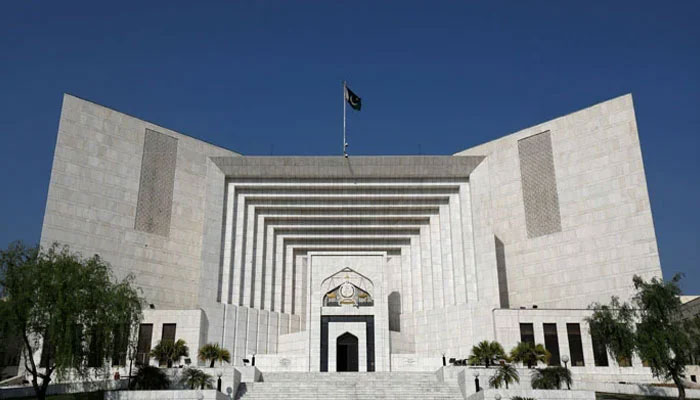
ISLAMABAD: Supreme Court Judge Muhammad Ali Mazhar Tuesday asked whether the Super Tax, once imposed for a specific time, will remain in force forever.
A five-member constitutional bench of the apex court — headed by Justice Amin-ud-Din Khan — heard the matter related to Super Tax.
Replying to a query, Makhdoom Ali Khan, counsel for the companies, submitted that the government should be asked how much tax had been collected so far under the Super Tax.
He submitted that the government had introduced the Super Tax in 2015 and its purpose was rehabilitation of the areas affected by Operation Zarb-e-Azb. He further submitted that the tax was imposed through the 2015 Finance Bill, and it remained in effect from 2015 to 2022.
The initial estimate was to collect Rs80 billion, but it is unclear how much the government has collected under the tax to-date.
Justice Jamal Mandokhail inquired about the government’s plan for the rehabilitation of affected areas and whether any estimate had been made for this purpose. He also questioned whether a tax on services could be imposed through a finance bill.
In response, Makhdoom Ali Khan argued that the government was already collecting income tax and that the Super Tax was introduced to avoid double taxation. He also pointed out that social welfare had now become a provincial responsibility.
The counsel further submitted that the Super Tax was imposed for only one year adding that the finance minister never disclosed the details about its recovery or expenditure. The counsel submitted that the government should be asked how much revenue was collected under the Super Tax.
Justice Muhammad Ali Mazhar repeated that the Super Tax was imposed once for a specific purpose and asked whether it was supposed to last indefinitely. Makhdoom Ali Khan further argued that the rehabilitation of areas affected by operations was a matter of local and provincial governments.
Justice Aminuddin Khan questioned how funds from the national exchequer could be spent without the provinces’ consent.
During the hearing, Raza Rabbani, the counsel for the Federal Board of Revenue (FBR), submitted that the war against terrorism was an ongoing process and that people had been displaced as a result of counter-terrorism operations. Makhdoom Ali Khan countered by asking whether terrorism had officially ended in 2020, as the government had stopped collecting the Super Tax that year.
Justice Mandokhail observed that Super Tax was intended for the rehabilitation of those affected by military operations, but in reality the country still faced terrorism daily. He then asked how many people had been displaced and from which areas. Later, the court adjourned the hearing for today (Wednesday).







-
 Prince Harry Reacts As Beatrice, Eugenie's Names Surface In Epstein Emails
 -
 Cyprus Joins European AI Race: What It Means For Greek LLMs And Regional Innovation
 -
 Amazon Soon To Launch 'AI Content' Marketplace, Says Report
 -
 Is AI Reliable For Health Advice? New Study Raises Red Flags
 -
 WhatsApp Web Starts Rolling Out Voice And Video Calling For Beta Users
 -
 Catherine O’Hara’s Cause Of Death Finally Revealed
 -
 Swimmers Gather At Argentina’s Mar Chiquita For World Record Attempt
 -
 Brooklyn Beckham, Nicola New Move Could Leave David, Victoria Reeling
 -
 Anthropic Criticises ChatGPT Ads As OpenAI Begins Testing Advertising In AI Chats
 -
 YouTube Star MrBeast Acquires Step: Redefining Finance For Gen Zs
 -
 Sarah Ferguson Plans Big Move To Cause ‘serious Damage’ To Andrew
 -
 Trump Nears 500 Press Interactions In His Second Term, Surpassing Former President Biden
 -
 Hailee Steinfeld Reveals Her Plans To Return To Music
 -
 Elon Musk Unveils SpaceX Plan For Civilian Moon, Mars Trips
 -
 MTG Commander Banned Update: Wizards Frees Infamous Instant-win Card
 -
 Royal Family Braces For ‘final Blow’ As Andrew Scandal Deepens