
Everyone came together to grant ex-army chief extension: SC
Justice Mazhar asks counsel that he had earlier argued that army could not exercise judicial powers
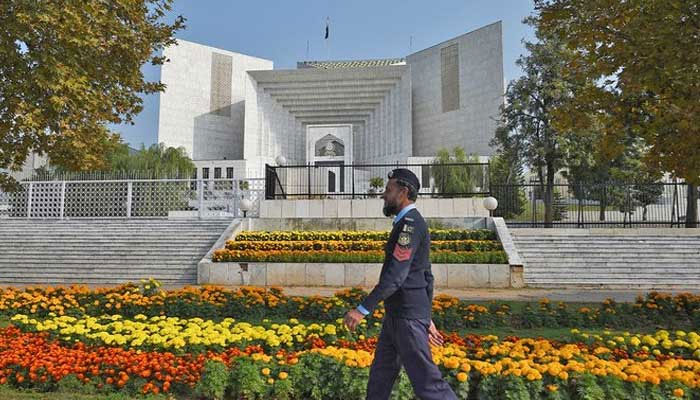
ISLAMABAD: The Supreme Court on Tuesday observed that everyone came together for a single notification to grant an extension to the former army chief’s tenure.
A seven-member Constitutional Bench of the Supreme Court, headed by Justice Amin-ud-Din Khan, heard the intra court appeals (ICAs) of the federal government and the Ministry of Defence against its judgement declaring trial of civilians in military courts as unconstitutional.
Other members of the bench were Justice Jamal Khan Mandokhail, Justice Muhammad Ali Mazhar, Justice Syed Hassan Azhar Rizvi, Justice Musarat Hilali, Justice Naeem Akhtar Afghan and Justice Shahid Bilal Hassan. Uzair Bhandari, counsel for PTI founder Imran Khan, concluded his arguments.
During the hearing, Justice Amin-ud-Din asked the counsel if any lawmaker had raised voice in the parliament against the civilian trial in military courts. “Has any member of parliament introduced so far any private bill against Army Act.”
Bhandari replied that the matter was before the court. He submitted that an ordinary court could conduct trial on criminal provisions to the extent of civilian accused. Justice Mandokhail asked the counsel as to how the civilian accused had been linked to Section 2(1)(d) of the Army Act, on which the counsel replied that nothing was said in F B Ali case regarding 2(1)(d).
Justice Mazhar asked the counsel that he had earlier argued that the army could not exercise judicial powers but was now saying that the army could exercise to the extent of its people but not civilians.
“If the army cannot exercise judicial powers, then it’s for everyone,” Justice Mazhar remarked to which the counsel submitted that the people of armed forces did not have basic rights under sub-clause 3 of Article 8, adding that Justice Muneeb Akhtar had also held in his detailed verdict of the main case.
Justice Jamal Mandokhail remarked that if individuals in the armed forces are governed under Article 8(3) of the Constitution, they are also not entitled to Article 10-A. This implies that their trial can take place anywhere, regardless of jurisdiction.
At the outset of hearing, Justice Afghan pointed out that the case regarding the extension of the former army chief’s tenure was also relevant. There was no law for the extension of the army chief’s tenure initially. Parliament legislated on the matter following the Supreme Court’s directives.
Justice Amin-ud-Din Khan noted that at that time, everyone came together for a single notification, adding that it was our state of affairs. He mentioned that Salman Akram Raja, in his arguments, referenced to India, stating that in India, appeals against military trials are heard by an independent tribunal. He questioned whether India granted the right to appeal through parliamentary legislation or judicial directives.
Similarly, Justice Mazhar cited the example of Kulbhushan Jadhav, who was granted the right to appeal through special legislation. Uzair Bhandari submitted that in FB Ali’s case, Aitzaz Ahsan had told the court as to how trial is conducted by the military court. He mentioned that even today, the Pakistan Tehreek-e-Insaf (PTI) founder is facing a jail trial, where fair trial standards are far from being met, and even a piece of paper is not allowed to be taken into the trial.
At this, Justice Amin-ud-Din Khan asked in a lighter tone, “If they don’t allow even a piece of paper, where do these letters come from?” This remark caused laughter in the courtroom.
Justice Jamal Mandokhail directed the counsel to focus his arguments on fundamental rights. The counsel argued that in court-martial proceedings, even death sentences can be handed down without the judge having a fixed tenure, proper training, or legal understanding. The accused has no right to appeal to a higher court and can only appeal for mercy to the army chief.
Bhandari further stated that while the high court can exercise its writ jurisdiction, it is limited. He highlighted that 103 individuals were currently facing trials in military courts, and the court must determine the extent to which the law can be expanded in this case.
After Bhandari completed his arguments, the hearing was adjourned. Today (Wednesday, Advocate Faisal Siddiqui will present his arguments.







-
 Prince Harry Warns Meghan Markle To 'step Back'
 -
 Selena Gomez Explains Why She Thought Lupus Was 'life-or-death'
 -
 New Zealand Flood Crisis: State Of Emergency Declared As North Island Braces For More Storms
 -
 Nancy Guthrie Case: Mystery Deepens As Unknown DNA Found At Property
 -
 James Van Der Beek's Brother Breaks Silence On Actor's Tragic Death
 -
 Megan Thee Stallion On New Romance With Klay Thompson: 'I'm Comfy'
 -
 Nicole Kidman Celebrates Galentine’s Day Months After Keith Urban Split
 -
 Justin Bieber Unveils Hailey Bieber As First Face Of SKYLRK In Intimate Campaign Debut
 -
 Caitlin O’Connor Says Fiance Joe Manganiello Has Changed Valentine’s Day For Her
 -
 Rachel Zoe Sends Out Message For Womne With Her Post-divorce Diamond Ring
 -
 James Van Der Beek's Final Conversation With Director Roger Avary Laid Bare: 'We Cried'
 -
 Jaden Smith Walks Out Of Interview After Kanye West Question At Film Premiere
 -
 Michelle Obama Gets Candid About Spontaneous Decision At Piercings Tattoo
 -
 Why Halle Berry Wasn't Ready For Marriage After Van Hunt Popped Question? Source
 -
 Bunnie Xo Shares Raw Confession After Year-long IVF Struggle
 -
 Brooks Nader Reveals Why She Quit Fillers After Years