
‘Pakistan committed to Saarc’
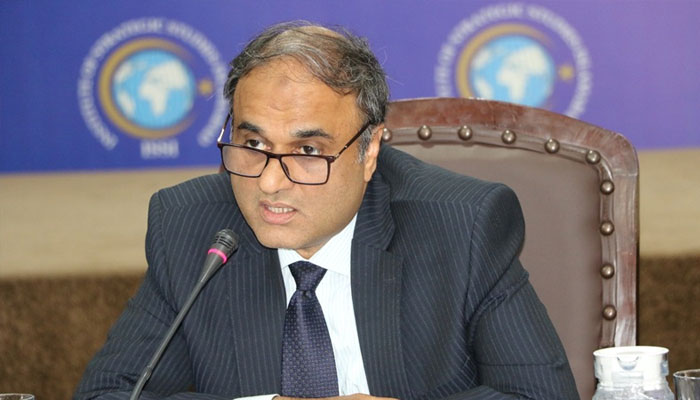
Islamabad : Imran Ahmed Siddiqui, Additional Secretary, Ministry of Foreign Affairs, has reaffirmed Pakistan’s unwavering commitment to uphold its Charter, principles and priorities.
Mr Siddiqui was delivering keynote address at a seminar on ‘Prospects and challenges of regional cooperation in South Asia: role of South Asian Association for Regional Cooperation (Saarc)’ organised here by Institute of Strategic Studies (ISS).
Mr Siddiqui emphasised Pakistan’s considered approach to play its role in fostering a harmonious regional environment where no single state could impose its agenda on the smaller counterparts. He positively evaluated the incremental resumption of Saarc activities since 2023, after a period of ineffectiveness due to bilateral issues, Covid-19 pandemic, and regional security problems. However, the organisation’s complete revival remains a rocky road.
He called for the member countries to adhere to the principles of mutual respect and sovereign equality in their journey to make South Asia a prosperous, developed, and economically integrated region.
Dr Saeed Ahmad Rid from Quaid-i-Azam University discussed the historical pattern of socio-cultural and political linkages in South Asia which were disrupted by the unnatural demarcations made by colonial powers rendering its populace to the levels of underdevelopment. He outlined a number of steps in public and private arenas to enhance people-to-people connections among South Asian states.
Dr Zahid Shahab Ahmed from National Defence College, UAE, emphasised that the geographical, social and political context made South Asia a unique region, therefore, it was not justified to draw a comparison between Saarc and other regional fora like European Union. He highlighted several structural as well as practical challenges restricting the efficient working of Saarc including competition between its members to find international markets outside South Asia, inter-state disputes, rising inclination
among several members toward sub-regionalism, funding issues, besides others.
Former ambassador Babar Amin observed that Indian approach to regional integration was motivated by its political and ideological inclinations. While expressing disappointment over India’s decisions like denial of visa to Pakistani students studying in South Asian University, New Delhi, he called civil society to play an active role in pressurising policymakers in New Delhi to revisit their approach.
Former ambassador of Nepal Yuba Nath Lamsal stressed that South Asian states and societies had more common characteristics than divisive issues. He emphasised that cooperation, and not competition in South Asia could guarantee a better future to the forthcoming generations.







-
 Rihanna 38th Birthday Detail Breaks The Internet, Featuring Unexpected Huge Item
 -
 Liza Minnelli Recalls Rare Backstage Memory With Mum Judy Garland In New Memoir
 -
 Armed Intruder Shot Dead At Trump's Mar-a-Lago Residence: US Secret Service
 -
 Total Lunar Eclipse: What You Need To Know And Where To Watch
 -
 Timothee Chalamet Admits To Being Inspired By Matthew McConaughey's Performance In 'Interstellar'
 -
 'Determined' Savannah Guthrie Plans To Honour Her Mother Nancy With Major Move: 'It's Going To Be Emotional'
 -
 Train's Pat Monahan Blows The Lid On 'emotional' Tale Attached To Hit Song 'Drops Of Jupiter'
 -
 Kurt Russell Spills The Beans On His Plans For Milestone Birthday This Year: 'Looking Forward To It'
 -
 PayPal Data Breach Exposed Sensitive User Data For Six-month Period; What You Need To Know
 -
 Prince William Receives First Heartbreaking News After Andrew Arrest
 -
 11-year-old Allegedly Kills Father Over Confiscated Nintendo Switch
 -
 Jacob Elordi Talks About Filming Steamy Scenes With Margot Robbie In 'Wuthering Heights'
 -
 Why Prince Harry Really Wants To Reconcile With King Charles, Prince William, Kate Middleton?
 -
 'Grief Is Cruel': Kelly Osbourne Offers Glimpse Into Hidden Pain Over Rockstar Father Ozzy Death
 -
 Timothée Chalamet Reveals Rare Impact Of Not Attending Acting School On Career
 -
 Liza Minnelli Gets Candid About Her Struggles With Substance Abuse Post Death Of Mum Judy Garland