
Ayaz optimistic about resolving govt-opposition issues
"I am sure once negotiations start, things will move forward," says NA speaker
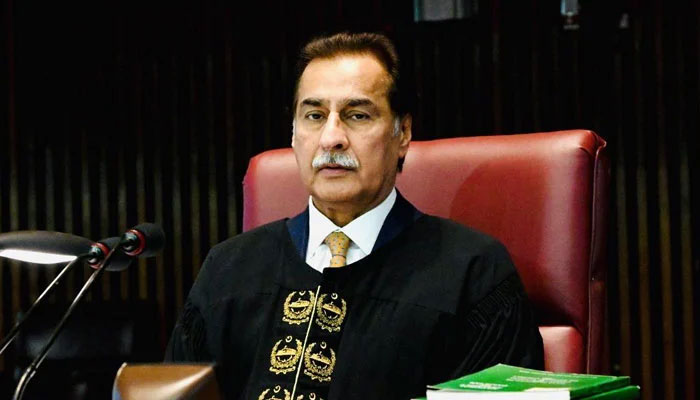
ISLAMABAD: National Assembly Speaker Ayaz Sadiq said on Friday it was his job to bring the opposition and the government to the negotiating table, but he could not force anyone to hold talks.
Addressing a press conference at the conclusion of the 18th Speakers Conference on Friday, he expressed optimism about resolving the political wrangling, stressing that initiating talks would pave the way for making headway. “I am sure once negotiations start, things will move forward. We will facilitate quietly and recite ‘Ayatul Kursi and Durood Sharif’ for positive outcome,” he added.
Ayaz said one party had formed a committee, but they were still speaking at news channels; they had not move forward for talks. “If they come for talk, I will ask the government to form a committee as well,” he added.
About non-formation of the Public Accounts Committee (PAC) despite passage of more than nine months, the NA speaker said he had given the government and the opposition a deadline to decide the name of the chairperson for the committee. “If no consensus is reached by next week, a PAC meeting would be convened, and the chairperson would be elected on-the-spot,” he explained.
Ayaz Sadiq reminded both sides that it was a parliamentary tradition that the PAC chairmanship would go to the opposition, though the final decision required agreement between the government and the opposition.
The NA speaker said the rules and procedures should be the same in all assemblies, and when necessary, the speakers would issue production orders for the assembly members.
He said the provinces decided to jointly formulate a strategy to deal with the future challenges, and they would work together to counter terrorism. He said the provincial assemblies decided to highlight the issue of Indian Illegally Occupied Jammu & Kashmir.
Ayaz Sadiq said it was hoped that the IT structure in the National Assembly would be completed by March.
He said speakers should play a role in ending political division in the country. “We have to make our respective assemblies more active; we have to take the government and the opposition members along,” he added.
The NA speaker said supremacy of the parliament was reiterated in the Speakers Conference. It had been decided that the rules and procedures should be the same in all assemblies. The speaker is the protector of the sanctity of the house; it is a responsibility of the speaker to take all members along, he added.
He said climate change was a new epidemic. “We want to focus on it. All provinces should come together and discuss in the house the effects of climate change.”
He said the next Speakers’ Conference would be held in Azad Kashmir. “We have resolved to work to make the parliament better and better. We want to play our part with good intentions,” he added. Earlier, the 18th Speakers’ Conference, chaired by National Assembly Speaker Sardar Ayaz Sadiq, concluded with the Islamabad Declaration, issued unanimously by speakers of federal, provincial and state assemblies of the country.
The declaration, consisting of 23 key resolutions, reaffirmed the commitment to promoting parliamentary values, ensuring transparency in legislation, addressing public issues effectively, upholding constitutional supremacy, combating climate change through robust parliamentary institutions, and protecting the rights of women and children. The conference participants included Senate Chairman Yusuf Raza Gilani, NA Deputy Speaker Ghulam Mustafa Shah, Federal Minister for Law and Justice Senator Azam Nazeer Tarar, Azad Jammu and Kashmir Assembly Speaker Chaudhry Latif Akbar, Balochistan Assembly Speaker Capt (retd) Abdul Khaliq Achakzai, Gilgit-Baltistan Assembly Speaker Nazir Ahmad, Khyber-Pakhtunkhwa Assembly Speaker Babar Khan Swati, Punjab Assembly Speaker Malik Muhammad Ahmad Khan, and Sindh Assembly Speaker Awais Qadir Shah.
The joint declaration acknowledged the sacrifices made by the people of Pakistan in establishing a democratic, federal, Islamic, and progressive welfare state, where citizens’ rights were safeguarded, and all provinces had equal representation in the federation. It reaffirmed that the state power in a parliamentary system, as enshrined in the Constitution and the Objectives Resolution, must solely be exercised by elected representatives of the people.
The conference underscored the need to align provincial regulations with constitutional principles to ensure accountability of the executive before the assemblies, enhance parliamentary oversight, and restore public trust in legislative processes through accountability and transparency.
Recognising the challenges of climate change, rapid technological advancements, socio-economic inequalities, and evolving public needs, the declaration called for enhanced collaboration among federal and provincial legislatures to address these issues effectively. The forum also stressed the importance of parliamentary diplomacy in promoting regional and international peace, cooperation, and understanding.
The Speakers’ Conference voiced concerns over the rising trend of offensive language in politics, fake news, and defamatory practices on social media, which harm parliamentary values and constructive dialogue. It called for fostering a culture of civility, respect for differences of opinion, and constructive discourse.
The declaration resolved to prioritise legislative and policy measures to combat climate change, terrorism, and other pressing issues while empowering women, youth, and children. It also called for establishment of parliamentary forums to address challenges such as polio, child labour, and malnutrition.
In a significant decision, the conference agreed to extend the mandate of the Pakistan Institute for Parliamentary Services (PIPS) to assist the legislative assemblies of Azad Jammu and Kashmir and Gilgit-Baltistan. Additionally, the conference resolved to establish an association of Public Accounts Committees to strengthen financial oversight and transparency across the country.
The forum condemned atrocities in Indian-occupied Jammu and Kashmir, including mass killings and human rights violations, and reiterated call for a peaceful resolution of the Kashmir dispute in accordance with United Nations resolutions.
The conference agreed on the use of modern technologies, including artificial intelligence and digitisation, to enhance parliamentary performance and governance.
Furthermore, it resolved to form a Commonwealth National Group to strengthen parliamentary diplomacy with the support of a dedicated secretariat in Pakistan.
The forum accepted the invitation of the Azad Jammu and Kashmir Assembly speaker to hold the 19th Speakers’ Conference in Muzaffarabad in 2025, and decided to conduct quarterly review meetings to evaluate progress. Reaffirming their commitment to democratic values, constitutional principles, and the aspirations of the Pakistani people, the speakers and presiding officers vowed to strengthen parliamentary institutions through cooperation, innovation, and inclusivity. The joint declaration was formally adopted on December 20, 2024, demonstrating the collective resolve of Pakistan’s legislatures to serve the nation better through unity, respect, and mutual understanding.






-
 Shamed Andrew Master Plan To Make Princess Beatrice, Eugenie Working Royals
 -
 Oil Price Climbs To $108 As Escalating Iran Conflict Raises Fears Of Global Energy Crisis
 -
 Christian Bale Shares Two Cents On Viral Comparison Amid 'The Bride!' Release
 -
 Prince Harry To Face ‘unwelcome’ Behaviour If Eugenie Comes Over
 -
 Georgian Bay Ice Rescue Sees 23 Anglers Saved After Drifting Ice Leaves Them Stranded Offshore
 -
 Vivica A. Fox Reflects On Iconic Fight Scene With Uma Thurman In 'Kill Bill'
 -
 Priyanka Chopra Jonas Celebrates Women Who 'run' Her World
 -
 Sarah Michelle Gellar Marks Freddie Prinze Jr.’s 50th Birthday With Sweet Gesture
 -
 Shamed Andrew Slid In Forgiveness Plea For Prince William
 -
 Katy Perry, Justin Trudeau's Unexpected Relationship Opening World's Most Powerful Doors
 -
 Joe Burrow’s Text About Maxx Crosby Trade Sparks Furious Reaction From Ja'marr Chase
 -
 Rihanna 'faced' Attack By Shooter At Home In Beverly Hills
 -
 David Beckham Celebrates 'strong Women' In His Life
 -
 Tracy Morgan Opens Up About Life Perspective At 57
 -
 Viola Davis Reveals Personal Trauma Influenced Novel Judge Stone Key Character
 -
 Michigan Tornadoes Kill 6 Including Child As Powerful Storms Rip Through Midwest And Oklahoma