
All risk factors for dengue fever spread in existence
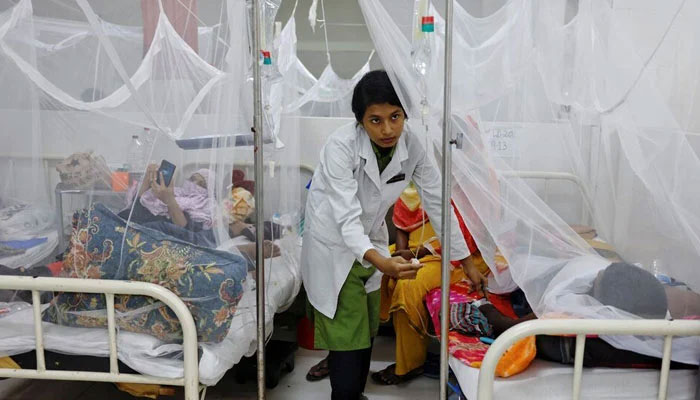
Islamabad:After the setting in of monsoon in this region of the country, the chances of incidence and spread of dengue fever have increased because all risk factors including rains, rising temperature, humidity and infected persons or travellers considered to be the most important for appearance of seasonal dengue fever have become very much in existence.
Data collected by ‘The News’ has revealed that a total of 45 individuals have so far tested positive for the infection from the twin cities of Islamabad and Rawalpindi while the teams of the district health departments have been finding larvae and adult mosquitoes ‘aedes aegypti’ in abundance from a number of localities in both the cities.
Health experts believe that it is time for the individuals to take preventive measures religiously to avoid a severe outbreak of the infection. It is important that the effects of temperature, humidity and rainfall along with artificial flooding, the man-made watering of lawns, fields and water spillage, are the genuine factors besides movement of infected patients to cause fast spread of the disease.
Studies reveal that ‘aedes aegypti’, the mosquito that causes dengue fever lay the first eggs of the year at the beginning of May and the mosquito density is maximal in early July, late August and early September while the egg laying activity remains until November though the larval density reaches to its peak in August and September depending on the weather conditions.
In this region of the country, the risk of incidence and spread of dengue fever remains high in August and September. The population of ‘aedes aegypti’ fluctuates with temperature, rainfall and humidity. Epidemiological findings reveal that dengue infections are generally encountered during or after rain, as an outcome of rise in vector population.
It is important to note that the optimal temperature for the growth of ‘aedes aegypti’ larvae is 28 degree centigrade and above this the rate of development is high, which means that the existing weather conditions are the most suitable for the breeding and growth of dengue fever vector. In humid weather conditions like the existing one, ‘aedes’ mosquitoes increase their population rapidly.
Experts say that it is time to take preventive measures more seriously to avoid breeding and growth of mosquitoes as the population of ‘aedes aegypti’ is high in the rainy season and the conditions in monsoon in the region become favorable for mosquitoes to grow.
It has been observed that during the rainy season, the risk of virus transmission by the vector is greater. Control measures are extremely needed at the time as dengue fever cases increase proportionally with the larval density. Experts say that individuals should take measures seriously to reduce the mosquito-genic sites and to control the population of immature and adult ‘aedes aegypti’ inside homes and offices.
Experts believe that by educating the public on aspects related to dengue fever incidence and spread, the outbreak can be avoided or controlled. Dengue mosquitoes have three water dependent stages including eggs, larva and pupa and the last aerial stage of adult mosquitoes. A surge in dengue fever cases is always expected after the rains when the incidence of the infection is being reported in a region.
Experts say that this is high time to start social mobilization convincing individuals to look for sites and places inside or outside homes that can attract rain water and provide a favorable place for the female ‘aedes’ mosquitoes to lay eggs. It is time to remain vigilant and people should destroy the possible breeding sites mechanically that can harbor larvae to develop into adult mosquitoes.







-
 Arden Cho Shares Update On Search For ‘perfect’ Wedding Dress Ahead Of Italy Ceremony
 -
 Ariana Madix Goes Unfiltered About Dating Life
 -
 Prince William Closes Saudi Arabia Visit With Rare Desert Shot
 -
 'King Charles Acts Fast Or Existential Crisis' Over Andrew Scandal
 -
 Brooklyn Beckham Charging Nearly £300 In Ticket Cost For Burger Festival
 -
 Prince William Makes Unexpected Stop At Local Market In Saudi Arabia
 -
 Zayn Malik Shares Important Update About His Love Life
 -
 Kate Middleton, William Are Holding Onto Their Hats As Worse Gets Threatened: Behind The Veil Of Shame
 -
 British Soap Awards Scrapped Again As ITV Confirms 2026 Hiatus
 -
 Climate Nearing Dangerous Tipping Points, Study Shows
 -
 James Van Der Beek, 'Dawson's Creek' Star, Dies At 48
 -
 Threads Launches Dear Algo AI Feature To Personalise Feeds In Real Time
 -
 Police Take Action Over Andrew's Ties With Jeffrey Epstein While In UK Office
 -
 Courtney Love Makes First Appearance Since New Report On Kurt Cobain's Death
 -
 King Charles Anxious As Uncertainty Grows Over Sarah Ferguson’s Next Move
 -
 Real Reason Kim Kardashian Is Dating Lewis Hamilton