
Two-day moot at Habib University examines intersection of climate, gender and peace
Climate change exacerbates existing vulnerabilities and disproportionately affects women and other gender minorities across various regions and socio-economic backgrounds. The United Nations estimates that 80% of the people displaced by climate change are women.
2022’s devastating floods alone left almost 650,000 pregnant Pakistani women deprived of access to healthcare, forced to give birth under the open sky. The relentless floods also left eight million girls and women without access to basic menstrual hygiene products and toilets to manage their period. Moreover, it brings to the fore existing inequalities significantly impacting socio-economic structures and human well-being, heightening the potential for violent conflicts.
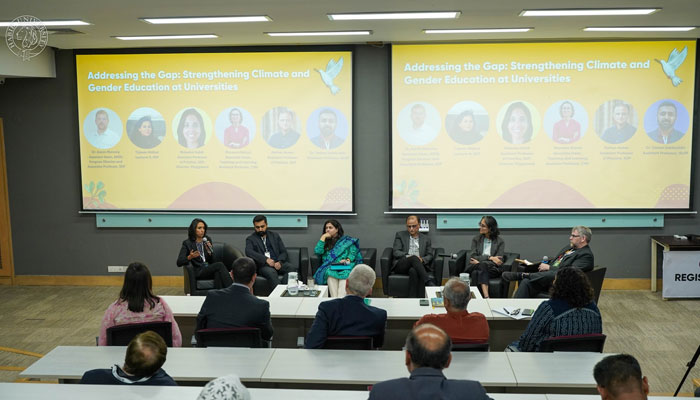
On March 8th and 9th Habib University, committed to fostering proactive community engagement and addressing societal challenges through profound intellectual undertakings, held a student research conference titled ‘Aamozish-e-Tehqeeq – Navigating Climate, Gender and Peace’.
“Aamozish” is derived from the word “Amoz,” which means “one who learns” or “student”. In this context, it signifies the aspect of learning and education. “Tehqeeq” means “research” or “investigation.” In this context, it represents the process of conducting research and gathering knowledge about a subject. The conference, organized under the University’s Social Development and Policy programme, invited young scholars, climate activists, educators and technology innovators to explore the linkages between climate change, gender and peacebuilding.
Featuring panel discussions, interactive talks, skill-building and artistic workshops, the conference enabled multidisciplinary dialogue centered around climate action and gender while emphasizing the role of strengthening communities to counter multifaceted challenges posed by climate change. Moreover, it stressed on the crucial need for resilience-building within diverse communities and cultivating inclusive practices in peace efforts.
The conference was borne out of a research grant awarded to Dr Shama Dossa, Associate Professor of Social Development and Policy at Habib University, by the United States Institute of Peace. The grant also facilitated extensive research undertaken by her students wherein they delved into the crucial intersection of climate change, gender and peace as part of their undergraduate education at Habib University.
Addressing the opening ceremony, US Consul General Conrad Tribble emphasized the need for a preventative approach when mitigating climate impacts and building climate resilience.
Elaborating on the thought behind the conference, Dr Dossa explained that the two-day event was designed with a specific focus on student researchers and community practitioners actively working to counter the impacts of climate change.
By providing emerging scholars a platform to showcase their research on the intersection of climate change, gender and peace, “Centering undergraduate students in the pedagogy and practice of social science research Pakistan requires a paradigmatic shift. Being intentional about facilitating innovation in research pedagogy also requires skill and resources. Habib University is the first undergraduate liberal arts university in Pakistan now in its 10th year and we have been exploring and experimenting with how to facilitate and resource student centered research.”.
“By welcoming contributions from students, professionals, academics, activists, artists and practitioners, we want to create an environment that fosters comprehensive discussions, enabling a multidimensional understanding of complex challenges of climate change concerning gender and peace,” she added.
Participants ranged from renowned journalists and practitioners like Afia Salam, Madiha Latif (Interim Country Director Pathfinder International), Farhan Anwar (Faculty member and Urban Planner), and Renuka Swamy (UNFPA). The event also included a number of film screenings, including Haya Fatima Iqbal’s The Sky is Far, The Earth is Tough, Karim Shallwanee’s A Cry from the Mountains, and Jawad Sharif’s Natari. The two-day event proved to be a transformative experience inviting introspection on existing and yet developing practices in climate action.


