
Industrial output falls again in October, clouding growth outlook
ISLAMABAD: The industrial output contracted by 4.08 percent year-on-year in October, reversing two months of positive growth and raising concerns for an economy facing high inflation, a weak currency and a widening current account deficit.
The latest data from the Pakistan Bureau of Statistics (PBS) on Friday showed that large scale manufacturing (LSM), which accounts for about a quarter of the country’s gross domestic product, declined by 4.08 percent year-on-year in October and 0.44 percent in the first four months of the fiscal year 2023/24.
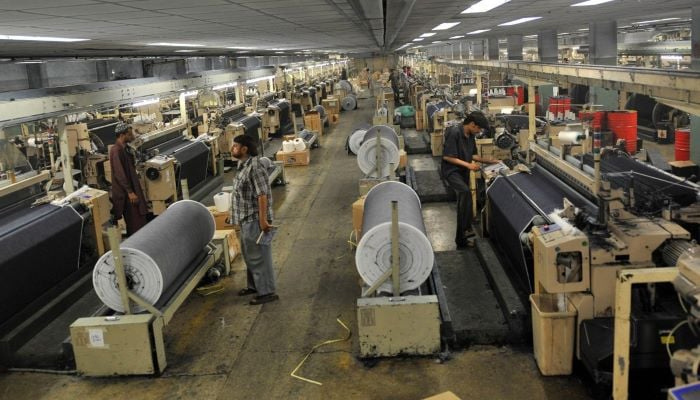
Over the previous month, LSM output decreased by 2.0 percent in October, dashing hopes of sustained recovery following the prolonged economic slump. The most under-performed sectors include textiles, chemicals, automobiles, cement, non-metallic minerals, iron & steel products, and petroleum products.
Economists attribute the decline in the sector to the government's policy of 'quantitative tightening' and maintaining a high policy rate of 22 percent to curb inflation. Critics argue that such measures have made bank financing costlier, adversely affecting industrial activities and impeding growth, without effectively limiting inflation.
Pakistani inflation, characterized as ‘cost-push’, contrasts with the policy focus on limiting 'demand-pull' inflation. The high energy costs, including petroleum, electricity, and gas, have also rendered the cost of doing business non-feasible, leading to reduced operational hours and plant closures in recent months.
From July 2022 to July 2023, LSM continuously contracted, showing negative growth across various sectors. Although there was a brief reversal of the trend in August 2023, with 2.5 percent growth, and in September, with a 1.01 percent increase, October witnessed another downturn.
Data analysis for October revealed that out of 25 sectors, only 10 displayed positive growth, leaving the rest in negative territory.Similar trends were observed in the cumulative growth for the first four months (July-October 2023/24) across these sectors.
Output increased in sectors such as Food, Beverages, garments, coke & petroleum products, chemicals, fertilizers, pharmaceuticals, non-metallic mineral products, machinery and equipment, and other manufacturing (football) during July-October 2023/24. However, output decreased in sectors including tobacco, textile, iron & steel products, electrical equipment, automobiles, other transport equipment, and furniture.
In the last fiscal year 2022-23, the LSM sector contracted by 10.26 percent, with major industries reporting substantial declines. In contrast, fiscal year 2022 witnessed a robust growth rate of 11.7 percent, fueled by affordable funding and favorable policies fostering production and GDP expansion.
During October 2023, key sectors reported declining output compared to the same month of the previous year. Notable declines included automobile output by 58.3 percent, cement by 11.7 percent, and tobacco by 37.2 percent. Conversely, some sectors experienced growth, with food increasing by 1.7 percent, leather products by 4.14 percent, and chemicals by 4.9 percent, including an 8.81 percent rise in fertilizers.
Similarly, pharmaceuticals output increased by 26.5 percent, rubber products by 9.8 percent, machinery and equipment by 82.7 percent, footballs by 13.2 percent, textiles by 1.1 percent, wood products by 9.7 percent, and paper & board output increased by 5.55 percent during October 2023 compared to the corresponding month of the previous year. —







-
 Prince William Closes Saudi Arabia Visit With Rare Desert Shot
 -
 'King Charles Acts Fast Or Existential Crisis' Over Andrew Scandal
 -
 Brooklyn Beckham Charging Nearly £300 In Ticket Cost For Burger Festival
 -
 Prince William Makes Unexpected Stop At Local Market In Saudi Arabia
 -
 Zayn Malik Shares Important Update About His Love Life
 -
 Kate Middleton, William Are Holding Onto Their Hats As Worse Gets Threatened: Behind The Veil Of Shame
 -
 British Soap Awards Scrapped Again As ITV Confirms 2026 Hiatus
 -
 Climate Nearing Dangerous Tipping Points, Study Shows
 -
 James Van Der Beek, 'Dawson's Creek' Star, Dies At 48
 -
 Threads Launches Dear Algo AI Feature To Personalise Feeds In Real Time
 -
 Police Take Action Over Andrew's Ties With Jeffrey Epstein While In UK Office
 -
 Courtney Love Makes First Appearance Since New Report On Kurt Cobain's Death
 -
 King Charles Anxious As Uncertainty Grows Over Sarah Ferguson’s Next Move
 -
 Real Reason Kim Kardashian Is Dating Lewis Hamilton
 -
 Rihanna Leaves Elderly Woman Star-struck In Viral Grocery Store Video
 -
 TikTok US Launches Local Feed Using Precise Location Data