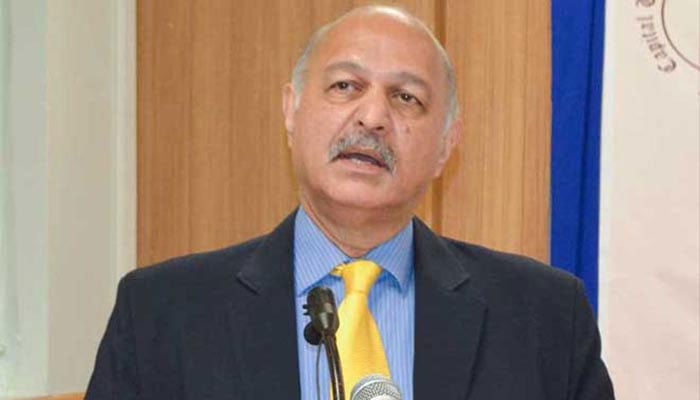
ISLAMABAD: The ruling Pakistan Muslim League-Nawaz (PMLN) Senator Mushahid Hussain Sayed Friday urged the government and Pakistan Tehreek-e-Insaf to stop fighting with the Supreme Court and the establishment respectively and set the rules of the game for elections on time.
He was speaking on a calling attention notice, moved in the House by opposition and government legislators on India’s move for revision of the Indus Waters Treaty (IWT). He strongly advocated a dialogue between the ruling coalition and the opposition, saying if talks could be offered to Modi and terrorists, then why not between them.
Mushahid insisted that Pakistan needed to set its house in order and express unity in order to face India as the US was also backing New Delhi to counter China in the region. He said the issue of water was extremely serious and linked with the future of Pakistan, saying Pakistan should fight its case with unity. Referring to his recent visit to China, he said the message from the time-tested friend was that all political parties should talk for the interest of Pakistan and its people by going beyond their party lines and personal affiliations.
On the letter from India, he believed that Pakistan had still not given an effective, solid and bold response to the January 25 notice. He remarked, “the reason is that we are too busy fighting among ourselves while national unity is a must to counter India. I think let us not get involved in unnecessary battles, because a fight against institutions is unwinnable”.
He regretted that the ruling alliance had picked confrontation with the Supreme Court while the PTI was fighting with the establishment. “If they were offering a dialogue to Indian Prime Minister Narendra Modi, then why don’t we have talks among ourselves,” he argued.
He emphasised even they were ready to talk to terrorists and then remarked, “Let us talk to the opposition also and other parties and set the rules of the game, so that elections are held on schedule and the Constitution is followed.”
He said the opposition (PTI) should also learn lessons from the past as it was unnecessary now to blame General Bajwa and General Faiz for anything and timely decisions should be taken by the political leadership. He said that political parties should decide on their own like former prime minister Nawaz Sharif had taken a bold decision to conduct the nuclear tests, who faced no pressure from the establishment. He said that political forces should not wait for phone calls from outside. “If they keep on fighting, someone will arrive and the party will be over,” he said.
Meanwhile, Minister of State for Law and Justice Shahadat Awan proposed the formation of separate courts in the country: a constitutional superior court and a federal supreme court, with the aim to efficiently resolve constitutional and normal cases.
Responding to a calling attention notice moved in the House by Senator Rukhsana Zubairi about the issue of pending cases in the Supreme Court and high courts, the minister pointed out that there were several reasons for the backlog, including unnecessary litigation, an increasing trend of people filing cases, and unnecessary adjournments. He also highlighted the failure to decide cases within the prescribed time-frame as a major contributing factor to the issue.
Senator Shahadat acknowledged that the shortage of judges had been identified as a significant factor contributing to the backlog of cases in the superior judiciary. “There are currently 17 judges in the Supreme Court, with 14 judges serving at the time. The Lahore High Court has 19 vacant posts of judges while the Sindh High Court has 11 vacant posts. The Peshawar High Court has one vacant post and the Islamabad High Court two posts of judges.”
He said currently there were more than 380,436 cases pending in higher courts as of December 31, 2022, while the Lahore High Court had 179,425 pending cases, Sindh High Court 85,779 cases, the Peshawar High Court 41,911 pending cases, Balochistan High Court 4,471 pending cases and the Islamabad High Court 17,104 cases. Additionally, the Federal Shariat Court has 103 pending cases. The minister said the Supreme Court had 51,744 pending cases.
Senator Rukhsana Zubairi raised concerns about the pendency of cases in the superior judiciary and called for reforms to improve the efficiency of the judiciary and ensure timely disposal of cases.
Before the start of the Question-Hour, raising a point of public importance, Leader of the Opposition Dr. Shahzad Waseem deplored the rulers’ defiance of a Supreme Court verdict and reminded them that Article 90 made it binding on the executive to comply with court decisions.
He also pointed out that there was also Article 68 of the Constitution and it had its own consequences as well. “And those who talk of a minority judgement should also see their own resolution as out of 372 members of the assembly, the resolution against the SC bench was adopted by only 42 members,” he noted.
About the government intention of filing a reference against three judges, he contended that it had never happened in the past that a reference could be filed just on the basis of personal likes and dislikes. Citing the rulers’ statements on “even scales” of justice, he argued that they did not believe in scales of justice but wanted to get hold of the scales so that they could get decisions of their own choice for which they would have to pay a price.
“They talk of a level-playing field, if so, then make Imran Khan prime minister three times. Muster up the courage and let there be elections in 90 days, being a constitutional requirement as the country has to be run as per the Constitution and not according to their wishes,” he emphasized. He challenged the rulers to face the people, hold elections, enabling the country to wriggle out of the crisis.
The Senate passed a resolution calling upon all the stakeholders to work tirelessly to augment the country’s health infrastructure with focus on quality and affordability. The resolution, moved by Sania Nishtar to mark the World Health Day, expressed concerns that a significant size of the country’s population had limited access to better healthcare facilities. It emphasized that the goals of development in the country could not be realized without taking steps towards building a healthy nation.