
Blood clot risk higher for six months after having Covid
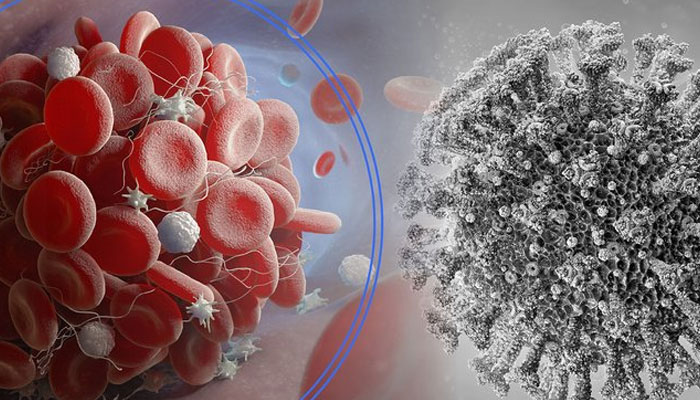
LONDON: After a Covid infection, there is an increased risk of developing a serious blood clot for the next six months, a study from Sweden suggests.
The research found people with severe Covid, and those infected during the first wave, had the highest clot risk. This highlights the importance of being vaccinated against the virus, the researchers say.
Blood clots can also occur after vaccination but the risk is far smaller, a major UK study found. People who have had Covid-19 are more likely to develop a blood clot -- particularly patients who have needed hospital treatment. Scientists wanted to find out when that risk returns to normal levels.
The researchers tracked the health of just over one million people who tested positive for Covid between February 2020 and May 2021 in Sweden, and compared them with four million people of the same age and sex who had not had a positive test.
After a Covid infection, they found an increased risk of: blood clots in the leg, or deep vein thrombosis (DVT), for up to three months; blood clots in the lungs, or pulmonary embolism, for up to six months; internal bleeding, such as a stroke, for up to two months.
When the researchers compared the risks of blood clots after Covid to the normal level of risk, they found that: four in every 10,000 Covid patients developed DVT compared with one in every 10,000 people who didn’t have Covid; about 17 in every 10,000 Covid patients had a blood clot in the lung compared with fewer than one in every 10,000 who did not have Covid.
The study, published in the BMJ, said the raised risk of blood clots was higher in the first wave than later waves, probably because treatments improved during the pandemic and older patients were starting to be vaccinated by the second wave.
The risk of a blood clot in the lung in people who were very seriously ill with Covid was 290 times greater than normal, and seven times higher than normal after mild Covid. But there was no raised risk of internal bleeding in mild cases.
“For unvaccinated individuals, that’s a really good reason to get a vaccine — the risk is so much higher than the risk from vaccines,” says Anne-Marie Fors Connolly, principal study investigator from Umea University in Sweden.
The researchers can’t prove that Covid caused the blood clots in this study but they have several theories on why it happens. It could be the direct effect of the virus on the layer of cells which line blood vessels, an exaggerated inflammatory response to the virus, or the body making blood clots at inappropriate times.
Vaccines are very effective against severe Covid, but offer less protection against infection, particularly with the Omicron variant — meaning repeat infections with symptoms are common as countries work out how to live with Covid.







-
 World Cup 2026: American Reporter Faces Backlash Over 'Insensitive' Remarks
 -
 Prince William, Kate Worried About Prince George Life At Eton
 -
 Princess Diana Felt Like ‘third Person’ In Her Own Divorce
 -
 Mitchel Musso Regrets Working In 'Hannah Montana' After Years?
 -
 Russia Fuel Shortage; Putin Sets Up New Task Force To Secure Supplies
 -
 Madonna Gets Honest About What Is Ruining Art And Music
 -
 'Love Island USA' Star Speaks Out After Leaving Show Over Racial Slur Video
 -
 'ITV' Removes 'Love Island' Contestant Gabriel Garland Over Past Incident
 -
 Austria Lobbies EU To Host Anthropic; Seeking AI Sovereignty
 -
 Why Kanye West Second San Antonio Show Won't Happen While Tampa Concert Went On?
 -
 Drake Can’t Stop Saying One Word After Eating At Popular Houston Eatery
 -
 Nicola Peltz Steps Away From Dog Charity Linked To Beckham Family Fallout
 -
 Inside: Magnitude 5.5 Earthquake That's Jolted Sichuan, China
 -
 Why Ex-FBI Agent Is ‘99%’ Sure The Nancy Guthrie Case Will Be Resolved?
 -
 King Charles Throws Prince Harry To Battle His Biggest Fear ‘at The 11th Hour’
 -
 Johnny Cash's Choice Of Favourite Country Stars Revealed